hatchery lake trout

Lake Trout

Salvelinus namaycush

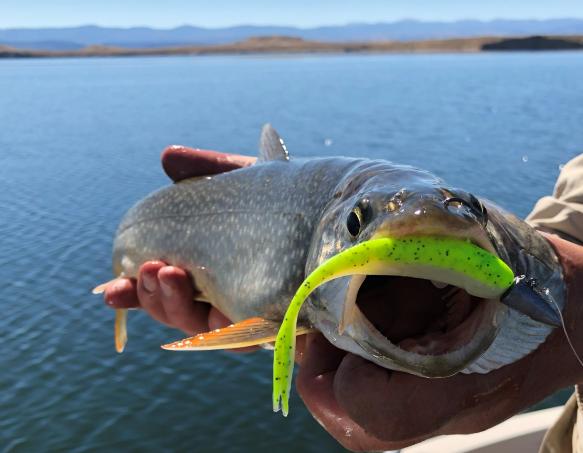
The lake trout, or mackinaw as it is commonly known, is native to Canada and The Great Lakes but they have made their home in many of the deepest and largest lakes we have here in Wyoming. Lake trout are a very popular species targeted through the ice during our long Wyoming winters.

Although called a trout, lake trout are a char, meaning they have light spots on a dark body and white margins on their fins. They can also be distinguished by their forked tail, yellow or orange fins, and a dark, blueish-gray body covered in small, light spots.

Phylum:
Chordata
Class:
Actinopterygii
Order:
Salmoniformes
Family:
Salmonidae
Subfamily:
Coregoninae
Genus:
Salvelinus
Species:
namaycush
An icon of a globe made up of a white stroke on a circular blue background

Native or nonnative?

Nonnative

An icon made up of solid white silhouette of a buffalo on a circular blue background

Wyoming classification

Sport fish

In icon of various food items, including chicken, fish, and wheat, made up of a white stroke on a circular blue background

Diet

Carnivore

An icon of a tape measure made up of a white stroke on a circular blue background

Length

30 to 40 inches on average, with some individuals exceeding 50 inches

An icon of a scale made up of a white stroke on a circular blue background

Weight

Their weight can vary greatly depending on their habitat

An icon of a heart with and EKG graph in the middle, made up of a white stroke on a circular blue background

Lifespan

20 to 30 years in the wild

Lake trout fun facts

  • Lake trout are one of the largest species of freshwater trout, growing up to 50 pounds.
    1/5
  • They can live for several decades, with some individuals reaching over 40 years old.
    2/5
  • Lake trout are often sought after in recreational fishing, especially for their large size.
    3/5
  • They are known for their aggressive predatory behavior and are primarily piscivorous, feeding on smaller fish, including other trout species, as well as various invertebrates such as midges, mayflies, stoneflies, and caddisflies.
    4/5
  • Lake trout are known to have two forms. One that is piscivorous and the other that feeds on invertebrates. The piscivorous form will grow to large sizes whereas the other will terminate its grown around 20 inches and a few pounds.
    5/5
Image

Why is this species important?

Lake trout are a top predator in cold-water ecosystems, playing an essential role in the fish community, especially those they prey upon. They are also a fast growing, large, cold water fish that is highly desirable from anglers. However, their introduction to non-native habitats has often disrupted balance by competing with native species for resources, highlighting their complex role in ecosystems.

Habitat

Lake trout are found in cold, clear, deep lakes with temperatures ranging between 4 to 10°C (39 to 50°F). They prefer deeper waters, typically between 20 to 70 meters (65 to 230 feet) in depth, and are usually associated with rocky lake bottoms.


Reproduction

Lake trout are sexually mature between 4 and 10 years of age, depending on the environmental conditions. They spawn in the fall, typically from October to November, in shallow, gravelly areas of lakes. Female lake trout can lay anywhere from 10,000 to 100,000 eggs per year, depending on their size. The eggs hatch in late winter to early spring.


Predators

Adult lake trout have few natural predators, except for large birds of prey, mammals such as otters, or humans. However, their eggs and young fish are vulnerable to a variety of predators, including other fish species.

More Species

View All
A photo of the profile of a buck pronghorn standing against a background of tall yellowish brown grass.

American Pronghorn

All pronghorn have an orangey-tan or reddish tan coloration going across their upper bodies. Their chest, sides, and rump…

Arctic Grayling

Arctic Grayling are a slender, silver-colored fish with coarse scales. However, the species is perhaps best known for their…
A Rocky Mountain bighorn sheep standing with its head turned as snowflakes fall, with two bighorn sheep ewes out of focus in the background.

Bighorn Sheep

Often nestled amidst the rocky terrain of the Rocky Mountains in North America, the bighorn sheep (Ovis canadensis) stand as…
A female brown trout underwater in a clear stream.

Brown Trout

The brown trout is native to Europe, Western Asia, and Northern Africa but has been distributed to waters all around the…
burrowing owl

Burrowing Owl

The burrowing owl is easily identified by its long legs, rounded head and mottled brown and white body. They also have…
Cow elk standing in sage brush

Elk

Elk are the second largest member of the deer family. They appear tan or light brown in color with dark neck manes. Males…
golden trout

Golden Trout

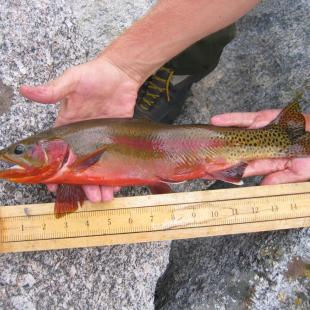
Golden trout are distinguished by their striking green and golden coloration, often featuring black spots near the tail, and…
Kokanee Salmon

Kokanee Salmon

Kokanee salmon are typically silver but turn bright red during spawning season, after which they migrate upstream to…
A bull moose stands among sagebrush with golden aspen leaves in the background.

Moose

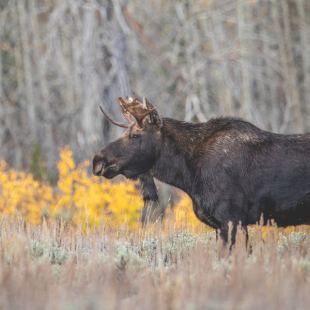
Moose are large animals with massive antlers, thick fur, and long legs, adapted for life in cold environments.

Mule Deer

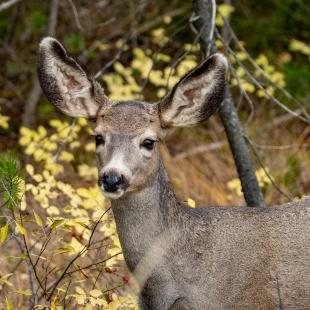
The mule deer is an iconic ungulate of the American West. It has a distinctive black forehead and a light gray face, and its…

Ring-necked Pheasant

Ring-necked pheasants stride across open fields and weedy roadsides in the U.S. and southern Canada. Males sport iridescent…
Swift fox

Swift Fox

Swift foxes are found in Wyoming, primarily in the eastern plains, but their range is expanding westward into higher…

Walleye

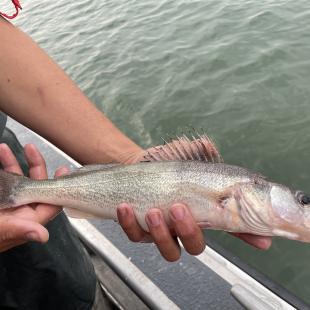
The walleye is known for its large, silvery eye, sharp teeth and anterior dorsal fin with spines. Walleye are distinguished…
Western tanager

Western Tanager

The western tanager is a brightly colored songbird. The male has a red head, a yellow body, and black wings. The female…
Wyoming toad

Wyoming Toad

The Wyoming toad was once abundantly found in the Laramie Basin of southeastern Wyoming, but in the 1970s an alarming…