
Wild Bison Hunting Information
Hunting wild bison in Hunt Area 2 offers a challenging and often unpredictable experience, as bison frequently reside within the protected boundaries of Grand Teton National Park for much of the season. Because hunting is prohibited within the park, success relies heavily on bison movements influenced by weather and migration onto adjacent lands like the Bridger-Teton National Forest and the National Elk Refuge. Hunters should be prepared for remote, physically demanding conditions, high grizzly bear density, and the necessity of staying informed about seasonal closures and boundary regulations to ensure a safe and legal hunt.
Bison Hunter Maps
In this video, North Jackson Wildlife Biologist Aly Courtemanch covers:
Overview of Hunt Area 2: Understanding boundaries of the Bridger-Teton National Forest (BTNF) and National Elk Refuge (NER). Note: Bison hunting is strictly prohibited in Grand Teton National Park (GTNP).
Access & Retrieval: Detailed walkthroughs of North and South bison hunt maps, including designated retrieval routes through GTNP and Forest Service roads.
Winter Closures: Important information on seasonal closures and how they impact motorized/non-motorized access.
Disclaimer: This video was recorded for the 2026 hunting season. Always consult the latest Wyoming Game and Fish Department regulations for any updates or changes.
Bison Hunter FAQs
In this video, North Jackson Wildlife Biologist Aly Courtemanch offers important information to help hunters prepare for the upcoming season. The video addresses 11 frequently asked questions:
Where do I get bison hunting information?
Where can bison be found during the hunting season and where should I hunt?
When should I hunt bison?
I have a Type 1 any bison license. Should I hold out for a large bull?
I have a Type 4 cow/calf bison license. How do I distinguish cows from bulls?
When do bison typically move to the National Elk Refuge, and how do I get a permission slip?
How long does the season run? How does the January portion work?
What type of harvest reporting and samples are required?
Are there outfitter and retrieval services available?
What should I do if I wound a bison and it goes into Grand Teton National Park?
Do bison carry diseases I should be aware of?
Disclaimer: This video was recorded for the 2026 hunting season. Always consult the latest Wyoming Game and Fish Department regulations for any updates or changes.
Before the Hunt
-
Answer
Check out the Game and Fish Hunt Planner to view the bison hunt area map, drawing odds, and land status.
The Bison Harvest Comparison Chart allows you to compare harvest statistics from 2008 to 2025. The data is organized by harvest month, location (National Elk Refuge or other), and total harvests broken down by license type. Please note that Type 4 licenses were not available from 2023 to 2025.
-
Answer
Type 1 (any bison) licenses: Type 1 licenses are valid for any bison. Drawing a Type 1 license is considered a once-in-a-lifetime draw, regardless of harvest success.
Type 4 (cow/calf) licenses: This license, which was last offered in 2022, is being reintroduced and is valid for cows and calves only. If an applicant receives a Type 4 license, regardless of harvest success, they must wait five years before applying for another Type 4 license.
For both license types, limited alternate permits for the National Elk Refuge may be available from Jan. 2- 31 through the department's Jackson Regional Office. These permits are issued on a first-come, first-served basis until the season ends, or until conditions require the start of supplemental elk feeding on the NER. For more information about hunting bison on the National Elk Refuge visit the NER Bison Hunter Management Area webpage.
During the Hunt
-
Answer
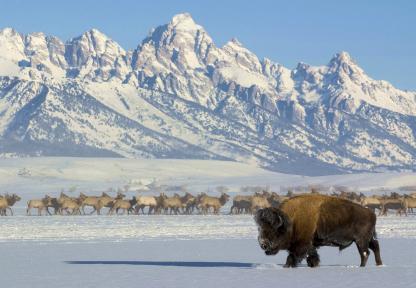
Bison hunting in this area has been unpredictable for the last several years. Over the 2017-2023 hunting seasons, bison stayed within Grand Teton National Park for the majority of the hunting season. Hunting is not allowed in the national park.
Bull bison occasionally move into the open hunt area to the east of the national park throughout the season. Areas to the east of the park are remote and have limited vehicle and trail access. As a result, most hunters utilize horses in this area and retrieval of harvested bison can be extremely strenuous. Hunters should also be aware that there is a high density of grizzly bears in this area.
Larger groups of cows, calves and bulls typically do not migrate south of the park into the open hunt area on the National Elk Refuge until mid to late January and may only stay for a few days, which gives hunters a minimal amount of time to harvest. In 2023, bison never moved onto the National Elk Refuge during the hunting season. In 2024 and 2025, bison moved earlier and were available for longer on the National Elk Refuge, which increased harvest success. The timing of these movements is dictated by snow conditions.
As a result of the unpredictable movements of bison, hunter success is variable from year to year and has been as low as 28% in Hunt Area 2. Hunter success was 35% in 2023, 95% in 2024, and 81% in 2025.
Hunters should also be aware that the number of mature bull bison in Hunt Area 2 has declined significantly in recent years. Although some large bulls remain, Type 1 license holders should expect limited opportunity and availability of large bulls. Type 1 licenses are valid for any bison and it is a once-in-a-lifetime license. In recent years, many Type 1 license holders (up to 41%) have opted to harvest a cow or calf bison.
-
Answer
If your license is valid for a specific sex of animal (i.e. Type 4 female/calf wild bison) it is important that you be able to differentiate between bulls and cows. A one to two year-old bull and a mature cow are difficult to distinguish. If you have a cow license, pay particular attention to the animal’s head. Generally, bulls are a considerably larger animal, with more massive horns and a ‘blocky’ head. Yearling bulls have horns that with a larger diameter base and grow outward more than female bison. Cows have similar shaped horns but are typically much thinner and curve inward at the tips. A penile sheath is typically evident on older bulls, but not on younger bulls. A profile view is not always the best identifying the sex of the bison.
Additional information and an interactive bison ID exam are available below:
-
Answer
Bison hunters in Area 2 should be aware that both black bears and grizzly bears inhabit the area. For guidance on hunting and camping in bear country, please visit the Game and Fish bear wise webpage and review this document.
After the Hunt
-
Answer
More information to come.
-
Answer
Before the hunting season begins, hunters will receive a "bison packet," which includes hunter information cards and supplies for sample collection. This season, all bison hunters are required to collect a blood sample and teeth. Additionally, all hunters must submit their Hunter Information Card, regardless of whether they were successful in their hunt.
Within three (3) consecutive days (seventy-two (72) hours) after harvesting a bison, the hunter must submit a completed Hunter Information Card to the Department's Jackson Regional Office. All unsuccessful wild bison hunters are also required to submit a completed Hunter Information Card to the Department's Jackson Regional Office within three (3) consecutive days (seventy-two (72) hours) after the season closes.
For successful hunters, the Hunter Information Card must include the following information:
- Licensee's name
- License number
- Date of harvest
- Total number of days hunted
- Sex and age class (adult, yearling, calf) of the harvested wild bison
- Drainage and legal description of the harvest location, including section, range, township, or UTM coordinates
For unsuccessful hunters, the Hunter Information Card must include:
- Licensee's name
- License number
- Total number of days hunted
Can I submit samples and my Hunter Information Card outside of business hours?
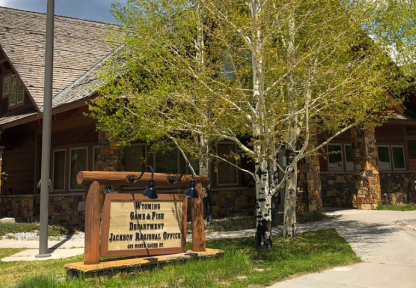
The Jackson Regional Office operates Monday through Friday from 8 a.m. to 5 p.m. During business hours, hunters can submit their information cards and biological samples at the front desk. For after-hours submissions, samples can be placed in the Bison cooler, which is located on the east side of the Jackson Regional Office at the back door.
Contact Information:
Jackson Regional Office
(307) 733-2321
Teton Interagency Dispatch
(307)-739-3301
National Elk Refuge Hunt Information Line
(307)-201-5437