
Most people who adventure in the outdoors have felt the jolt of traveling down a remote, dirt road only to find it clawed open by deep, jagged ruts. What should have been a nice, quiet drive can turn into a bone-rattling trip as your tires lurch through the gouges and your suspension groans with every dip. It can be hard not to mutter a few choice words about those who left the land in that condition, choosing to scar the area rather than leave it as good or better than they found it.
We instinctively understand that these wounds in the earth aren’t good for the land — or for our truck’s shocks. It feels like an even bigger violation when those ruts veer off the beaten path, tearing through fields, grasslands or prairies.
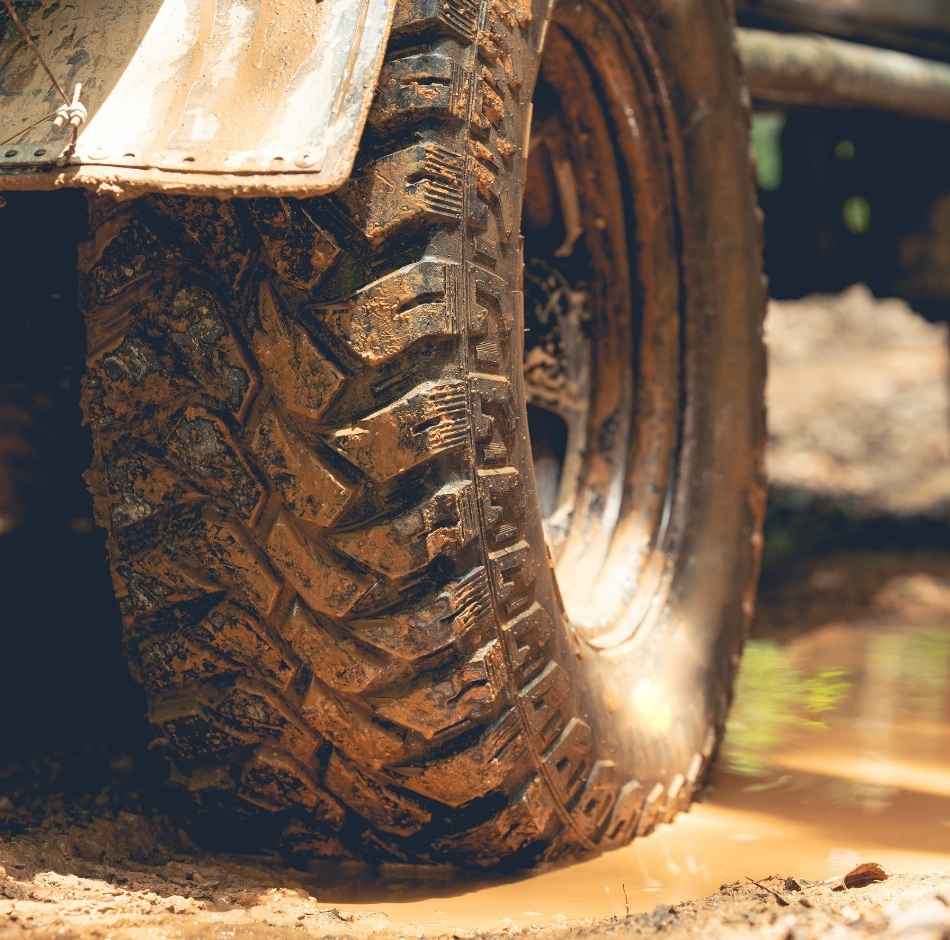
Taking vehicles off the trail can cause more damage than you may think. Stick to designated roads and trails when adventuring outdoors.
Yet a subtler harm often goes unconsidered and unnoticed. When the ground is firm and the grass is brown, it may seem harmless to steer a four-wheeler, side-by-side or pickup away from the trail. After all, the dirt isn’t flying and the vegetation looks mostly intact. The injuries caused by this simple act aren’t announced with dramatic grooves or axle-twisting ruts. Instead, it lingers with little fanfare, reducing plant growth, limiting available forage for wildlife and sometimes distributing seeds that take root in unwelcome locales. This damage can go far deeper than the ruts ever could.
Why people stray
Off-roading is an increasingly popular recreation activity. Generally described as the driving of a vehicle on unpaved surfaces, most people participating in the activity stay on designated roads and trails, often using all-terrain vehicles or utility-task vehicles like four-wheelers or side-by-sides to access difficult-to-reach places, traversing steep and rough terrain to see remote areas otherwise inaccessible. Provided the trails are open and laws are followed, off-roaders can enjoy wild places with minimal impact to wildlife or the places they call home.
The increased popularity of off-roading has come with greater access to the vehicles that make it possible. It wasn’t long ago that a four-wheeler or side-by-side was seen largely as a luxury. Now, there are more ATVs and UTVs on the landscape, and people are increasingly exploring those hard-to-reach places.
With more access, there’s also been an increase in those who venture from the path. Those who go off the trails cause more damage than they realize.
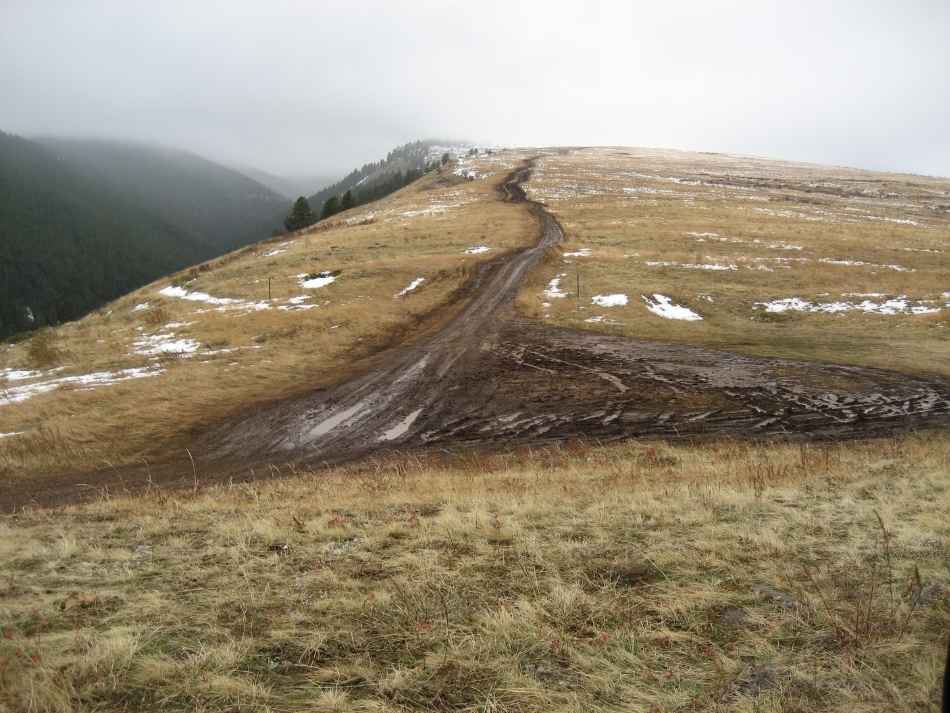
Off-trail use at Kerns Wildlife Habitat Management Area in the Sheridan Region has left areas of bare dirt, reducing the vegetation on the land. (Amy Anderson/WGFD)
“Most people generally stick to the roads and trails that are available,” said Amy Anderson, a Wyoming Game and Fish Department terrestrial habitat biologist in the Lander Region. “People usually know it’s illegal to go off the road or trail, so they stick to that. There’s definitely a subset of people who don’t, though. I think those people likely don’t know the damage that’s being done when they go off the trail.”
People may go off the beaten path for several reasons. Jason Hunter, Game and Fish regional wildlife supervisor in Lander, said spring and early summer are usually the first parts of the year when he observes people heading off the road. One common draw for this behavior is the search for shed antlers. While most people search the area on foot, some try to cover more ground by using a vehicle.
“We’ll see tire tracks in a grid every 20 to 30 feet in some areas,” Hunter said. “Sometimes people try to cover more ground that way, and they don’t realize the damage it causes.”
In the summer, Hunter said the motivation for off-trail driving tends to shift more to sightseeing excursions. Game and Fish personnel have seen groups that take ATV tours in remote areas, which is a great way to see the land and enjoy nature. Occasionally, though, the groups decide to detour from the trail, choosing to look over a ridge, snap a photo or just see something from a different perspective. When this happens, the group tends to move together, beating down the vegetation even more than an individual would.
“Using ATVs is a really cool way to see our Wyoming Game and Fish Commission-owned lands,” Hunter said. “People should stick to trails and choose to walk to areas without a path rather than driving.”
Fall brings hunters to the landscape, although Hunter said he doesn’t see them as the most frequent offenders of off-trail vehicle use. It’s common to see a hunter try to peek over a ridgeline from the four-wheeler if they are off the trail, but it may be less frequent than during other times of the year.
No matter the reason or the season, beating your own path can cause a lot of damage.
The price of off-roading
When a vehicle is driven off the road, grass that provides important forage is broken off or laid flat. This effectively removes that grass from wildlife's edible forage. This is especially true during particularly dry years when grasses easily dry out and become brittle, breaking or folding under the pressure of the tires. Even if the damage occurs in the summer, the impacts from flattening grasses can reach into the winter months, especially on crucial winter range.
“If the grass is flat on the ground, animals can’t grab it,” Anderson said. “They’re looking for forage that’s standing upright, often sticking up through the snow. They can grab it when it’s standing up, but their lips aren’t quite agile enough to pick up grass that’s flat on the ground.”
Anderson has seen an increase in ATVs heading off the beaten track in recent years, especially at Commission-owned lands like wildlife habitat management areas. Table Mountain, which is located within the Spence and Moriarity WHMA north of Dubois, saw a steep decline in grass production in 2025. While the area usually produces more than 350 pounds of grass per acre each year, dry conditions reduced yields to around 130 pounds per acre, a 63 percent decline. That’s a lot of reduced forage for wildlife. The site supports as many as 1,000 elk through the winter, so every blade of grass counts when food is scarce.
Even one ATV heading off-trail can remove significant forage for wildlife. For example, Torrey Rim provides winter habitat for bighorn sheep at the Whiskey Basin WHMA near Dubois. If one person goes off the trail for 1 mile with 10-inch-wide tires, nearly ¼-acre of forage is broken down and left unavailable for wintering sheep. The area usually produces about 420 pounds of forage per acre each year. Removing that ¼-acre means around 105 pounds of food is made unavailable for those sheep, equaling about 21 days of food lost for an individual sheep eating around 5 pounds of food a day. This can be made even worse when someone else sees tire tracks through the forage and decides to follow them, further damaging the vegetation.
“Sometimes one person will drive off the road and leave tracks, then the next person comes along, sees those tracks and they think they can do it, too,” Anderson explained. “It can quickly become another trail, and it permanently removes that plant base and fragments the habitat by creating a new road. People just need to consider the effect they’re having.”
Plus, some vegetation recovers more slowly than others. While grass can recover for the next year if the trail isn’t beaten down too far, plants like sagebrush can take decades to recover from damage.
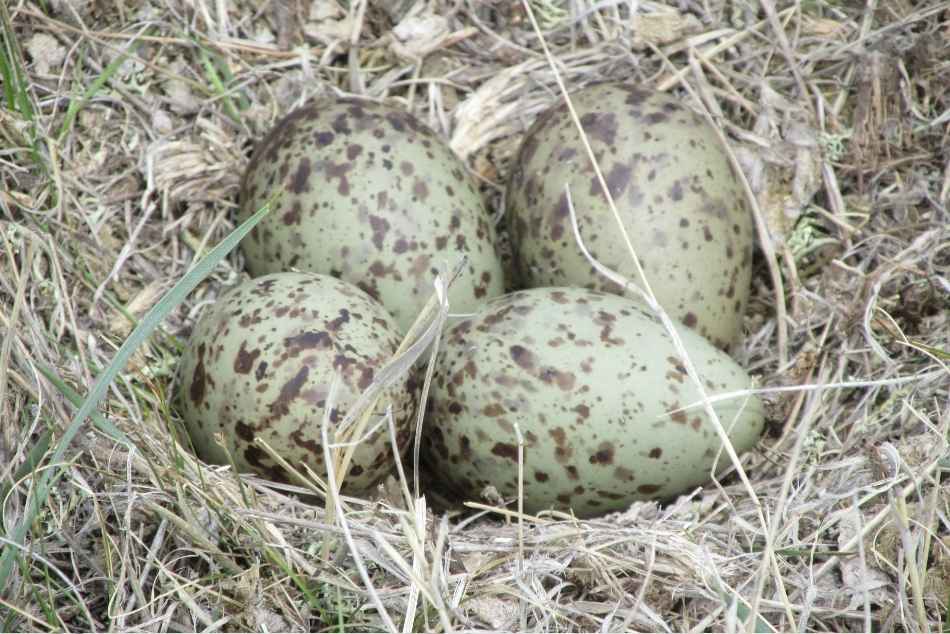
Long-billed curlew eggs like these are often difficult to spot on the ground, making them susceptible to damage from off-trail driving. (Grant Frost/WGFD)
Vegetation isn’t the only casualty in off-trail driving. Wyoming is home to many small, ground-dwelling animals — many of which may be difficult to spot. Several bird species — like the western meadowlark, thick-billed longspur, long-billed curlew and others — nest on the ground in sagebrush country and grasslands. These birds build their nests in places hidden from predators, making them difficult for humans to spot as well. An ATV can easily destroy a nest, eggs or young birds, even if the driver is trying to watch for them. Similarly, burrows for reptiles and small mammals may be damaged by vehicles driving over them.
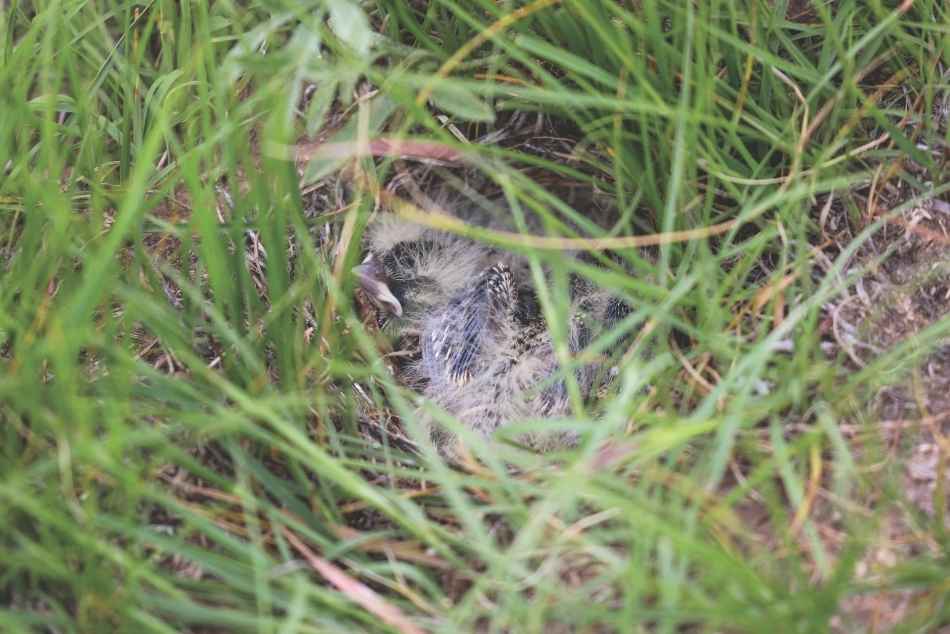
Thick-billed longspur chicks stay hidden in some grass. These birds, along with many other species in Wyoming, nest on the ground in the spring. (Grant Frost/WGFD)
Helping invasion
Another concern with off-trail driving stems not from damaging vegetation, but from spreading it. Invasive grasses like cheatgrass, medusahead and ventenata are at risk of spreading to new locations when people venture off-trail. When a vehicle is involved, seeds can be disbursed to more remote locations and at a quicker rate.
“People often don’t wash their ATVs after every use,” Anderson said. “So if someone drives through an area with an invasive grass and then goes to a new area, they distribute those seeds. That becomes a real problem for land managers.”
Invasive grasses like cheatgrass create numerous problems for wildlife. The grass is unpalatable, so it doesn’t provide forage value. It also outcompetes native grasses. Cheatgrass greens up earlier than Wyoming’s native grasses, removing much-needed moisture and nutrients from the soil before native grasses have a chance to flourish. Invasive species can spread rapidly and are costly to control.
Roads are a vector for the spread of invasive species. Traffic frequently distributes seeds along roads and trails without travelers even realizing it. Land managers can usually detect invasives near roadways fairly early, giving them a leg up when it comes to removing them. Game and Fish regularly works with partners to spray for invasive grasses along roadways.
When those invasives are spread to more remote locations, early detection is often impossible. This gives invasive species more time to establish, leading to more treatments and costly monitoring in areas that may be difficult to access.
“In those cases, we generally have to do landscape-wide treatments with aerial spraying,” Hunter said. “That comes with an increase in cost compared to spraying near roadways, and pre- and post-treatment monitoring is more costly as well.”
Ultimately, the choice to venture off-trail is a choice to leave a lasting mark on the wild places we love. While the modern adventurer might not always leave behind the deep scars that spark frustration, the invisible toll of a single detour is a more profound violation. Respecting the landscape means acknowledging that our vehicles are guests on the land, and their tracks should never become the new map for others to follow.
Off-limits: the purpose of winter closures
Many of the Wyoming Game and Fish Department’s wildlife habitat management areas are closed or have limited access during the winter. These closures are meant to protect wildlife during especially vulnerable times.
“Our Wyoming Game and Fish Commission-owned lands were acquired primarily for winter range habitat for one species or another,” said Jason Hunter, Game and Fish regional wildlife supervisor in the Lander Region. “We put seasonal closures in place to allow animals to be undisturbed while they’re on their winter range.”
Winter is a particularly difficult time for wildlife in Wyoming. Forage is scarce, and energy stores are depleted. Keeping disturbance low gives wildlife the best chance of survival.
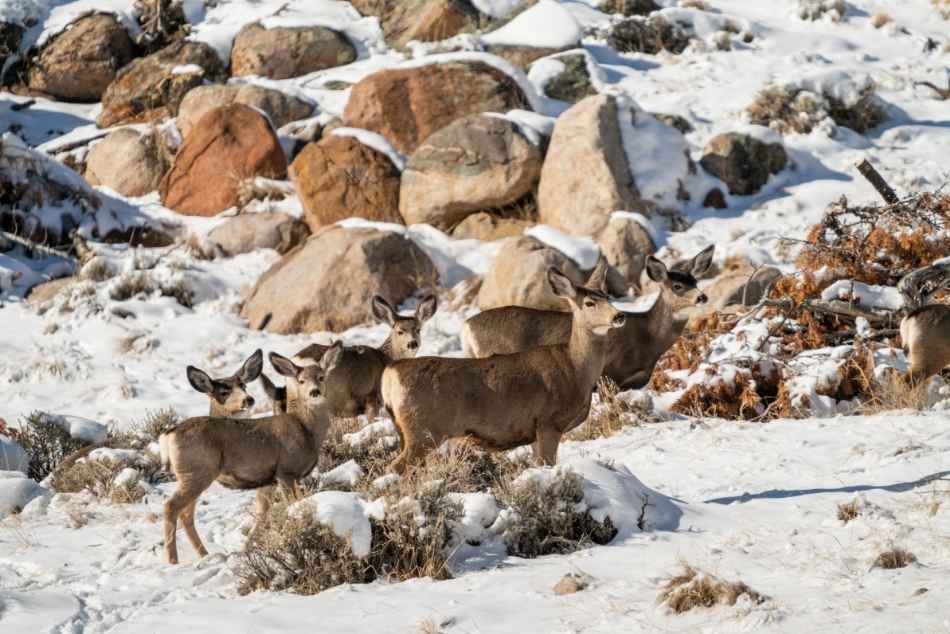
Winter closures at wildlife habitat management areas allow animals like mule deer to remain in winter range without disturbance. (Chris Martin/WGFD)
“Depending on the severity of the winter, animals not being disturbed can be the difference between that animal surviving the winter or not,” Hunter said. “So that’s hugely important to minimize stress on these animals.”
In addition, these lands serve as a place for animals to overwinter without moving to areas where disturbance is high or where they aren’t tolerated. Reducing disturbances on WHMAs means animals stay on land where there is forage and space rather than causing damage to private lands or moving onto roadways.
Game and Fish maintains more than 500,000 acres of land through WHMAs. The areas include access to nearly 225 miles of streams, more than 21,000 lake surface acres and more than 148 miles of road rights-of-way.
Report illegal Activity
If you see someone illegally driving off-trail on Wyoming Game and Fish Commission-owned property or committing a wildlife violation, please report it to the Stop Poaching Hotline by scanning the QR code, visiting the Stop Poaching page on the Game and Fish website or calling 1-877-WGFD-TIP. Please provide as much detail as possible, including the location, vehicle description, license plate information and submit any photos you have from the incident.
We can have nice things
People love exploring Wyoming's vast outdoors. With abundant public lands across the state, Wyoming offers opportunities for people to get outside and appreciate nature. In the excitement of an adventure, it’s easy to overlook the small actions that help protect these places. Here are some simple considerations that can help you to leave the land as good, or better, than you found it.
Clean up after yourself — and others: Plan ahead to pack out any trash you bring in. If you’re able, pick up any litter you find along the way. This includes debris from target practice, cigarette butts, packaging, wrappers, etc.
Tend to the fire ring: Be sure to fully extinguish the campfire, and don’t leave it until it is cool to the touch. This prevents embers from igniting and starting a wildfire. Be sure to check the ring for unburned debris like cans or nails, and remove them along with your trash.
Respect wildlife: Observe wildlife from a safe distance and minimize disturbance. Never feed or approach wildlife, and properly store food so wildlife can’t access it.
Tend to your pets: Remember to keep pets under control and away from wildlife, and clean up after them.
Follow laws, rules and regulations: Be aware of what is and isn’t allowed in the area you’re visiting. Consider if there are fire or camping restrictions or if access is limited during certain times of the year.
Avoid damaging the land: Stay on designated roads and trails. Avoid driving in particularly muddy or wet conditions that may cause ruts.
— Tracie Binkerd is the editor of Wyoming Wildlife.