
Since their introduction to Wyoming in 1881, brook trout have filled mountain streams and frying pans across the state.
They are not native to Wyoming, yet ingrained in the angling culture of the state.
They are not big, but abundant in many places.
They are not difficult to catch, but some pose challenges.
They are pretty, good to eat and have provided fond memories for generations of anglers.
Brook trout are native to the eastern part of North America from Labrador to Georgia and west through the Great Lakes region to Wisconsin and northeast Iowa. They were introduced in Wyoming in 1881 and are now found in streams and lakes in all of the state’s major mountain ranges.
“From what I’ve gathered over the years is you have two groups of anglers that really love brookies. One is those folks that camp in the mountains in the summer, love to fish a small stream, have high catch rates and cook them for dinner or breakfast,” said Bobby Compton, Wyoming Game and Fish Department fisheries supervisor in the Laramie Region. “Or, I have a kid that’s learning to fly-fish and I can take them to a high mountain lake, put on a dry fly and catch brook trout all day.”
Brook trout are one of 15 cold-water fish species managed by Game and Fish, 12 of which are trout. The only trout species native to Wyoming are cutthroat trout. Brook trout are doing well in Wyoming, but like all species, they need the right resources and management.
Management matters
When brook trout have cold water and good spawning grounds that include rocks and gravel, they are mostly hands-off when it comes to management.
“Once in there, they usually reproduce at high rates which is good for hands-off management if you want high catch rates,” said Paul Gerrity, Game and Fish fisheries biologist in the Lander Region. “However, that can make it challenging if managing for larger, trophy-size fish. As far as hands-on management, we stock some of our prairie lakes and reservoirs where fish can’t reproduce.”
Game and Fish stocks some of its high-mountain lakes with brook trout, including the Snowy Range in the Laramie Region. That region also is home to the Pole Mountain beaver ponds between Laramie and Cheyenne, which hold brook trout and are popular among anglers, but don’t offer much in terms of spawning habitat. The department stocks 12,500 brook trout in these ponds annually.
Overall, Game and Fish stocked 105,000 brook trout in 40 different water bodies throughout the state in 2025. In 2010, the department stocked 97,000 brook trout. In 2000, it stocked 89,000.
“Brook trout are important to Game and Fish, and they are considered a great sportfish,” said Travis Trimble, Game and Fish assistant fish culture supervisor.
Trimble said Game and Fish sends several thousand brook trout eggs to other states to fulfill trade commitments in which the department gets cool- or warm-water fish in return. Brook trout also are used in Wyoming’s hatchery system to make splake and tiger trout. Splake are a cross between a male brook trout and a female lake trout, while the tiger trout is a sterile hybrid that crosses a male brook trout and a female brown trout. These species provide angling opportunities and also can help reduce the number of overabundant fish species. At the Story Hatchery last fall, approximately 1.3 million eggs were used for splake and tiger trout.
“On an annual basis, hatchery crews put quite a bit of effort into raising and stocking brook trout,” Trimble said. “From the spawning and incubation operations at the Story Hatchery, and then hatching and raising several thousand brookies at multiple hatcheries across the state.”
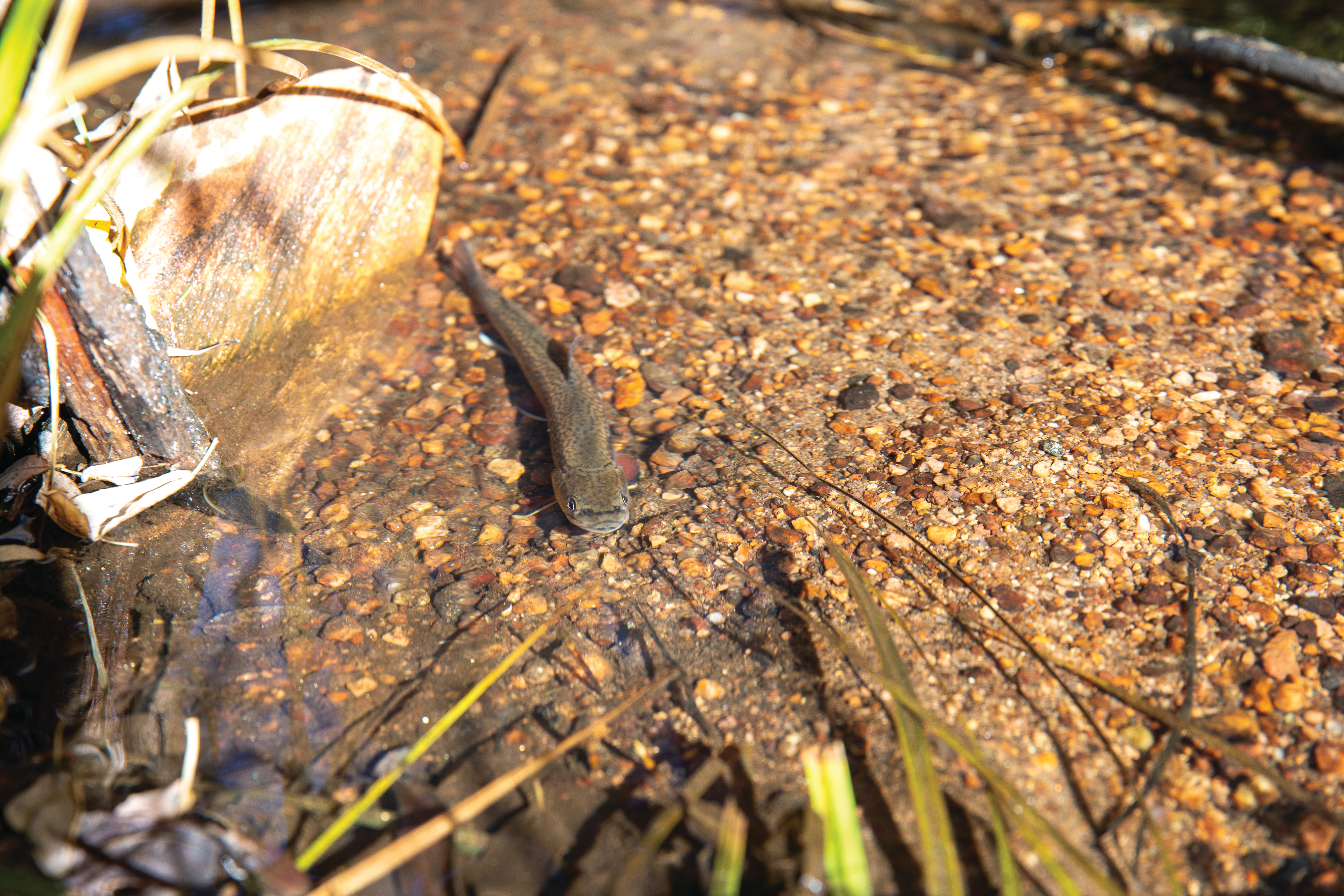
Brook trout in the Pole Mountain area in the Laramie Region do not have a lot of quality spawning habitat. (Photo by Patrick Owen/WGFD)
Getting into trouble
One issue with brook trout being a fast-reproducing fish is it can stunt itself. Too many brookies competing for food and habitat often means a lot of small fish.
Harvesting brook trout is usually a good thing, and in most cases, the creel limit for brookies in Wyoming is 16 — although there are some exceptions.
A priority for Game and Fish is and has been the conservation of native fish — including the state’s four subspecies of cutthroat trout. Game and Fish and partners have conducted numerous projects over the years to reintroduce and reestablish native cutthroat to their native waters — those same waters that have been home to brook trout and other nonnative sportfish for a long time. The result often is the removal of those nonnative fish and the stocking of cutthroat.
Brook trout are removed from these particular waters because they outcompete with cutthroat for food. They also spawn in the fall, while cutthroat spawn in the spring, which isn’t good for the cutthroat.
Does that make brook trout the bully on the block when it comes to cutthroat restoration?
“People who are into native fish conservation, cutthroat in particular, may see it that way, but I think to the general public a brook trout is just like any other trout,” said Pete Cavalli, Game and Fish fisheries biologist in the Pinedale Region. “I wouldn’t say the brook trout have gotten a bad reputation from the cutthroat conservation work we’ve done. They’re still quite popular.”
Andrew Nikirk, Game and Fish fisheries biologist in the Sheridan Region, said four streams in his region have been treated to reestablish Yellowstone cutthroat trout. He added that there are numerous waters in the Sheridan Region with brook trout, and thinks they are an important sportfish in Wyoming.
“There is a balance. We have to come up with a plan with the public where it is sometimes acceptable to remove nonnative brook trout for the sake of cutthroat,” Gerrity said. “Depending on where you are at, sometimes removing brook trout provides an additional sport fishing opportunity for another species, in addition to conserving native fish.”
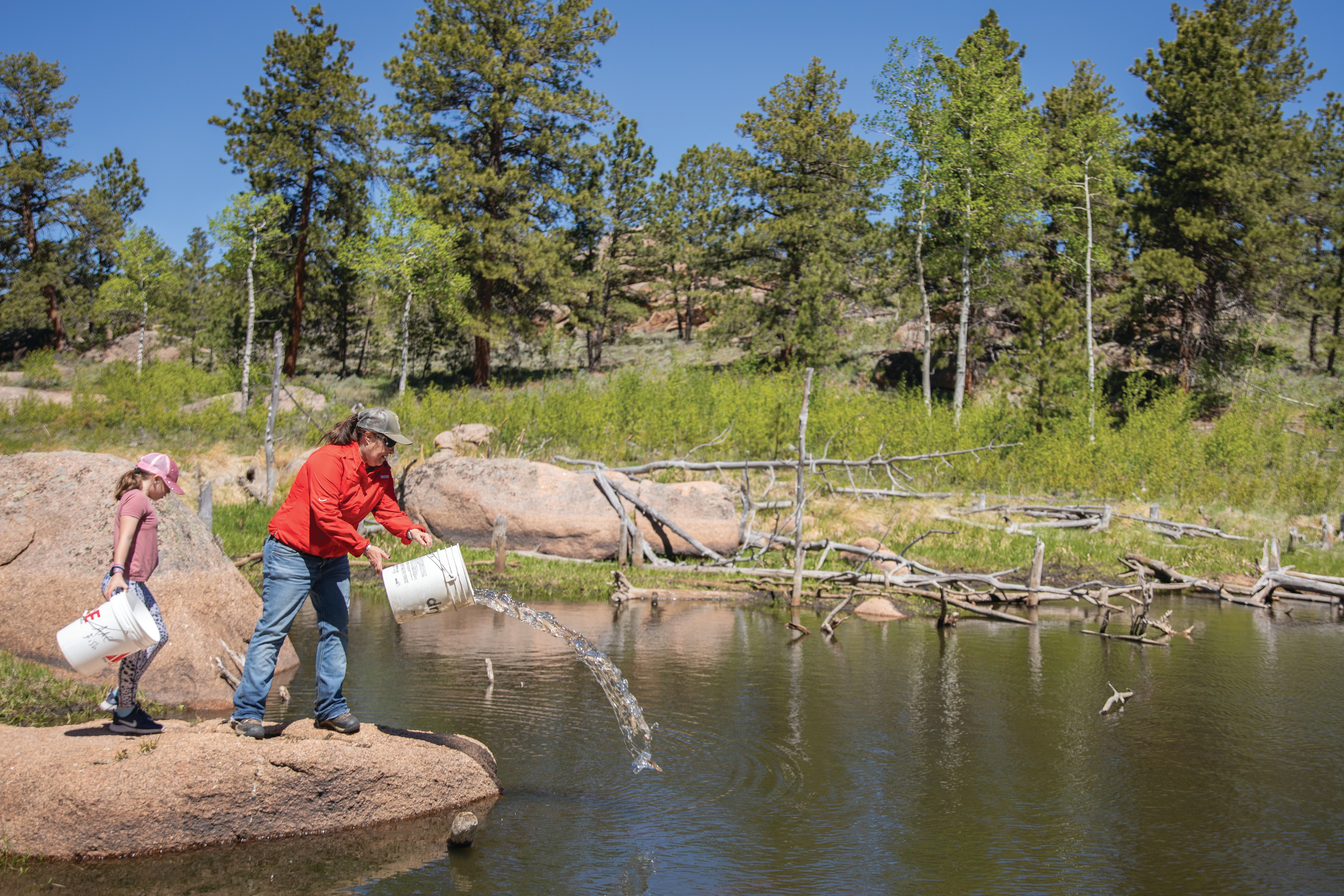
Game and Fish annually stocks beaver ponds and small creeks with brook trout in the Pole Mountain area in southeast Wyoming. (Photo by Patrick Owen/WGFD)
What’s a big brook trout?
Many say 12 inches long or longer. However, the Game and Fish’s Master Angler program, one of four fishing challenges offered by the department, requires a brook trout to be 16 inches long to qualify.
Bigger brook trout often are more of a challenge to catch.
“Catching a big brook trout — a 15-18 inch brook trout — is a hard thing to do,” Compton said. “They’re not everywhere, and people are pretty guarded and passionate about those honey holes. You can catch a 7-8-inch brook trout all day, but it can be a technical pursuit to get into those large brook trout. One, you have to know where they are. Two, you have to catch them. I think there is a big challenge in trying to target those big fish.”
Compton said one of the most common calls he receives from anglers is where to target Master Angler-sized brook trout. Gerrity gets similar questions, but said he doesn’t get a lot of inquiries from anglers about brook trout in his region because most know they can catch them in numerous places.
“I think people like brook trout, and sometimes I think they are a little underappreciated,” Compton said. “They’re beautiful, easy to catch and you’re in the mountains — all good reasons to go fishing for them in my mind.”
Added Gerrity: “There may not be a lot of big brook trout out there, and you may have to work to get to them, but they exist and that makes them popular. You can take a kid and go out and catch a bunch of brook trout, or go after a big one.”
— Robert Gagliardi is the associate editor of Wyoming Wildlife.