
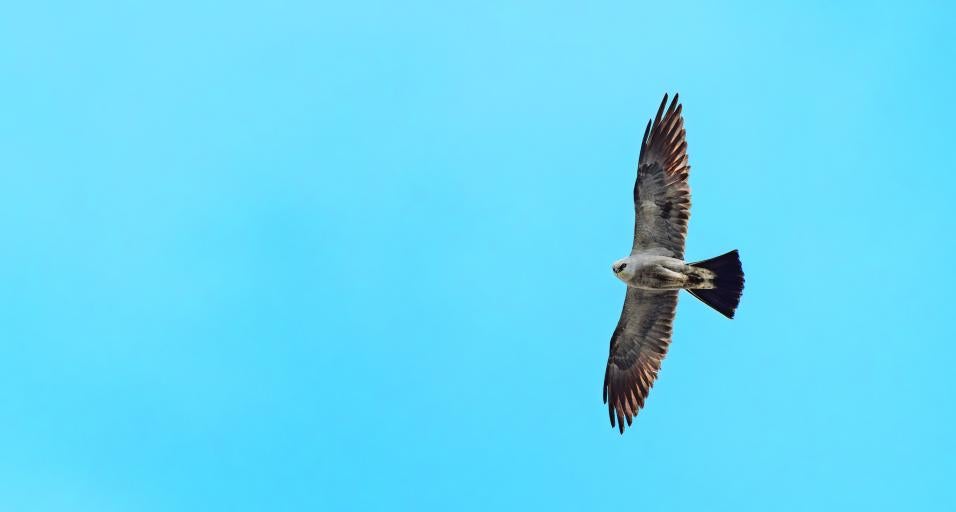
If you were playing the license plate game with your kids on a trip in Wyoming, a plate from the state of Mississippi would be a really good find and would probably go a long way to winning the contest. If you are birding in Wyoming and you see a bird called a Mississippi kite, you will probably be one of only a handful of people who will do so each year. In fact, the Wyoming Bird Records Committee asks that all sightings of Mississippi kites — MIKI for short — be reported.
DATE CRASHER
In 2024, I was one of those rare few when I had a chance encounter with one in Cheyenne. I took my wife to get ice cream one evening in early August, and since the Lakeview Cemetery is a nice, quiet place, we went there to eat. As soon as I turned off the car, we heard a bird call I wasn’t familiar with. I opened the Merlin bird ID app on my phone, stuck it out the window and after a few more calls pulled it back to see MIKI as the bird it identified. My wife claimed if I bird on a date, it doesn’t count as a date. Still, the biologist in me couldn’t resist trying for a rare sighting. I got out of the car, walked around a spruce tree and saw the bird perched on the dead top of another spruce.
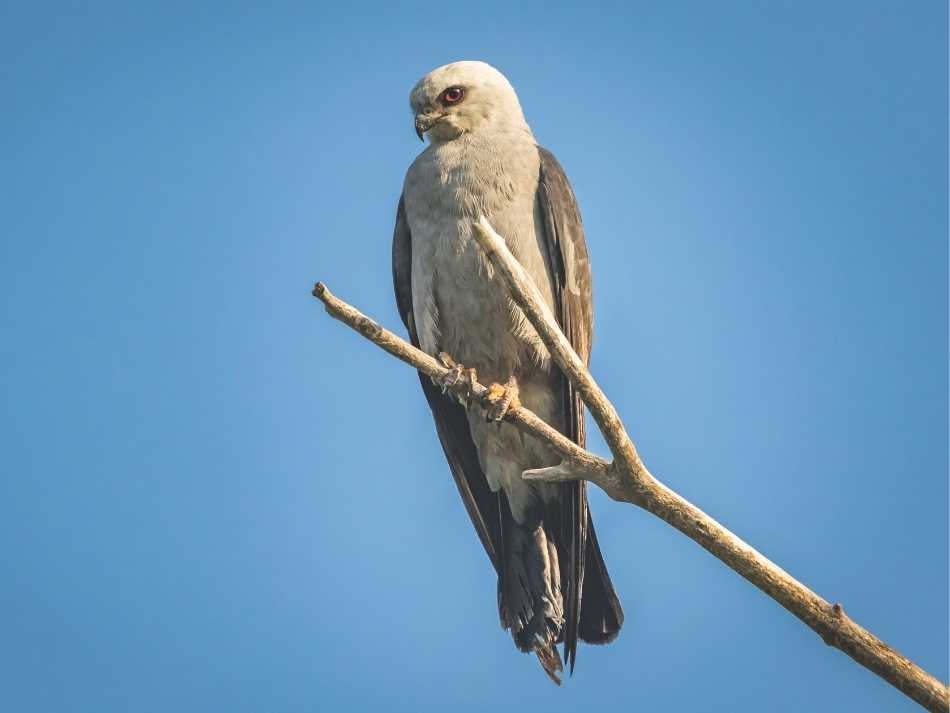
Mississippi kites are one of five species of kites regularly found in the U.S. Most of them are concentrated in the deep south. (Adobe Stock Photo)
The Merlin app did not disappoint. True to the call ID, the bird perched atop the tree was a Mississippi kite. I gazed at the crow-sized raptor. These birds are mostly different shades of gray, with a lighter-colored head and secondary feathers, a black tail and eye mask, and deep crimson eyes. In the middle of all that gray, if you see a picture of an adult flying with the wings down, you can see the primary feathers often have an orange coloration. Juveniles look different with brownish, wavering strips on the breast and belly, a finely-streaked head and light-colored bands on the tail feathers. They are mostly aerial insectivores, after such things as dragonflies, and must be very acrobatic in flight. They are a beautiful bird to watch soar, with quick turns and adjustments to catch insects, often without flapping their wings much. They are found mostly in the southeast U.S., up the Mississippi River valley into the southern Great Plains and a little into the southwest. They winter in central South America.
So, it was a surprise to see the bird in Cheyenne. I didn’t spot any other kites, adult or juvenile, during that encounter. After a while, the bird flew off — leaving me to contemplate how I’d make up the date to my wife.
TWICE AS NICE
This past summer, I was downtown in Cheyenne, which put me near the cemetery. I stopped on the remote chance I would encounter a MIKI again. Not only did I see one soaring, but soon there were two in my view. I couldn’t believe it.
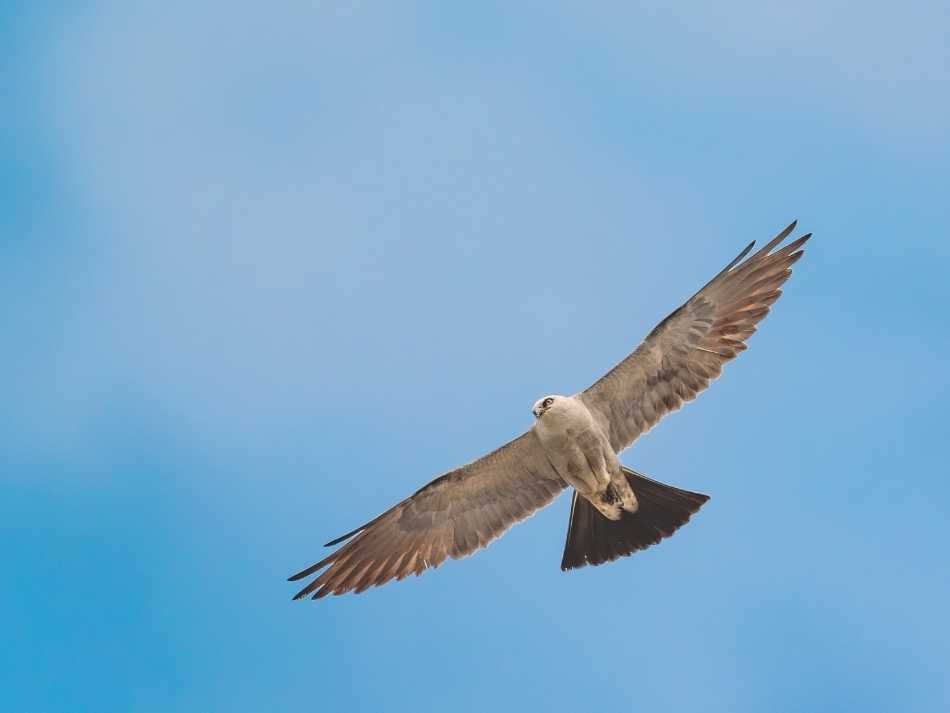
A better name for MIKI might be black-tailed kite. It is distinctive overhead with the black tail, narrow, pointed wings and gray coloration. (Photo by Patrick Owen/WGFD)
Even more interesting was the possibility they might be nesting. Two raptors of the same species staying near one place for multiple days was a good indicator. They had never been documented breeding in Wyoming. So, much to my wife’s dismay, the biologist in me took over and it became my new obsession. I visited almost every day, varying the times in hopes I could get evidence of a breeding pair. All that effort produced nothing. I usually saw one adult, sometimes both, but I didn’t see them carrying food or going to one particular place in a specific tree. It was odd, and I almost gave up.
Luckily, on Aug. 19, 2025, a friend and fellow birder from work, Katie, wanted to see them. We went at lunch, and it was like a switch had been flipped. Both adults were actively hunting. Then we heard a new call — a juvenile calling out. The adults made several visits to a tree, and we suspected the nest was there. Katie and I tried to see the nest from multiple angles, but it was high in a cottonwood tree and well hidden.
I continued my daily visits, trying to spot the young bird. Five days later, I finally found the right spot and got a glimpse of the young MIKI. I started calling it Junior, but in retrospect, I should have named it Mikey, like the kid in the Life cereal ad.
Finding Junior launched an unforgettable set of weeks as I, along with many other birders, monitored its progress.
A TIME OF GROWTH
A rare bird that is constantly found in one place tends to attract attention from birders, and that was the case here. It didn’t take long for word to get out about the breeding pair and their chick. At least 52 people came to see them, including 38 from out of town. Luckily, the neighbors — the nest was actually in a residential neighborhood — were accommodating and interested, and I had several nice conversations with them. I think as they learned about the birds, they started to take a certain amount of pride in the birds and nest.
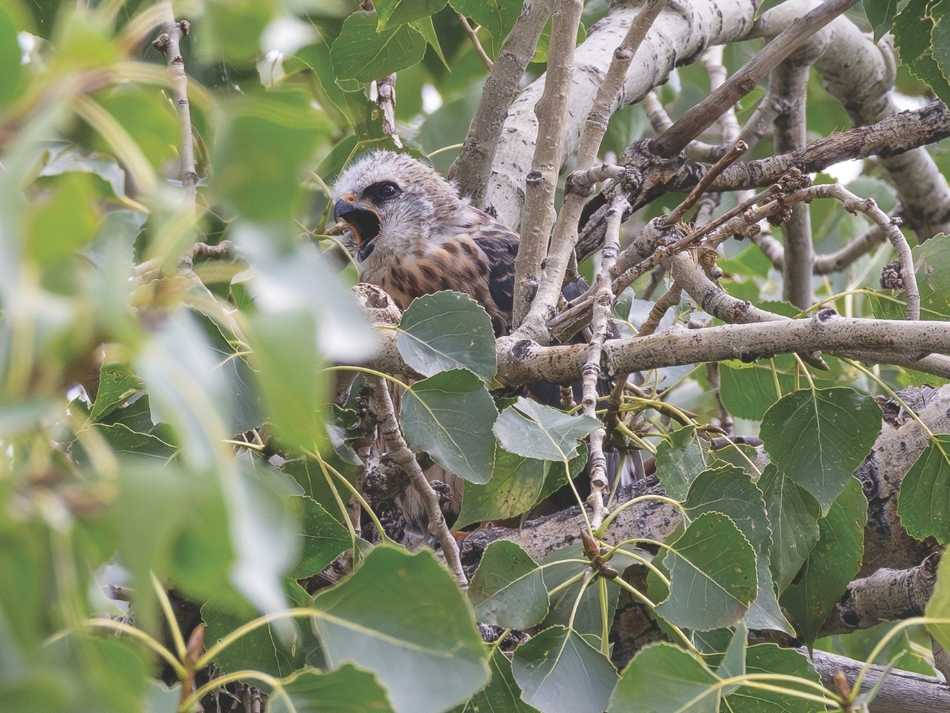
As August progressed to September and Junior continued to grow, it was fun to watch its progress. Junior persistently called out in a high-pitched, two-note call, whether or not the adults were visible, to let everyone in the neighborhood know it was hungry. It moved farther from the nest but was fairly predictable in positioning itself to be fed at an open place where the adults easily flew. As it got bigger, the juvenile became more aggressive when the adults arrived, and it was almost like witnessing a mugging each time.
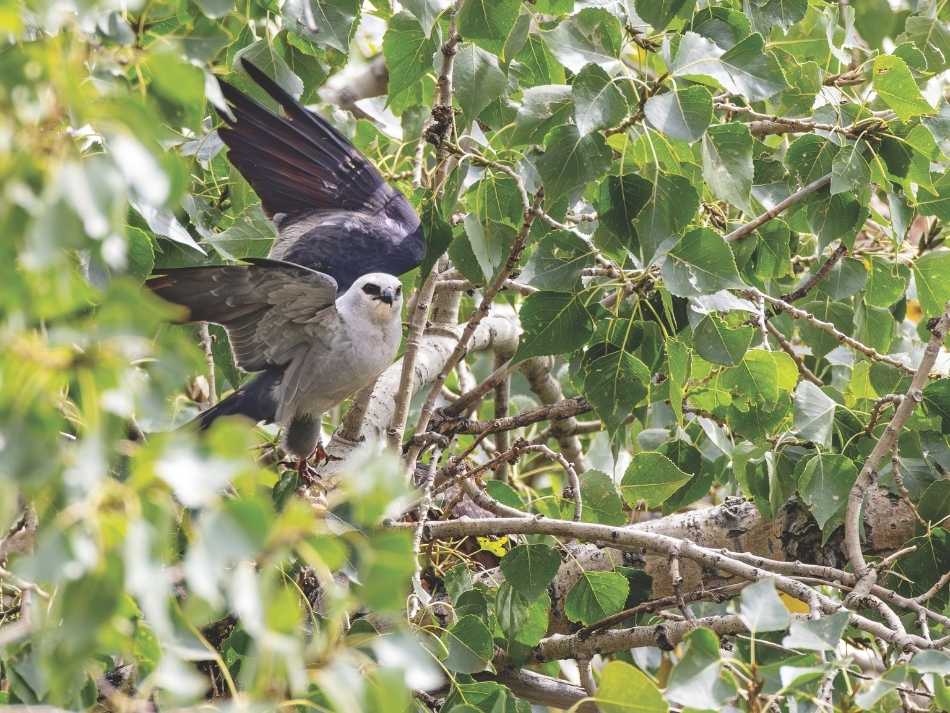
When the adults hunted close enough to be visible, it was entertaining to watch them. They made lazy circles and occasionally quickly accelerated. The legs swung forward to nab the prey, the head dropped to grab it from the feet, and they headed toward the nest tree. Depending on elevation, it was possible to see spectacular stooping dives as they folded their wings like a falcon, then pulled into a stall and landed for the aggressive greeting.
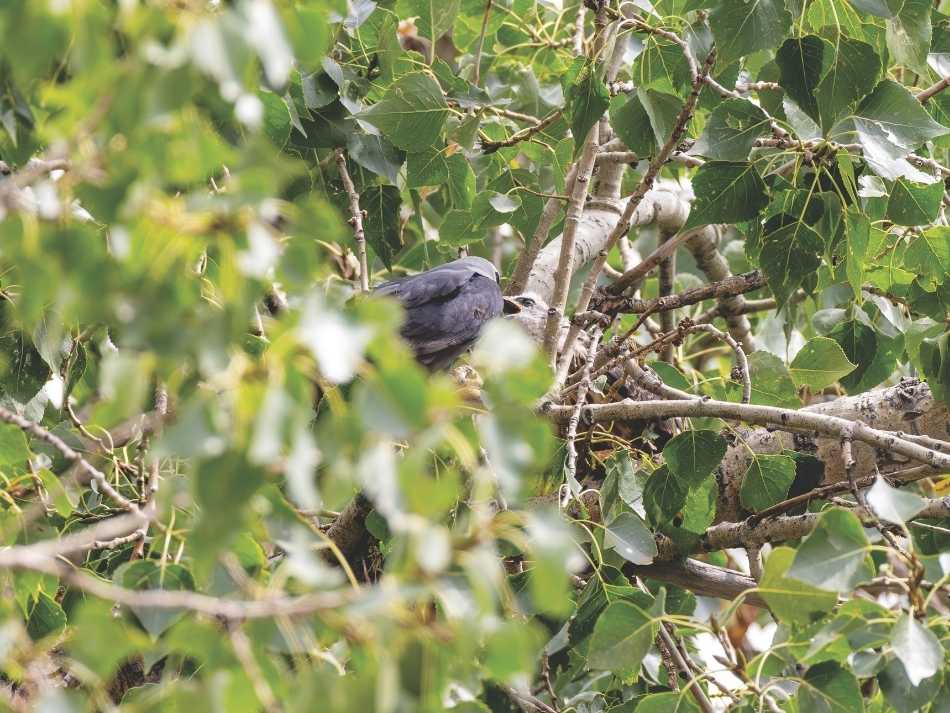
All this time, I wondered why they hatched a chick so late in the season. Did a male and female just happen to meet up here during the summer and decide to roll the dice? Did the adults have to wait until there was sufficient insect prey here in colder Wyoming to raise an offspring? I also wonder if they may have bred here before and we didn’t know about it. There is a small concentration of sightings in past years around the cemetery, so it is possible.
BEYOND THE NEST
In the bigger picture, what does a successful nesting by MIKI in Wyoming mean? They have been known to nest in Colorado as close as Greeley and in central Nebraska, and have a substantial population in southwest Kansas. Is this the continuation of a natural range expansion for the species, or just a one-off event that will not happen again?
In the southeast U.S. and up the Mississippi River valley, MIKI mostly breed in mature, bottomland forest areas. But further west, they have adapted to nesting in tree shelterbelts and, in the 1960s, started nesting in urban/suburban areas with mature trees. This could mean kites are slowly finding new, suitable areas based on the age of towns and associated trees, and they might be able to continue moving further north as long as the appropriate prey base is available.
But in Wyoming, there are a couple of other factors to consider for observations and documentation. One is the paucity of towns that could support a breeding pair. In southeast Wyoming, where most previous observations have occurred, Laramie is possible and maybe Pine Bluffs. Further north, Wheatland may have potential with warmer temperatures that could promote the insect prey base. Torrington would be a good place because there might be a natural connection to Douglas and Casper via the North Platte River.
There also is the recognition aspect. The casual observer would probably look at a medium-sized bird overhead, think it’s a hawk and not obsess about it further. If I hadn’t been specifically looking for MIKI, this entire event might never have been recorded.
There are some excellent birders in Wyoming, but relatively few of them compared to other, more populated states, and there is a lot of area to cover in the Cowboy State. Additionally, few birders are actively birding in residential areas. So, there could be more out there than we realize. Perhaps the Cheyenne MIKI aren’t alone in this endeavor.
BEAT THE COLD
As summer started to wind down, I became increasingly concerned for Junior. I hoped it would be able to migrate before the weather turned cold, and learning to fly was the first step toward migrating to warmer areas. Selfishly, I wanted Junior to fly ahead of a personal deadline. I was going to be gone for 11 days in September, and I didn’t want to miss it. On Sept. 6, I went to see them before I left the next day. I didn’t see it fly, but with a big movement to the other side of the nest tree, I think that was the first evidence that it had flown. I asked several friends to keep tabs on the bird while I was gone, and a friend photographed it flying on Sept. 9. A new fear emerged. Rather than worrying that Junior wouldn’t fly before cold weather, I began to worry that it would leave before I got back. When I returned, I checked on the birds on Sept. 18. My fears that I had seen the last of Junior evaporated when the sight of the bird flying was the first thing that greeted me. I likened it to seeing a favorite niece or nephew graduate, perhaps not as powerful as that of a child or grandchild, but it was a big moment.
I realized how different this whole experience had been from the usual bird sighting. I usually see a quick glimpse and then they are gone or I move on to look for more birds. Yet for weeks I would visit every day to check on the progress of the family. I went from wondering if a young bird even existed to cheering it on and hoping it would be ready to migrate before fall seriously arrived. It became very personal.
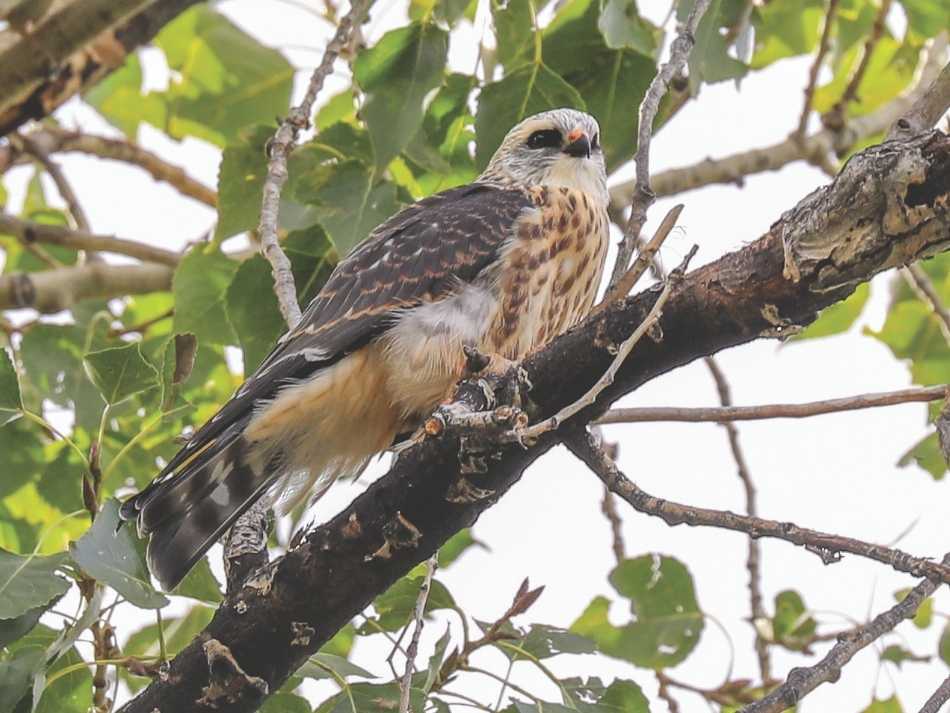
From then on it was a guessing game as to when the bird would leave. It was at least a month behind others that would be headed for central South America. It seemed like each day the juvenile would fly out of sight, and the birders in the area wondered if that was it, but the next day it would be back at the nest tree. Junior wasn’t seen on Sept. 23 and the next day I went to check if it was gone — the bird was still there. It was calling constantly, but there were no adult visits, and I didn’t see the adults hunting. I think there was only one adult for the last few days, and then they were all gone. As far as I know, that was the last time Junior was seen in Cheyenne.
A HOPEFUL GOODBYE
This successful nesting will be reviewed by the Wyoming Bird Records Committee, as any observation of a new species or breeding by one would be. Those records are accepted or rejected based on the documentation and evidence provided, although the review in this case will be just a formality with the Mississippi-sized mountain of different observations, observers, sound recordings and pictures. I have a feeling this might be the best documented first nesting in the state. The Wyoming Game and Fish Department will add it to the list of species officially managed by the department, which includes all native wildlife that reproduce here. The latest raptor to be included in that list was the barred owl, which was found to be nesting in Grand Teton National Park and possibly other locations in Teton County.
I’ll always wonder if Junior survived. Did it learn to hunt quickly enough to avoid starvation? Did it avoid all the other hazards that can befall a long-distance migrating bird? In addition to starvation, migrating birds of all sorts face the obstacles of weather, window collisions, terrestrial and aerial predators, artificial/overwhelming light sources, and, in the case of raptors, persecution for simply being a hawk. If I see a MIKI in Cheyenne again, will it be Junior after pulling off a small miracle and beating the odds by returning to its birthplace? I would like to think that a Cowboy State native would be just a little tougher than its cousins raised further south in better conditions.
In the future, I will make it a point to look for MIKI above the neighborhoods surrounding Lakeview Cemetery. It appears to be the best place in Wyoming to see them with any consistency. I’ve also tried to enlist the help of residents in that neighborhood by printing off a thank-you note with pictures of Junior and the adult birds, and asking them to contact me if they do see them again.
— Grant Frost is a senior wildlife biologist for the Wyoming Game and Fish Department
NEST WATCHING ETHICS
Nesting is one of the most critical and sensitive times for birds. The kites in Cheyenne selected a site in a residential neighborhood, but high and well concealed in a tall cottonwood tree. They even tolerated most of the houses in the area being re-roofed after a severe hail storm. They were used to people being around and lots of activity.
Each species, and even individual birds, has a different degree of sensitivity to human presence. However, many bird species have little tolerance for any level of disturbance and may abandon eggs or even chicks. Those great pictures you see of many birds on nests are usually taken from a blind, and photographers spend hours in them and enter and leave in ways designed not to disturb the family. The welfare of the birds takes precedence over any picture or observation. In most cases, it is best to move on as soon as a nest is detected or the adults start paying attention to you instead of their young. A good overall guide is the American Birding Association Code of Birding Ethics.
RARE SPECIES REPORTING
Wardens and biologists at the Wyoming Game and Fish Department are in the field regularly and see many things, but that doesn’t compare to the thousands of hunters, anglers, trappers, birders, hikers and others that take an interest in wildlife. Observations of rare species or happenings often come from the public, and all such sightings are welcomed and encouraged to expand the department’s knowledge of wildlife and fish resources. General observations can be reported through the Wyoming Bird Records Committee.