

A new study tracks pronghorn in the Black Hills
In November 2022, a multiyear study of the North Black Hills pronghorn herd was initiated with the capture and GPS-collaring of 35 doe pronghorn by a professional wildlife capture crew. The study’s aim is to better understand the herd’s movement patterns and survival rates. The herd unit encompasses pronghorn hunt areas 1, 2, 3, 18 and 19 in Campbell and Crook counties. The number of animals in the study is a representative sample of the larger herd. But just over 100 years ago, 35 pronghorn constituted the entire annual count of pronghorn in Crook County.
The 1919 Wyoming state game warden annual report, the first to publish a county-by-county census of big game animals, estimated pronghorn in Campbell and Crook counties at 550 and 35, respectively. The count of 35 was certainly inaccurate, and the report notes it was a conservative estimate, but it spoke to the struggles pronghorn populations across Wyoming and the West faced in the early to mid-1900s.
Decades of successful conservation efforts have allowed pronghorn to rebound. But individual herds are still buffeted by periodic events such as severe winters, drought and disease outbreaks, or by longer-term habitat changes. Helping herds become more resilient to these challenges is the goal of the North Black Hills study.
Precision tracking
The North Black Hills pronghorn movement study is the first of its kind in northeast Wyoming.
“This was a project I wanted to do for several years,” said Erika Peckham, Wyoming Game and Fish Department wildlife biologist in Gillette. “Between conversations I had with landowners over the years and observations myself and other personnel have made, I knew pronghorn in this herd were sometimes undertaking a lot of movement throughout the area, particularly in bad winters.”
The herd is under the management objective of plus or minus 20 percent of 17,000 animals — 13,600-20,400. Though counts have trended higher in recent years, the most recent population estimate is 12,600.
It has been impacted in recent years due to a relatively harsh winter in 2018-19, followed by drought conditions in 2020 and 2021. But a severe outbreak of epizootic hemorrhagic disease and blue tongue virus in late summer 2021 had population-level effects the herd is still recovering from.
Working with multiple agencies and nonprofit organizations, Game and Fish secured funding to begin a movement study in fall 2022 and contracted with research biologist Hall Sawyer of Wyoming EcoSystems Technology, Inc., for project logistics. The initial 35 captures focused on pronghorn in the Little Powder River drainage running north of Gillette into Montana. The collars collected and stored locations every two hours and were programmed to automatically release from the animal after two years.
While the initial 35 collars provided important insights, managers had lingering questions about where and how animals used the landscape elsewhere in the herd, particularly how they navigated potential barriers like roads. In February 2025, the project expanded. Fifty-three collars were fitted on female pronghorn, this time further east in the Little Missouri River drainage. Another 25 collars were deployed in February 2026 in Hunt Area 2. The latest batch of collars uses Geofence technology. With this technology, a predetermined geographic area is programmed – in this case, along U.S. Highway 212. When animals move into the area, locations are collected every 15 minutes rather than every two hours.
“We want to see how and where these animals are interacting with the roadway,” said Peckham. “We want to see if they are attempting crossings, if there are areas they attempt to cross but cannot or if there are mortalities associated with crossing attempts. The 15-minute locations will give us fine-scale data to see those interactions.”
As of May 1, 2026, 64 animals are collared with collars scheduled to begin releasing from the animals in 2027 and 2028.
Although it will be several years before data collection and analysis are complete, initial findings are already helping local wildlife managers craft conservation and management actions.
Restoring the mosaic
Providing quality habitat is critical in helping populations stay resilient in the face of the kinds of challenges the North Black Hills pronghorn has experienced in recent years, and local wildlife managers are already working toward making that happen.
Monitoring and improving pronghorn and other wildlife habitat in northeast Wyoming is the charge of Sheridan Region Terrestrial Habitat Biologist Todd Caltrider. He works with private landowners, conservation nonprofits and state and federal land management agencies to evaluate habitat conditions and implement improvement projects.
“Current habitat conditions in the Little Powder River watershed are good,” Caltrider said. “The major land use in this area is ranching, and as a result, intact native grasslands are abundant. The plant community in this area contains a good mix of native shrubs, grasses and forbs pronghorn need to meet their dietary needs throughout the year.”
However, Caltrider is seeing changes, including encroachment of trees into the area’s grassland prairies, and an upcoming habitat project will start reversing this trend.
“The Little Powder River Basin is surrounded by badland breaks timbered with ponderosa pine and Rocky Mountain juniper,” Caltrider said. “These are native plants, but their densities are unnaturally high in parts of the watershed due to years of fire suppression. Wildfires historically thinned out these badland forests. As humans became better at putting out wildfires, pine and juniper increased. The result is we are seeing conifers growing in places that were grasslands or sagebrush stands 80 years ago. Pronghorn typically avoid areas that have visual obstruction, so as conifers encroach in grassland and shrubland habitat, we expect the likelihood of pronghorn using these areas to decline.”
Using preliminary movement data, Caltrider has identified high-use areas by pronghorn and targeted several hundred acres of nearby conifer stands for removal or thinning on state and private sagebrush grasslands. He is currently working with funding partners to initiate groundwork in 2027.
Another component of the project will improve movement of pronghorn between resource areas.
“It is well documented that pronghorn can be restricted in accessing habitats by human infrastructure,” Caltrider said. “Pronghorn, unlike deer and elk, are much more averse to jumping over fences and prefer to crawl under them. Fence design in terms of its permeability plays a big role in letting pronghorn move throughout the landscape to access good habitats.”
As part of the project, 2.4 miles of fence will be converted to a wildlife-friendly design to facilitate easier crossing by pronghorn and other big game. Other potential fence modification locations will be identified when final data analysis is complete.
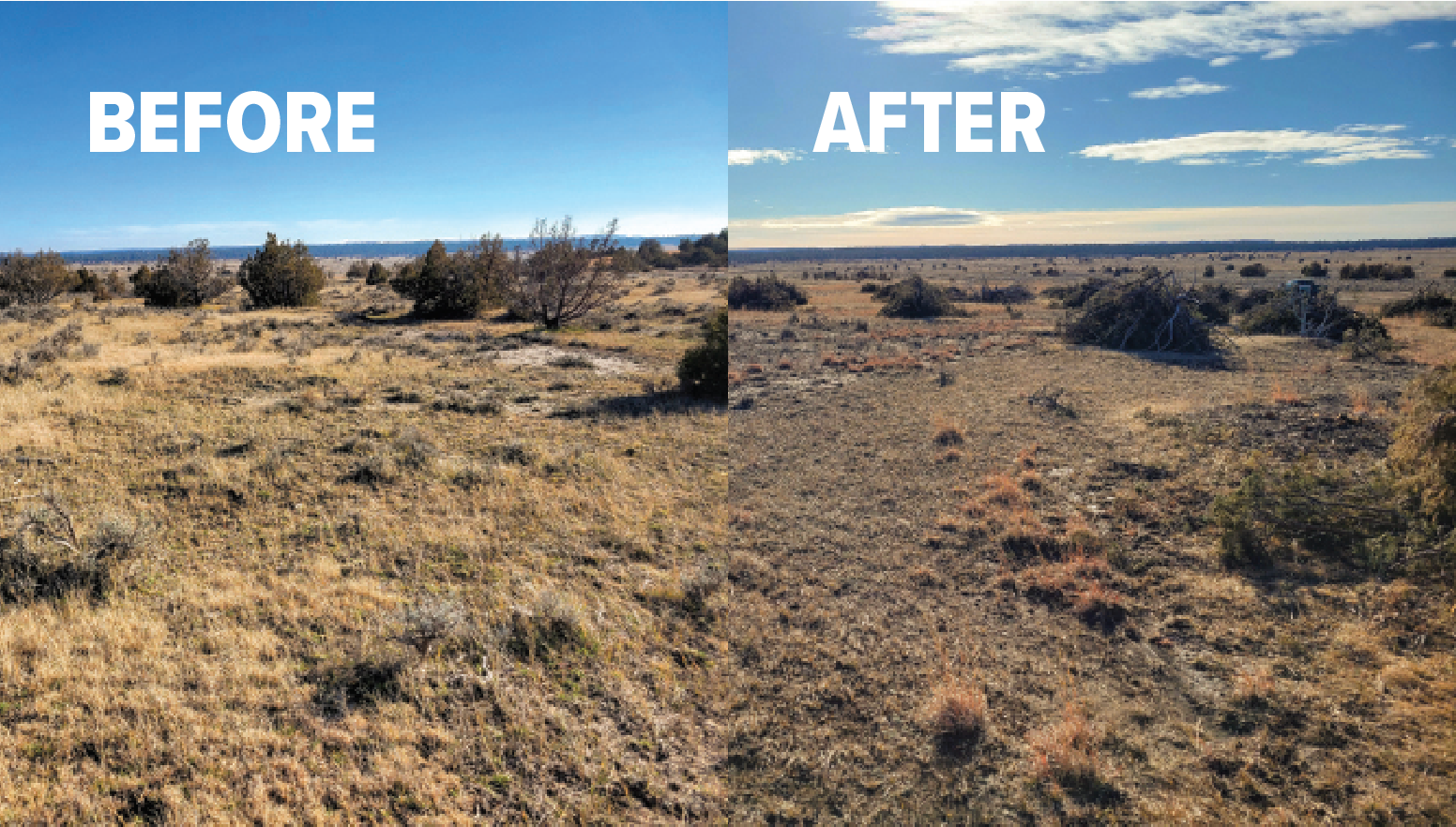
The Wyoming Game and Fish Department has worked to reduce encroaching conifers in high-use areas for pronghorn (Photos by WGFD).
Crossing state lines
Wyoming’s study and associated habitat work dovetails with a similar, recently completed pronghorn study in Montana. In 2020, Montana Fish, Wildlife and Parks initiated a four-year study of seven pronghorn herds. One of the herds, the Powder River-Carter herd, adjoins Wyoming’s North Black Hills herd.
The Montana Pronghorn Movement and Population Ecology study looked at multiple factors affecting pronghorn populations, including seasonal movements and demographic data. It found most of the collared animals don’t make significant seasonal movements, but are considered resident in nature. However, many individuals did make notable movements, including into Wyoming along the Little Powder River.
“One of the key points from our study was the mixture of methods that the animals tried and patterns they had,” said Ryan DeVore, MFWP wildlife biologist based in Broadus who manages the Powder River-Carter herd. “There were some individuals that stayed in a small area year-round and didn’t migrate. Others moved a moderate amount, from 5-15 miles between seasons and some surprised us and moved 20-50, or even up to 70 miles.”
DeVore observed if collared individuals made seasonal movements, particularly into Wyoming, it was usually during winter months and associated with a period of cold weather or snow events. Mild winters showed less movement.
Another finding was the barrier that some roadways created for pronghorn movement.
The study identified a particular stretch on U.S. Highway 212 that impeded movement. Few individuals were able to cross, usually after much back-and-forth movement along the fenceline looking for an access point. One of the animals that attempted to cross at that location was an animal collared in Wyoming. Working with local landowners and other partners, fences on either side of 5.25 miles of the highway were modified to make it easier for pronghorn to cross.
“It is exciting and rewarding to see research data turned into on-the-ground work,” DeVore said, noting his ongoing collaboration with Peckham. “I can’t say enough of the partnership between us and Wyoming Game and Fish, private landowners, conservation groups, our highway department and others to identify movement barriers and then implement habitat projects that will make a tangible difference.”
DeVore will monitor the modified stretch for the next year to measure its impact and inform future fence modifications.
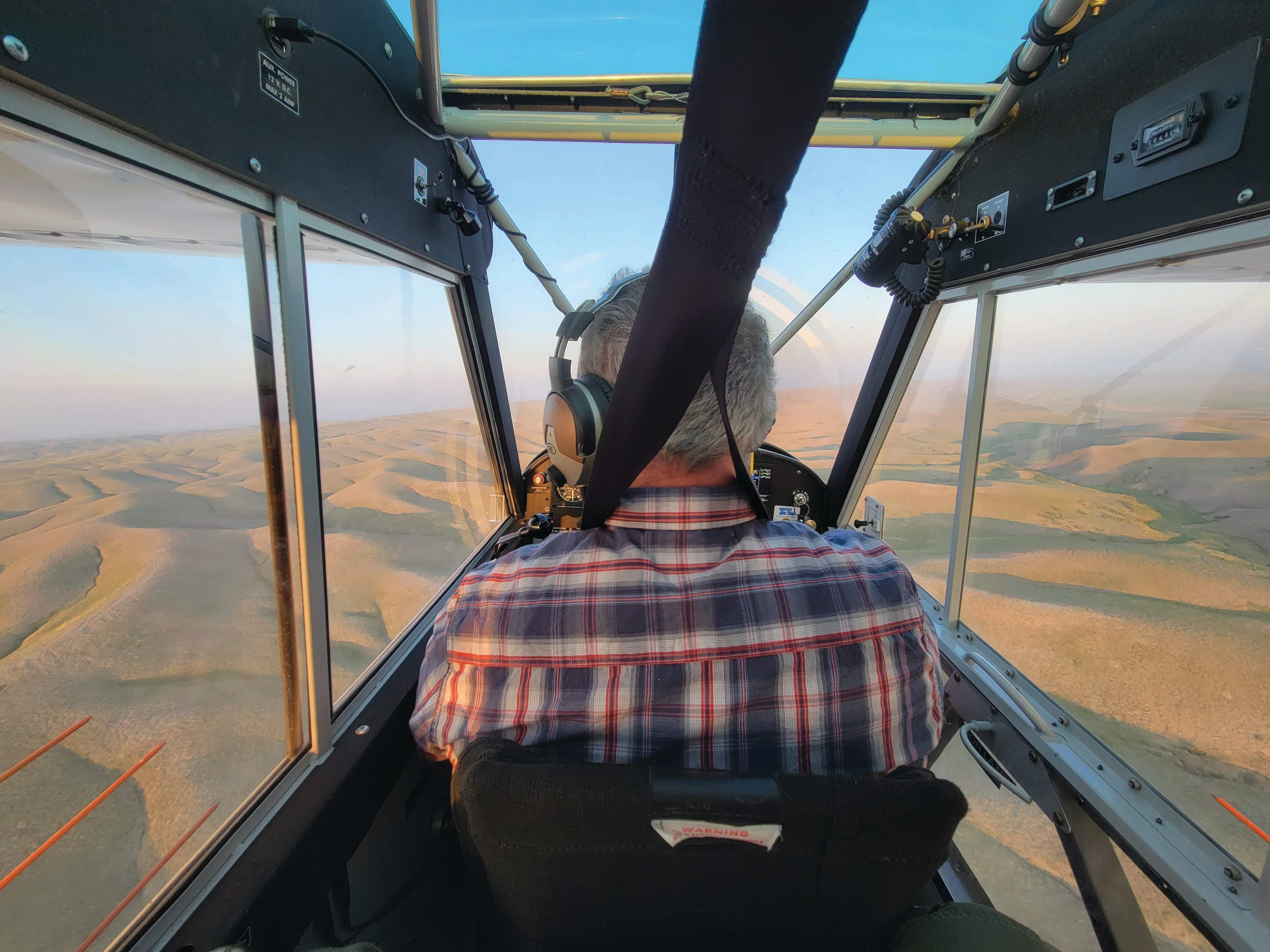
Aerial surveys are a common method for wildlife managers to estimate wildlife populations, including pronghorn (Photo by WGFD).
Managing the herd
So far, the North Black Hills project data mirrors that of Montana — with individuals traveling seasonally along the Little Powder River, sometimes between 30-50 miles.
Writing in the U.S. Geological Survey report, Ungulate Migrations of the Western United States, Volume 6, Hall Sawyer, who analyzed the initial GPS collar data, noted that while Montana pronghorn moved into Wyoming during winter, Wyoming pronghorn tended to travel into Montana during summer.
“Regardless of the migratory type or state origin, all pronghorn migrations paralleled the Little Powder River, and the heaviest use was on the river’s east side,” Sawyer wrote. “Pronghorn movements to the south were limited by Interstate 90 in Wyoming and blocked to the north by U.S. Highway 212 in Montana.”
In addition to mapping important movement routes, resource areas and interactions with infrastructure, Embere Hall, supervisor of the Game and Fish Science, Research and Analytical Support Unit, helping administer the North Black Hills pronghorn study, said collected data will help local wildlife managers better manage the herd.
“We expanded the project in 2025 and 2026 to address some vacancies in what we knew about pronghorn in this area. It is a big herd and an understudied herd,” Hall said. “This was a spot where on a statewide level, we realized there were some information gaps in terms of connectivity and movement but also herd unit boundaries — where animals are moving, when and where they are vulnerable to harvest. Unlike some other herds where we’ve had the luxury of lots of information for many years, that has been missing for this herd.”
For example, it is suspected there may be more than one distinct population within the current herd unit. Pronghorn are not evenly distributed across the herd unit, and population trends and fawn-to-doe ratios have varied in the different hunt areas in recent years. Hunt areas 1, 18 and 19 are performing better, while hunt areas 2 and 3 continue to struggle.
“Hunt areas 2 and 3 have less suitable pronghorn habitat, with higher amounts of conifer forest throughout those hunt areas, and the suitable habitat is somewhat fragmented,” said Matt Huizenga, Game and Fish wildlife biologist in Sundance, who co-manages the herd with Peckham. “Fawn ratios over the prior 5-year period averaged 65.7 fawns per 100 does in hunt areas 2 and 3, while hunt areas 1, 18 and 19 averaged a bit higher at 68.2.”
If analysis at the end of the study indicates more than one population, that information may influence future management decisions, including potential herd unit boundary shifts or harvest strategies.
“I’m excited to see and learn from more data in the coming years,” Peckham said. “The results of this collaring project will assist with management of this herd in a big way.”
— Christina Schmidt is the information and education specialist for the Wyoming Game and Fish Department in the Sheridan Region.