
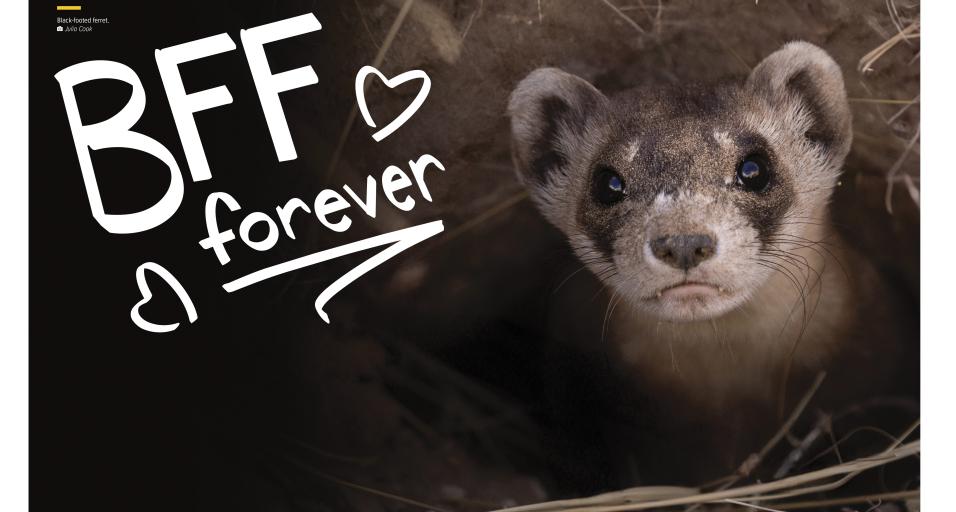
How a handful of ferrets, Scarface and a bold plan saved black-footed ferrets from the brink of extinction.
The rediscovery of the black-footed ferret is one of the most incredible and well-known stories in all of conservation. In case you haven’t heard that part, here is a quick synopsis. Black-footed ferrets, or BFFs, were declining across the Great Plains and the West as prairie dogs were being eradicated. They were presumed extinct as early as the 1950s. In 1964, a small population was discovered in South Dakota. An unsuccessful captive breeding program was attempted at the Patuxent Wildlife Research Center in Maryland. The wild population died out in 1975, and the last captive ferret in the program died in 1979. Presumed extinct, again.
Enter Shep. In 1981, the ranch dog from Meeteetse brought a dead ferret home to his owners, the Hogg family. They took the ferret to the local taxidermist and reported it to the Wyoming Game and Fish Department. After some surveys, trapping and radio telemetry, the department and federal partners determined about 120 ferrets were living in the colony. Unextinct again.
What follows that dramatic rediscovery is an even more incredible story. On the 40th anniversary of the Game and Fish’s captive breeding efforts, it is time for that next part to get its due.
The decision
“There was a big debate about what to do with them, once we found them,” said Bob Oakleaf, former Game and Fish nongame biologist. “There was certainly a camp that felt strongly about capturing the ferrets and getting them into captivity as soon as possible.”
Game and Fish and the United States Fish and Wildlife Service intensively studied the population in Meeteetse after the rediscovery while deliberating the best course of action. Ultimately, the decision was made to monitor the wild population and to prepare for the eventual need for captive breeding. Preparation for captive breeding was a monumental effort aimed at securing long-term funding and bureaucratic agreement while establishing management procedures.
“One of my roles was developing a contingency plan,” Oakleaf said. “What would happen if the wild population declined past a certain point? The thought process was that if that threshold was met, we would bring all the ferrets we could capture into captivity.”
In summer 1985, both the Meeteetse ferret population and its primary food source, prairie dogs, rapidly declined. Sylvatic plague was documented as impacting prairie dog numbers, but a developing epizootic of canine distemper went undetected. Also undetected until years later was the reality that black-footed ferrets, unlike other mustelids, are not immune to sylvatic plague.
In fall 1985, Game and Fish brought six ferrets to the Sybille Wildlife Research and Conservation Education Unit in southeast Wyoming to begin work on a captive breeding program. All six died of canine distemper shortly after. Six more ferrets were captured and quarantined, and they survived for captive breeding. By 1986, the surviving population in Meeteetse crashed.
“The contingency plan was approved before they started surveys in summer 1986 and initiated following surveys that indicated all surviving ferrets were most valuable for captive breeding,” Oakleaf said.
Eleven more ferrets were captured in 1986. The last wild ferret was captured on Feb. 28, 1987. Extinct in the wild — again.
One last hope
With the failure of the captive breeding program from the South Dakota colony fresh on everyone’s mind, experts from around the world in small-population biology and captive breeding were invited to Laramie in August 1986 to discuss next steps. These included members of the International Union for the Conservation of Nature's Captive Breeding Specialist Group, representatives from commercial fur farms, Fort Dodge Laboratories on canine distemper, the Department of Veterinary Sciences at the University of Wyoming and many other collaborators. The mission was complex and daunting, set against a ticking clock.
“Ferrets really only have 2-3 years where they are actually breeding,” Oakleaf said.
The breeding program was headed by Dr. Tom Thorne. He wrote the following about the results of the first year of the program in 1986: “Only six recently captured black-footed ferrets, including two juvenile males, were available during the 1986 breeding season. … The 1986 breeding season was unsuccessful, probably because the two males were physiologically and psychologically immature.”
The 1987 season started with promise. Eighteen ferrets were available thanks to those captures from the wild. But as time passed, worries grew. Thorne wrote: “Pairing was initiated in late January 1987, and there was concern about the 1987 breeding season when no breeding occurred by late February and early March.” It appeared another year was ticking away. Artificial insemination was attempted unsuccessfully. The researchers observed the male and female ferrets seemed to be on different cycles, with the males coming out of seasonal sexual maturity as the females were cycling into it.
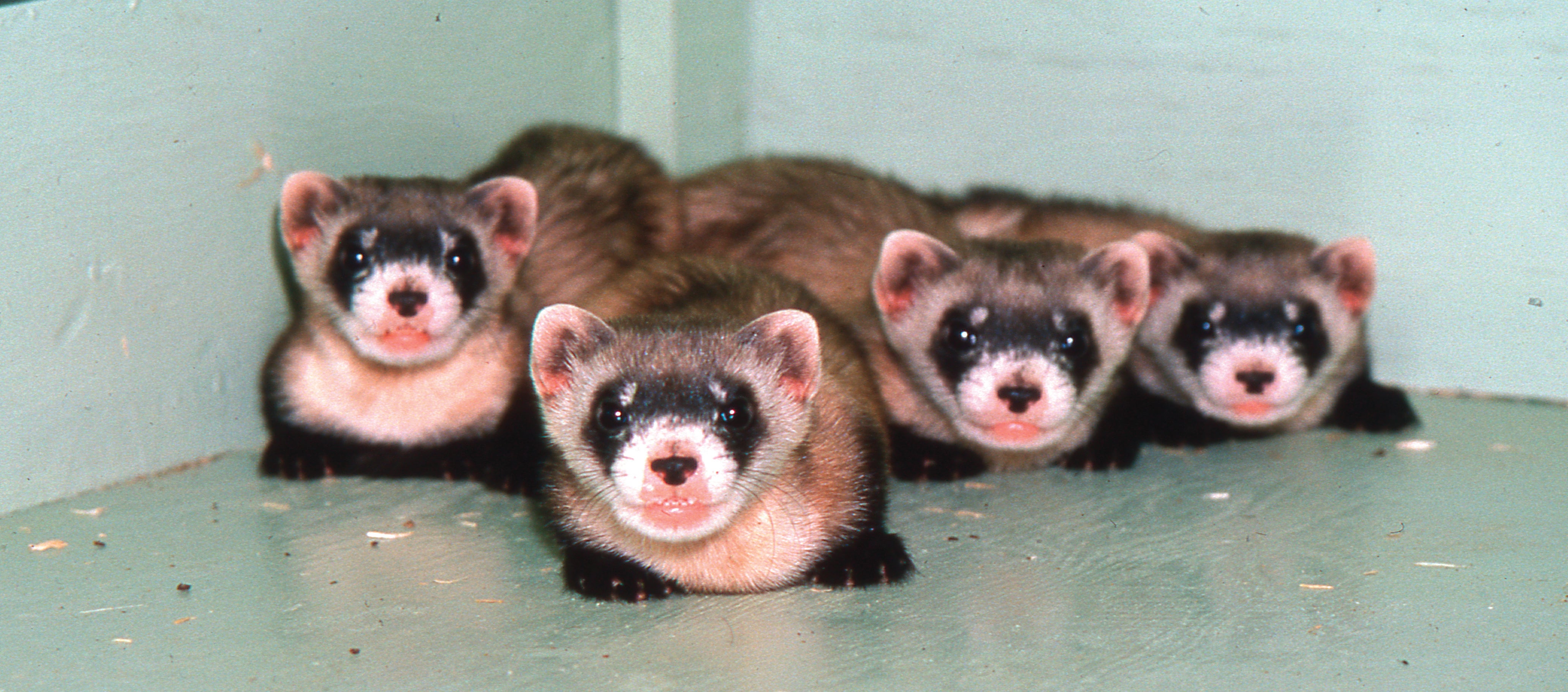
The captive breeding program for black-footed ferrets had a breakthrough in 1987 when two litters were born during the breeding season.
Breakthrough
Remember that last ferret caught in the wild in 1987? He was caught just before the start of the 1987 captive breeding season. He was given the name Scarface, and he turned out to be very important. Most of the males brought in for the captive breeding program in 1985 and 1986 were juveniles. Scarface was a mature male and provided a spark to the program. The first litter born in captivity was bred between Scarface and a female named Becky. Those six ferret kits represented a breakthrough for the program.
Not only did those kits increase the total ferret population by 33 percent, they also represented belief — the belief that this species was not going to blink out of existence. Researchers at Sybille applied what they learned from the successful breeding of Scarface and Becky to another pair of ferrets, a juvenile named Dexter and a female named Jenny. Jenny produced two kits, though only one survived to the next year. Thorne wrote: “Of importance to the future success of the captive breeding program was participation in breeding by juveniles. The success of 1987 and knowledge gained in 1987 allow for guarded optimism that 1987 and 1988 objectives can be met in 1988.”
Thorne’s guarded optimism proved correct. If 1987 was the breakthrough, then the floodgates opened in 1988. Fourteen females were bred by six different males and produced 13 litters — a total of 34 kits. The ferret population increased by 138 percent in one breeding season. The recovery plan called for establishing a second captive breeding site once a certain threshold of ferrets was reached. Following the success of the 1988 season, 14 of the kits — seven males and seven females — were moved to the Henry Doorly Zoo and Conservation and Research Center in Nebraska to establish a breeding program there.
Back to the prairie
Following the success of 1988 and even before that, discussions and research on where to reintroduce ferrets began.
“We had a tremendous amount of work between ‘86 and ‘91,” Oakleaf said. “We surveyed potential sites, wrote management plans for them, and, with Meeteetse and Shirley Basin, we spent a lot of time working with landowners.”
Landowner support was essential to the long-term success of recovery efforts. Oakleaf describes the sentiment at the time as “very positive and very supportive, once they saw the approach we were taking.”
Game and Fish held public meetings, but personnel also went door-to-door to explain the program to landowners. This personal, community-based approach was crucial to continued support.
In 1991, the captive population grew enough to support a reintroduction effort. Monitoring prairie dogs was key to the reintroduction decision. Not only are prairie dogs the main food source for BFFs, but the ferrets rely on their burrows for shelter and protection.
“The unfortunate thing was Meeteetse’s prairie dog population collapsed again (following the initial collapse in 1985) right as we were about to reintroduce,” Oakleaf said. “So there wasn’t much question about going to Shirley Basin in ‘91.”
Researchers released 49 captive-bred, four-month-old ferrets at various prairie dog colonies in the Shirley Basin beginning on Sept. 7, 1991. Black-footed ferrets returned to the prairie for the first time in five years and to this specific area for the first time in decades. Extinct in the wild no longer.
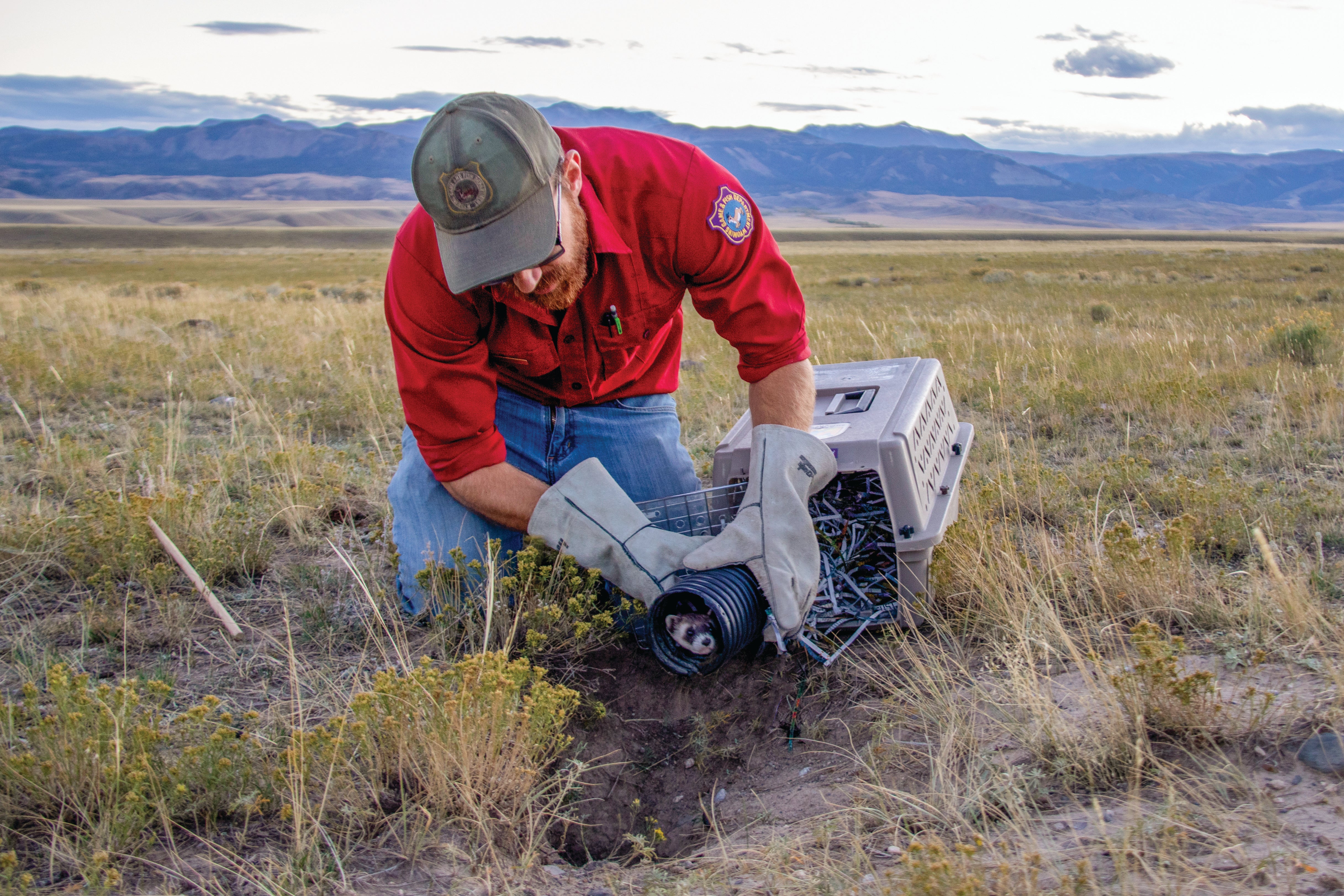
Andy Gygli, small carnivore biologist with Game and Fish, releases a captive-bred ferret near Meeteetse.
Building on a conservation miracle
“I don’t think people realize how close we were to failure with the captive breeding program,” Oakleaf said.
He credits Drs. Thorne and Beth Williams at the University of Wyoming Veterinary Lab for soliciting external expertise to ensure the program's success. Building on the initial success of that research team, the captive breeding program was transferred to the USFWS in 1995. It has overseen the expansion of wild reintroduction from one site in Wyoming to include 11 other states.
As a federally endangered species, ultimate authority over black-footed ferrets remains with USFWS, though Game and Fish continues to lead management within Wyoming. Andy Gygli, small carnivore biologist for Game and Fish and lead of the black-footed ferret program, said this about current efforts: “One of the fundamental questions is how do you count ferrets? Detecting ferrets is incredibly difficult, and so recapturing ferrets in populations that aren’t very dense is very rare. This makes it difficult to get a statistically valid estimate”
Gygli said some sites can be monitored with mark/recapture efforts, particularly smaller areas with dense prairie dog populations, but getting enough hands in the field can be a challenge. For spatially larger sites with less dense prairie dog colonies, like white-tailed colonies at Shirley Basin, getting an accurate count becomes very challenging. Gygli said Game and Fish continues to find better ways to count prairie dogs in those circumstances.
“One of the most promising things, in my mind, is drones with thermal imagery,” Gygli said.
Gygli continues to monitor ferret ranges via night spotlighting. Ferrets are most active at night, so one of the more reliable ways to detect them is to go out after dark and use spotlights to look for their distinctive green eye shine. This work is essential to determining if those ferret ranges are shrinking or expanding.
Another key piece of the ferret program is the potential for reintroduction.
“We have to consider the biological carrying capacity. Is there enough habitat to support ferrets? And then also the social carrying capacity,” Gygli said. “Are landowners hostile toward prairie dogs and/or ferrets?”
These two factors in balance, along with the disease issues from plague and canine distemper, make selecting reintroduction sites incredibly difficult. Since the reintroduction to Shirley Basin in 1991, only one other site in Wyoming has been established.
Ferrets returned to Meeteetse in 2016. Thirty-five were released onto the two ranches where they had been rediscovered in 1981. A full-circle moment for a species that threatened to have its story end prematurely. Due to the hard work of conservationists then and now, the black-footed ferret will persist on wild Wyoming landscapes for generations to come.
— Parker Everhart is the Conservation Education Coordinator for the Wyoming Game and Fish Department.