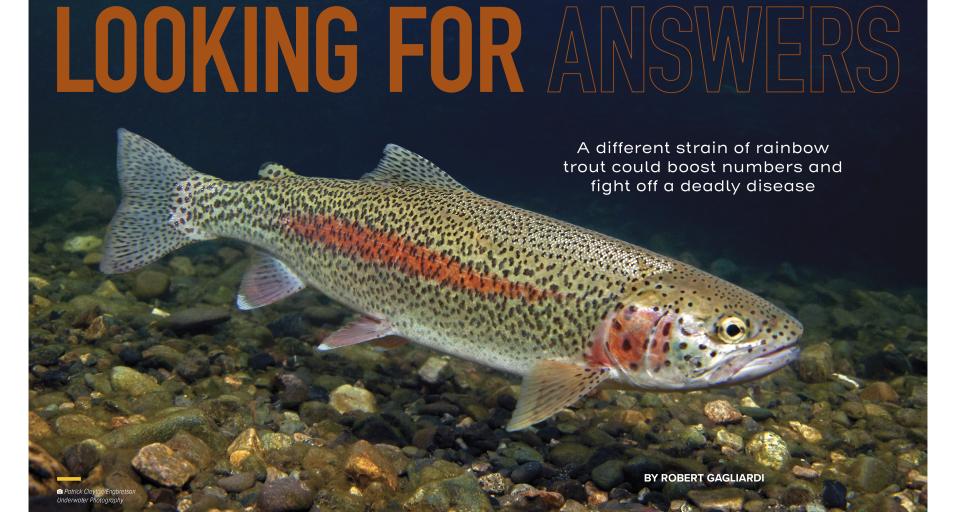
It’s a problem at fish hatcheries in Wyoming and throughout the West. Fish can die, and often do. It’s treatable, but not in all instances.
However, the Wyoming Game and Fish Department is taking steps to manage the problem and possibly find a long-term solution.
Bacterial Coldwater Disease — known as BCWD — is a major and often fatal infection that affects trout and salmon in cold freshwater. Caused by the bacterium Flavobacterium psychrophilum, it results in significant fish losses in hatcheries worldwide. It leads to necrosis — the premature, uncontrolled death of living tissue — along with fin rot and neurological damage. Fish that survive often suffer from deformities.
“This disease causes the most fish mortality in our hatchery system, and nationally we see the same,” said Guy Campbell, Game and Fish fish culture supervisor. “Every year we lose some number of fish from the disease, with the severity differing year-to-year with numbers ranging from several hundred to as many as tens of thousands at various life stages.
“Nationally, this disease causes more death with cold-water fish species than any other single disease found in fish hatcheries.”
BCWD was first detected worldwide in 1948 in coho salmon in the Pacific Northwest. However, similar symptoms were reported with rainbow trout and salmon earlier in the 1940s. Today, BCWD is found across the globe.
BCWD affects all cold-water fish species raised in Wyoming hatcheries, which include brook, brown, cutthroat, golden, lake, rainbow and tiger trout, along with splake and kokanee salmon. BCWD typically infects fish in 40-63-degree water, and Campbell said Wyoming facilities with warmer water supplies are more plagued than those with colder water. Rainbows have been the most impacted in Wyoming, but Campbell said all cold-water fish species have been affected to some degree.
“Each year we can lose up to a few percent in each of our other cold-water species, but it’s typically not at the higher mortality levels we see with rainbow trout,” Campbell said. “Universally, rainbow trout, steelhead and coho salmon are known to be the most susceptible to the disease and most impacted through mortality.”
Game and Fish has had protocols in place for more than 12 years to manage BCWD. In the last two years, Game and Fish implemented an additional protocol, which has proven effective, that requires all salmonid eggs to be water-hardened in an iodine solution immediately after fertilization.
Other protocols include disinfecting eyed eggs before they are brought into another facility, using salt in certain situations to reduce stress on fish, lowering rearing densities of fish in tanks and raceways, increasing water flows to speed up water exchange rates in circular tanks and raceways, covering rearing units, picking out infected fish in sick tanks and raceways several times a day and administering antibiotic fish feed to sick fish.
Federal drug approval processes can delay how quickly medicated feed can be purchased, delivered and administered, which can exacerbate problems during severe outbreaks.
Campbell said he can’t pinpoint how BCWD entered Wyoming’s hatchery system, but one possibility was receiving eyed eggs and/or fish from an unknown, positive out-of-state source many years ago. Another is the transfer of eyed eggs and/or fish from a wild source that was a positive carrier for the disease within the state.
“Once in our hatchery system, the transferring of eyed eggs and fish definitely spread the disease to all our facilities,” Campbell said.
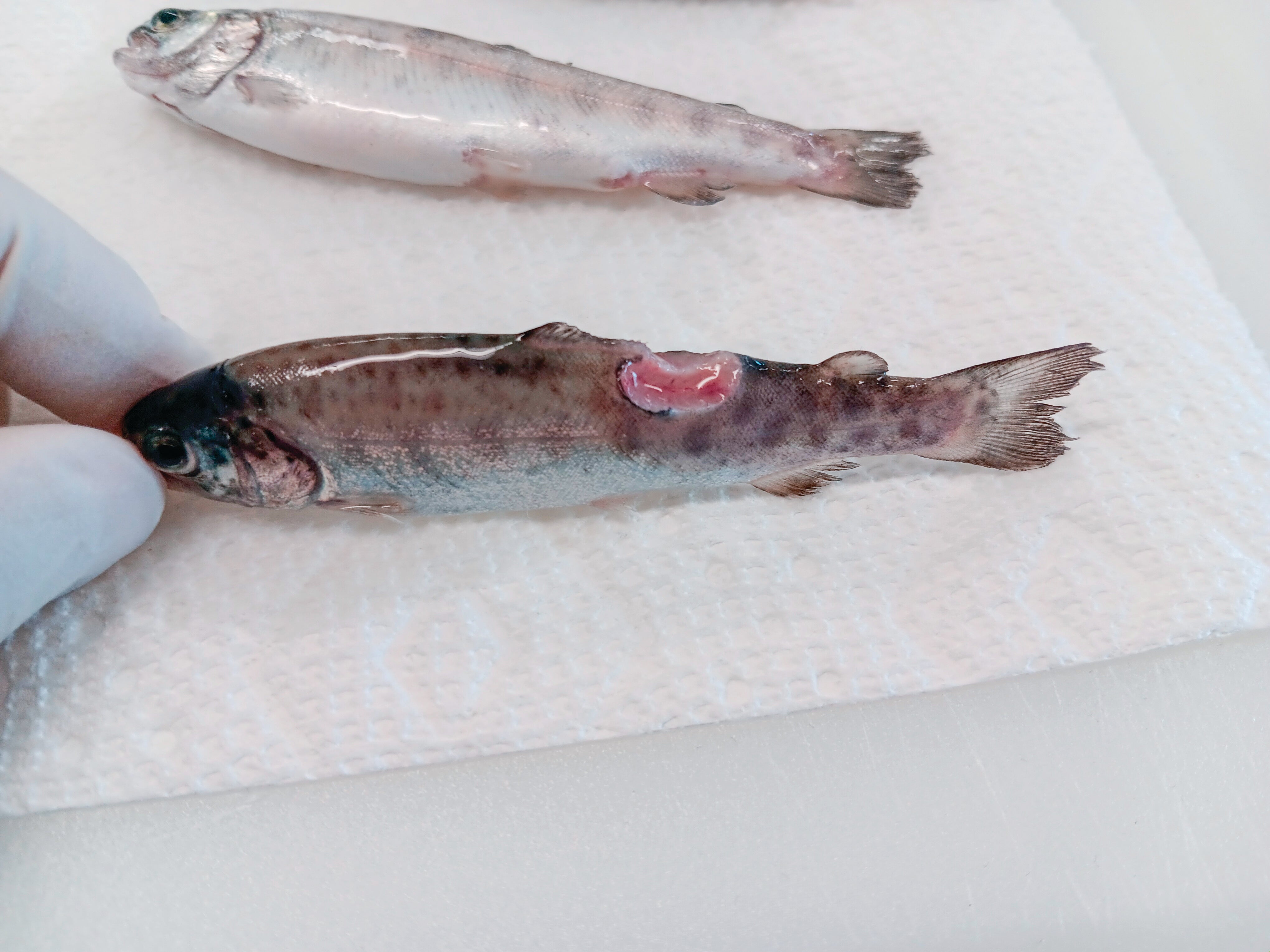
This rainbow trout developed a dorsal caudal lesion after being infected with Flavobacterium psychrophilum. (Photo by Carl Smith/WGFD)
Rainbow warriors
There is a fish that seems to be helping states like Wyoming deal with rainbow trout losses due to BCWD.
West Virginia rainbow trout combines strains of four different rainbow trout — House Creek from Idaho, Shasta from Montana, Donaldson and Kamloops/Puget Sound and Steelhead from Washington. This strain is resistant to BCWD.
The strain was developed at the National Center for Cool and Cold Water Aquaculture in Leetown, West Virginia, hence the name West Virginia rainbow trout.
Wyoming received its first eyed eggs of West Virginia rainbows from Utah in February 2022, which were sent to the isolation facility at the Dan Speas Fish Hatchery near Casper. Fisheries crews incubated, hatched and began feeding the fish in the isolation unit before moving them into the hatchery building at Speas.
A broodstock has recently been established, which took three years and is housed at the Clarks Fork Hatchery near Cody. The current broodstock numbers include 1,000 4-year-old fish and 900 3-year-olds. Crews spawned eggs from the broodstock this year for the first time. There were 490 females paired with an equal number of males that produced 691,000 eggs. Females averaged 1,410 eggs per fish.
“This past season, eggs eyed up at an incredible 90 percent,” Campbell said.
Already in Wyoming
Game and Fish has stocked 290,000 West Virginia rainbows since 2022, and 280,000 of those were stocked in 2022 and 2023. Alcova Reservoir in the Casper Region received 102,000 fish 8-8.5 inches long in 2022-23. Nearby Pathfinder Reservoir was stocked with 120,000 in 2023. Seminoe Reservoir in Carbon County was stocked with 18,000 and 37,000 were stocked in Lake DeSmet near Buffalo.
“In 2024 and 2025, we were unable to acquire the requested number of eyed eggs, so stocking only equated to around 10,000 fish in fewer waters across the state,” Campbell said. As a result, those fish were stocked in some smaller waters and community fishing ponds.
Campbell added about 120 retired broodstock fish were stocked in Beck Lake in Cody this spring from the Clarks Fork Hatchery, and the plan is to stock 285,000 8.5-inch fish into Pathfinder (140,000) and Seminoe (145,000) this fall.
Campbell said fish losses from BCWD have decreased the number of rainbow trout Game and Fish stocks around the state in recent years, so we manage for it.
“It depends upon the severity of a disease outbreak,” Campbell said. “At a facility and within a tank we can see an infection cause mortality on just a handful of fish (more typical) or all the way up to 7 to 8 percent of the total population in a rare larger outbreak.
“Our hatchery facilities plan for some level of mortality each year, but we are intrigued about what we are seeing with the BCWD-resistant West Virginia rainbow trout.”
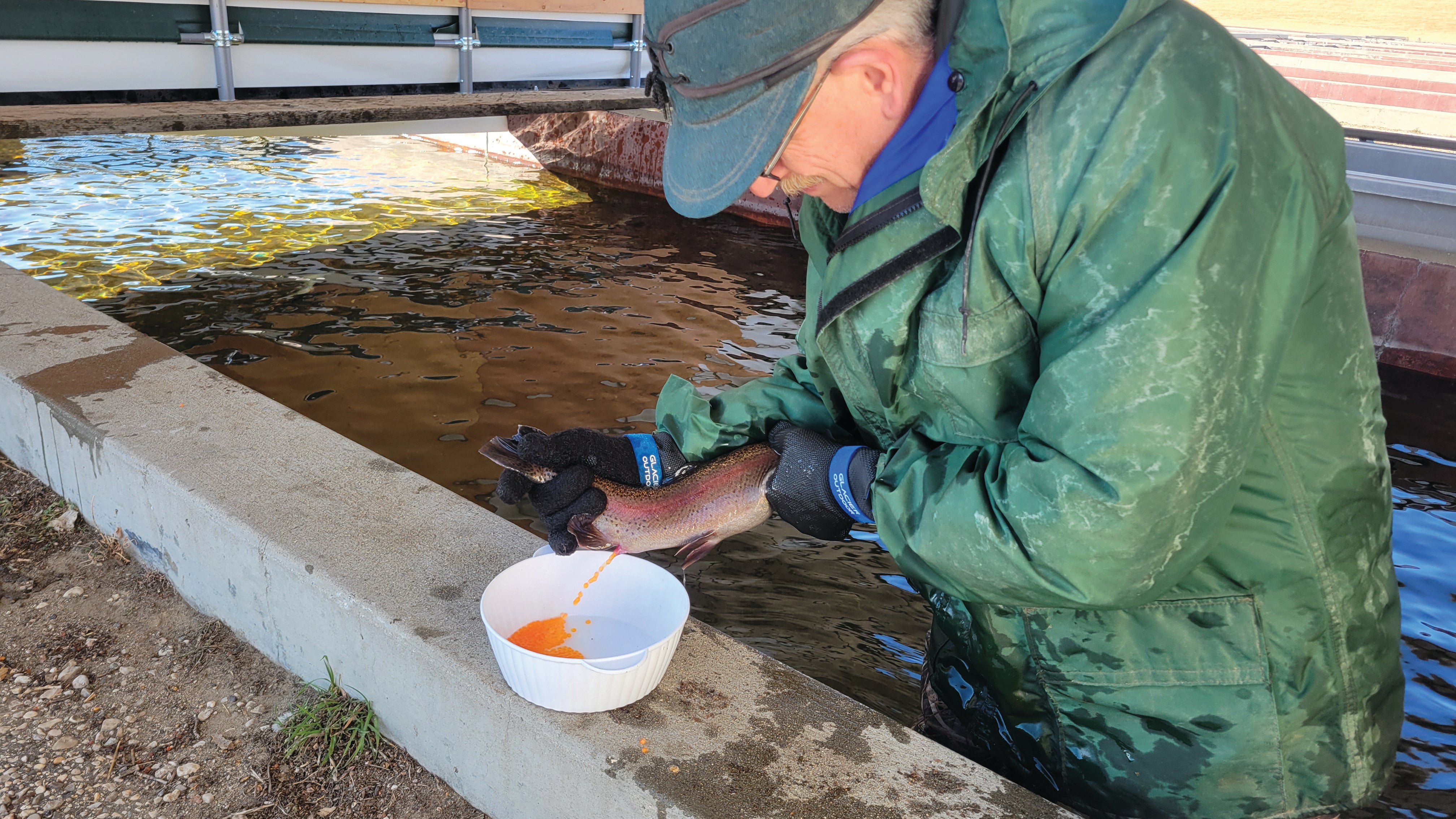
Follett extracts eggs from a female rainbow trout. (Photo by WGFD)
Upcoming study
Prior to West Virginia rainbows, Game and Fish stocked many different strains of rainbow trout in Wyoming waters, but for the last decade the prominent strains were Eagle Lake and fall. Eagle Lake is a strain that originated from Eagle Lake in Lassen County, California, which spawns in the spring. Fall rainbows, through water temperature manipulation, now spawn in the fall.
Game and Fish’s last extensive study of rainbow strains was in the 1990s in some Casper Region reservoirs. Data showed a decline in fall rainbow numbers, despite consistent stocking. Over time, Game and Fish received similar reports in other Wyoming waters.
Work started this spring to determine how hatchery-raised strains of West Virginia, Eagle Lake and fall rainbow trout perform in five Wyoming reservoirs — Pathfinder, Alcova, Seminoe, Boysen and Lake DeSmet. The study involves genetic analysis in collaboration with the University of Wyoming. This is a long-term study through 2031.
Fisheries biologists genetically sampled parent fish from the three strains this spring, and those fish will be stocked in the five reservoirs in fall 2028. The three strains will be genetically sampled for three consecutive years. Game and Fish will start collecting information on the performance of these fish through net and angler surveys in spring 2029, which also will be done for three straight years.
Each reservoir will be stocked with similar numbers of West Virginia rainbows and one of the other two strains. When Game and Fish collects fish from the reservoirs, and through the genetic sampling of the parents, it will be able to identify the parents and how that particular strain is performing.
Game and Fish’s culture system also will track how all the strains of rainbows do in the hatcheries prior to stocking, which can include water temperature, handling and also disease such as BCWD. Depending on the results, there could be evidence that certain rainbow strains struggle to survive from hatchery to the wild.
Game and Fish — and anglers — have benefited from Eagle Lake and fall rainbows due to the different times they spawn. Game and Fish can raise more fish, which results in stocking more fish for anglers.
If this study finds West Virginia rainbows perform well, and say, better than the fall strain, then perhaps the department shifts to more West Virginia rainbows for rearing and stocking.
After all the data is collected, a committee of Game and Fish biologists, fish managers and culture personnel will meet to decipher the information.
“We will try and put the puzzle together and see if there are any consistent patterns that indicate why we get post-stocking failure or success,” said Chance Kirkeeng, Game and Fish assistant fisheries management coordinator. “The finish line is way down the line, but that is the end goal of this study.”
— Robert Gagliardi is the associate editor of Wyoming Wildlife.