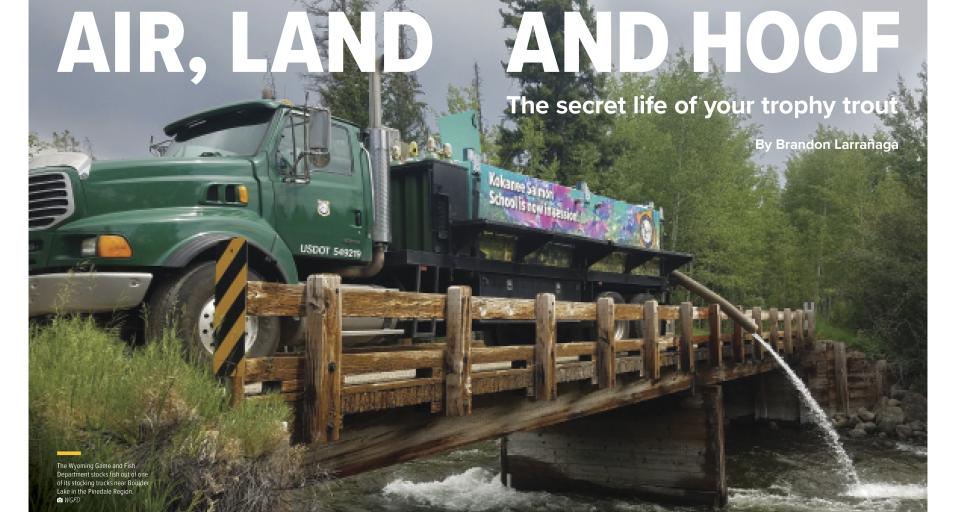
The secret life of your trophy trout
For diehards and novices alike, the pull on the line when hooking a fish never fails to get an angler excited. It’s the tangible payoff from preparation, patience, time and effort it takes to reach the perfect spot when conditions are just right.
In the Cowboy State, few pastimes are more beloved than fishing. In the last five years, the Wyoming Game and Fish Department and license-selling agents have sold 1.8 million fishing licenses in Wyoming. Of all those anglers, each has a favorite memory about the lake they landed their limit or caught that trophy trout. They’ll tell you about the hours spent fishing that spot, the conversations they’ve had with other anglers and how they had the perfect bait that did just the trick. Having the chance to catch trophy-sized fish doesn’t come down to these factors, however. It doesn’t even come down to luck, either.
That 20-inch rainbow trout you hold out proudly for the camera underwent quite a journey before you hooked it. What’s now a trophy fish in your hands was likely a tiny fry in a hatchery on the other side of the state. How did that fish land in that water to begin with? What factors led to it being there? Chances are, Game and Fish had something to do with it.
This is the odyssey of fish stocking in Wyoming, and the journey undertaken by the Cowboy State’s fish from start to finish.
A journey begins
It starts with biologists in the field. Game and Fish staff get boots on the ground at different waters across the state. They conduct scouting visits to determine the species and quantities to stock.
“We work toward sampling all waters that are stocked,” said Bobby Compton, Game and Fish fisheries supervisor in the Laramie Region. “It’s on us to know when, where and what species should be stocked, and that’s through years and years of monitoring and knowing what does and doesn’t work.”
Field staff weigh numerous factors to help make these calls. Fish survival rates, water levels, harvest pressure and drought conditions are all considered. Certain waters may have varying objectives as well. Some have targets for a certain size that fish should reach. Others may be intended to have so many fish caught per hour, whether by field staff or by anglers.
“We always talk about returning to the creel, and that means, generally, stocking fish that are going to end up being caught,” Compton said.
Several parties help inform these stocking decisions. There are experienced decision-makers on the culture side, where professionals raise the fish, and on the management side, where biologists evaluate their waters. However, there’s also a third party that helps paint a more complete picture.
“We also listen to the public,” Compton said. “When you have an angler that’s fished a certain water for 20 years, that’s valuable — that’s information we can use.”
The process for deciding which waters are stocked begins more than two years in advance. Once all factors are considered and field staff have a good idea of what needs to be stocked, requests are compiled and submitted. However, accommodating all of those requests is a challenge, and that begins in the hatcheries.
Home is Where the Hatchery Is
Game and Fish has 10 hatchery facilities across the state. It is here that most of Wyoming’s stocked fish begin their journey toward maturity. Nine hatcheries produce fish for stocking, while Story Hatchery at the base of the Bighorn Mountains in the Sheridan Region operates purely as a brood station. It’s at these facilities where the challenge of juggling stocking requests begins.
“In 2025, we stocked 7.6 million fish,” said Guy Campbell, Game and Fish fish culture supervisor. “Typically, we receive 650-700 stocking requests each year. Each of those requests asks for specific dates, species and sizes in each water and sometimes as specific as a certain boat ramp. We have a specialized system that uses our nine stocking facilities to try and accommodate all of those simultaneously, and we decide which hatchery makes the most sense to raise the fish to meet all of those requests.”
These facilities raise various strains of several fish species, including brook, brown, rainbow, cutthroat, tiger and golden trout — among others. These are all cold-water species, which make up the majority of fish raised in the hatcheries. Of the 7.6 million stocked in 2025, 5.5 million were cold-water species. The remaining 2.1 million fish are primarily cool- and warm-water species — the majority of which come to Wyoming through trade with other states.
“Of all the fish that are raised or brought into our state to be stocked, 85-90 percent are stocked in lakes or reservoirs,” said Travis Trimble, Game and Fish fish culture assistant supervisor. “The remaining 10-15 percent go into streams or small rivers. The number of waters we stock varies from year to year, but there’s anywhere from 300-350 different lakes, rivers, streams, ponds and everything in between.”
After stocking requests are organized and accounted for, a master schedule is created to coordinate the different hatcheries across the state, matching them with the waters they’ll stock, what they will stock, how many, what type of each fish species, and when that stocking will occur.
Each stocking season, a small percentage of fish are retained as broodstock. Broodstock are sexually mature, adult fish kept specifically for breeding in hatcheries. Game and Fish’s broodstock are carefully developed over time, requiring years of significant effort to ensure genetic purity. This process has included harvesting eggs from specific areas such as Yellowstone National Park. The department’s broodstock at each facility typically consists of around 3,000 adult fish that are generally raised four years before they're retired. Retired broodstock are often stocked into community waters for high-profile events, such as free fishing days.
Stocking season occupies a good part of the year. The process begins at the end of March or start of April, depending on the severity of winter in the part of the state being stocked. From this point, stocking takes place nearly nonstop every week until the start of July.
“Our facilities and entire fleet run nonstop during this busy period,” Trimble said. “Our hatcheries are pretty full at this point, and that constant stocking helps deplete their capacity and free things up for smaller fish to grow for the fall stocking season.”
Stocking slows in July and August when many of the state’s waters get especially warm. The process ramps up again in September and continues through the fall.
“Our trucks are going all out those last three months before winter sets in,” Trimble added. “The statewide trucks could potentially be on the road Monday-Friday covering all corners of the state.”
Road well traveled
The department’s trucks hit the road to adhere to a precise stocking schedule. But even the best laid plans need room for adaptability.
“We can have a certain date targeted to actually get fish in the water, but there are a lot of factors that might force us to adapt,” Compton said. “Is snow melting? Is there deadfall covering the roads we need? What are the water levels looking like? Is there ice covering the lake? Are the temperatures right? These are all factors we look at to help us make some adjustments on the fly if need be.”
As impressive as the array of trucks is, however, they are not the only means of transport the department uses to stock fish across Wyoming.
“We typically stock 65-70 waters each year aerially by helicopter,” Campbell said. “We also stock using ATVs, horseback, backpacking and even by boat or barge when the occasion calls for it.”
In certain areas of the state, the trucks can only take the fish so far. One or more specialized methods are often needed to access backcountry waters in high-elevation areas.
Aerial fish stockings have taken place in Wyoming since 1957. At that time, fixed-wing aircraft were used to deliver fish to isolated lakes and ponds. The department first utilized helicopters as a method of stocking in the 1970s. It’s a practice implemented to reach many of the alpine waters across the state. And while the vast majority of fish are stocked using the truck fleet, the novelty of helicopter stocking offers a certain appeal.
“It’s an extremely popular program,” Trimble said. “It’s a unique process that gets fish into remote waters for those who really love hiking or riding into wilderness areas.
Waters stocked by helicopter are on an alternating odd and even year schedule. The Bighorn and Snowy Range mountains are stocked every other year, while the Wind River Mountains will have some stocking occurring every year. Helicopter stocking takes place only one week out of the season, usually during the last week of July. By this time, most high-elevation lakes are ice-free, and the early-morning weather is conducive to helicopter flights.
The helicopter is equipped with eight cylinders that each hold anywhere from five to eight gallons, depending on how many fish are loaded. Each cylinder is fed oxygen to replenish what the fish use during transport, and ice is added to slow their metabolic rate and reduce stress. The pilot can open each cylinder door individually, dropping the fish into the water at a height that is safe for the fish. When compared to backpack, or horse pack stocking, helicopter stocking is a very quick and efficient process.
Other backcountry waters require different solutions to deliver the fish to their final destination. In the Jackson Region, Game and Fish still uses horses and livestock to transport fish to certain alpine waters that helicopters can not practically access — a method from a different age that still holds value today.
“I love it,” said Jackson Region fish biologist Diana Miller, in reference to fish stocking using horses. “We don’t always need to use them, but I love it when we do.”
Stocking wilderness waters in the area using horses began with outfitters who either took on the task on their own or were contracted by the department. With many alpine lakes lacking fish passage due to barriers like waterfalls and cascades, stocking these lakes provides angling opportunities for backcountry anglers. Decades of consistent stocking have allowed these opportunities for anglers who crave a challenge off the beaten path.
One pack horse can carry approximately 12 pounds of fish in 10 gallons of water. These are transported in plastic-lined panniers, where ice is added to water to slow metabolism. Longer trips require extra ice and sometimes oxygen bottles mounted on the pack saddles equipped with aerators, depending on the distance being covered.
“A lot of the people in the Jackson Region have horses,” Miller said. “They’ll pitch in and help out on some longer distances when need be, so we can do it all in one trip.”
Ending and beginning
While the stocking season may end in the fall, regional biologists are thinking ahead to the next several years to evaluate future needs and begin the process again. Not long after waters have been stocked, biologists return to evaluate and observe how those populations are growing.
“We try to find a good balance between catch rates and healthy fish,” said Paul Gerrity, Game and Fish fisheries biologist in the Lander Region.
“We sample populations to ensure there are enough fish for anglers to catch, as well as collect data to determine how healthy the fish are.”
Lengths, weights and relative weight — a factor that looks at fish body condition — are sampled. Catching a lot of skinny or unhealthy fish may indicate the water needs to be stocked less. On the other hand, catching only a few large fish might imply more fish should be stocked. It’s all dependent on what the individual water is being managed for and what angler preferences are for that water.
“We’re always looking at the balance between overstocking and understocking, but also what the specific management objective is for that lake,” Gerrity said.
All data gathered from these evaluations is used to inform any changes to future requests, and the cycle begins again. The cycle is a year-round process that relies on a detail-oriented approach and meticulous planning, but the end product is worth the effort.
“It’s really cool seeing the helicopter fly off with its cylinders full of fish or watching the fish swim away and knowing that those are going to turn into 16-inch golden trout in a few years that I’m going to hear anglers talk about catching one day,” Gerrity said.
“When I get a report from an angler and know that they’ve had a great experience, that’s what’s really rewarding,” Miller added.
For those who treasure Wyoming’s wildlife as much as anything else the state has to offer, it’s easy to take for granted the animal we harvest or the trout we reel in with jubilation. But the next time you catch a trophy, take a moment to reflect on the effort that ended with the prize fish you hoist for that picture-perfect memory.
“There’s so much pride in raising those fish and seeing them get released,” Compton said. “The fisheries we have today wouldn’t be the same without the hatcheries, drivers and management crews that take so much pride in their product. They want those fish to do well, and they work darn hard to raise them that way. It’s almost immediate satisfaction knowing that stocking these waters could mean someone has a great day with their family. It’s awesome.”
— Brandon Larranaga is a hunter and angler recruitment, retention and reactivation contract employee with the Wyoming Game and Fish Department.