How the Wyoming Game and Fish Department utilizes horses for wildlife conservation
In a world of increasingly advanced technology, ranging from new, off-road vehicles and drones to internet access in the most remote areas, the Wyoming Game and Fish Department remains committed to a timeless backcountry partner — the horse.
This is why every spring, Game and Fish employees, including wardens, biologists and others, travel to Meeteetse for annual horsemanship training. The goal is to refine their skills in using horses for fieldwork, which is essential for those assigned to a horse district. Despite technological progress, why do we continue to rely on horses?
"Horses start every day," said Dave Hyde, Game and Fish Jackson Feedgrounds manager and member of the department’s horse committee.
Throughout its history, Game and Fish has recognized horses as an invaluable asset in wildlife management. These animals allow staff to reach remote areas and conduct essential fieldwork that would be impossible by vehicle and extremely strenuous on foot.
The importance of using horses for wildlife management is underscored by historical accounts, such as from D.C. Nowlin, one of Wyoming's first game wardens. In an annual report to the governor in 1903, Nowlin wrote: “I have tried to visit in person the principal game sections of the state, and during the present year have visited or passed through 11 counties. During the open season I rode constantly in the counties of Uinta, Fremont and Big Horn, where most of the elk and antelope are found, traveling more than 1,000 miles on horseback.”
Though the technology available to game wardens and other wildlife managers has advanced significantly since the early 1900s, the unique capabilities of horses remain vital for accessing the remote landscapes that define Wyoming. Their superior mobility and minimal environmental impact are especially beneficial in sensitive habitats and designated wilderness areas where motorized vehicles are restricted. A horse can navigate challenging terrain and carry necessary equipment and supplies, making them essential for research, surveys and backcountry law enforcement patrols. As Gary Hornberger, Pinedale Elk Feedgrounds manager, said: “A good horse is like having an extra person, maybe two.”
Horses are indispensable for various department professionals, including game wardens, wildlife biologists and fisheries biologists. Many of their daily duties are performed more effectively from the saddle.
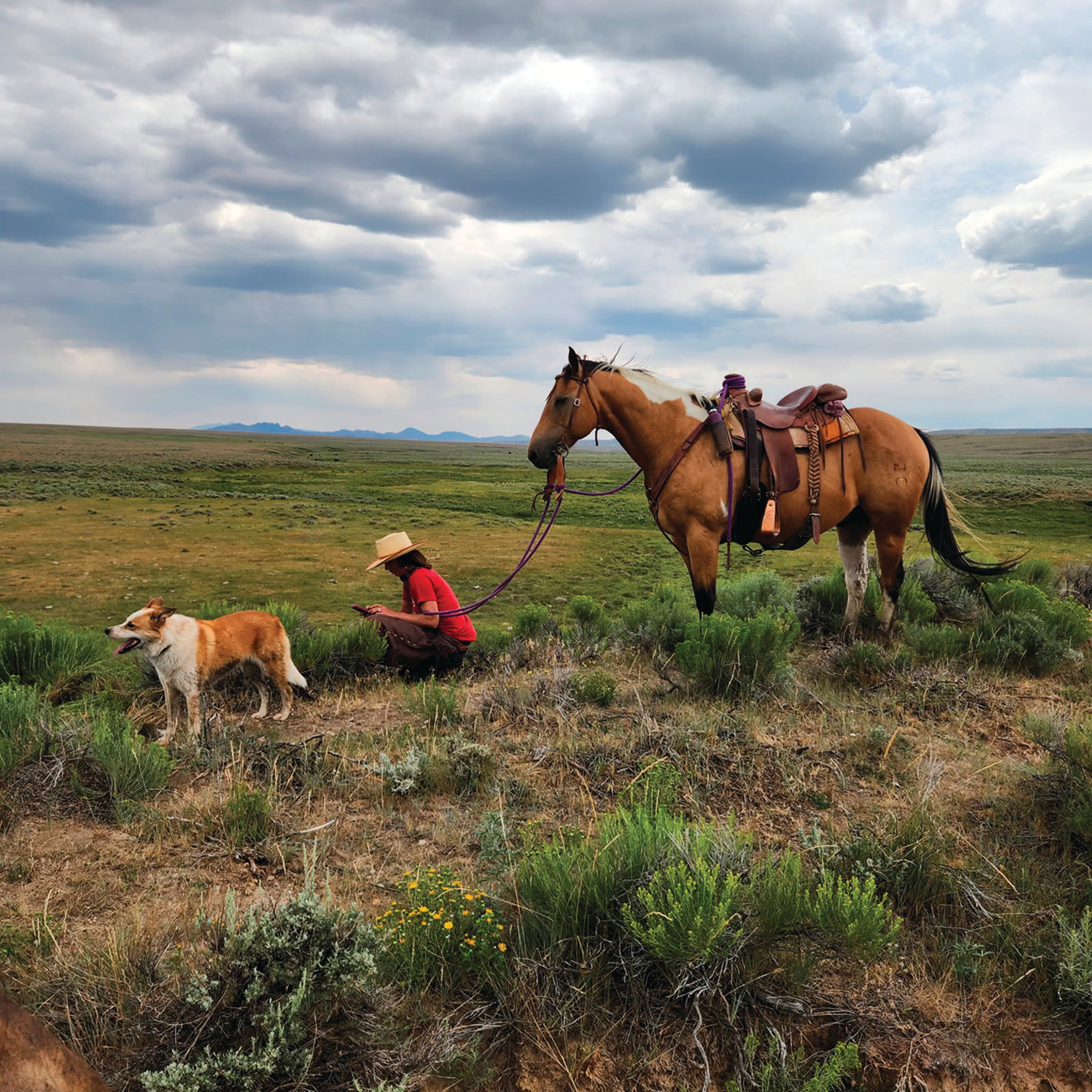
Willow Bish, Casper Region terrestrial habitat biologist, works on cheatgrass mapping in the Shirley Basin. (Photo by WGFD).
Support for law enforcement and wildlife management
Game wardens are tasked with upholding wildlife laws and protecting the state's natural resources. Horses enable them to navigate the landscape within their warden districts throughout spring, summer and fall.
"While many of us would happily ride every day in the summer, our wide-ranging duties require us to balance work between the frontcountry and the backcountry,” said Jacob Miller, north Pinedale game warden. Miller’s primary use of horses is to check backcountry hunters and anglers in the summer and fall, but they are also used for other tasks such as checking bear baits, recovering dropped collars from wildlife, investigating wildlife mortalities, packing in gear for fish crews and conducting wildlife surveys.
Horses also allow wardens to transport necessary equipment and resources into the backcountry, enabling longer and more effective patrols. They facilitate a faster response time and the transport of necessary gear for a thorough investigation. Miller believes the public values seeing game wardens on horseback, particularly when patrolling hard-to-reach areas.
"One memorable instance involved checking a drift boat from horseback in the middle of a river," Miller said. "The anglers were genuinely thrilled, commenting on how unique it was to have their fishing licenses inspected in that manner."
The continued use of horses by Game and Fish employees reflects Wyoming's cultural heritage and long-standing tradition.
"The romance of working the backcountry on horseback is what initially drew me to this career," Miller said. "However, it's not without its challenges. Setting out on the trail means committing to facing all weather and obstacles — moments that can lead one to question life choices. Fortunately, by the time we return to the trailer, the discomforts are forgotten, and we immediately begin planning the next trip."
Monitoring wildlife populations is one of the most important tasks for wildlife biologists. In the winter, biologists often take to the sky, usually in a helicopter, to count and classify wildlife on winter ranges. While aerial surveying is a large part of their monitoring, extensive on-the-ground surveying throughout the rest of the year is also essential.
Biologists often spend days in remote areas retrieving radio collars that have dropped off animals, observing wildlife distribution or conducting research. Utilizing horses can greatly help conserve energy during these demanding field efforts, allowing staff to cover more ground and focus on their scientific objectives.
Unconventional tool
One overlooked advantage of horses is their usefulness in fisheries management. When we think about the equipment used by fisheries biologists, we picture boats and rafts. However, biologists like Diana Miller in Jackson have discovered horses can provide innovative solutions for various projects and research initiatives.
Miller and her team have used horses equipped with pack saddles and hard-sided panniers to transport thousands of fish to remote backcountry lakes. The horses have also enabled them to reach high mountain lakes, where they can assess fish stocked by helicopter and evaluate wild fish populations in mountain streams. While using horses to stock fish in remote areas is still commonly practiced today, alongside options like helicopters and stocking trucks, this method was essential in the early days. An 1895 fish commissioner’s report describes what sounds like an adventurous trip. It details how teams of horses pulling wagons were one of the most efficient methods for stocking fish and transporting them to hatcheries for rearing.
"After supervising the construction of the ponds and hatchery work, everything being in running order, I at once arranged for a trip to the lakes known as Ten Sleep, in Johnson County," the report stated. The trip required crossing the Bighorn Mountains via the Dome Lake wagon road, and the speaker noted they were the first to make the crossing with a team of horses. They had to dig through deep banks of snow and drive over "muddy and rough mountain roads," finally reaching the lake on July 6.
Once there, the speaker was "compelled to organize a pack train to convey the (empty) fish cans over an old game trail to the lakes, which were a mile from where we had to leave the wagon." Getting the fish back to the wagon meant packing them over snow banks "10 feet in depth." Because the lakes were deep, it was "impossible to seine the trout from them, but the men and myself took, with hook and line, 600 native mountain trout in two days’ fishing." Of this catch, 500 were loaded into cans and packed to the wagon. They were transported overland, through Buffalo and Sheridan, a distance of 150 miles to the hatchery, "with a loss of only 75 fish." The wagon travel time with the fish back to Sheridan took 3½ days.
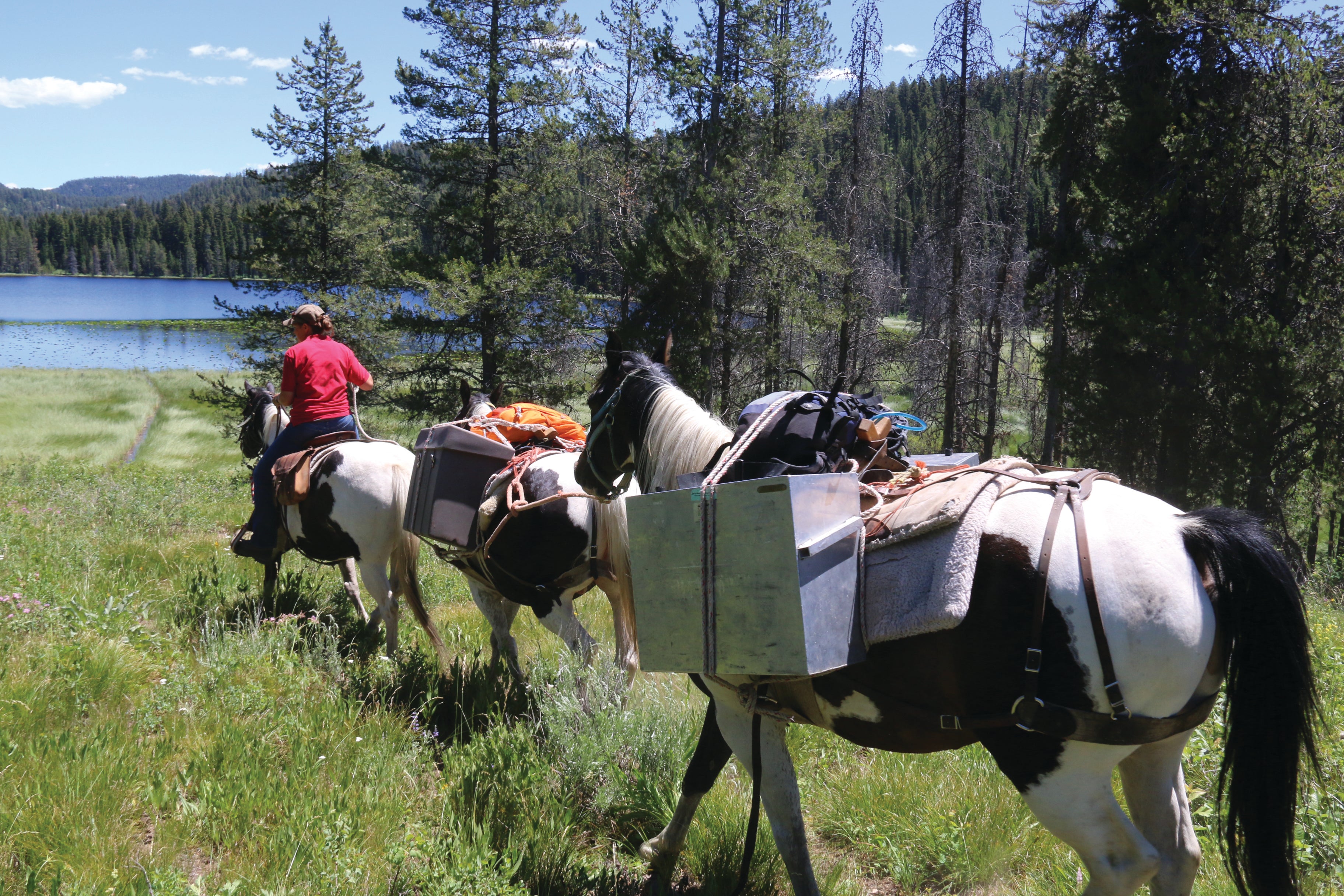
Game and Fish continues to use horses to haul fish to backcountry lakes for stocking. (Photo by WGFD).
Reliable winter work
Game and Fish has relied on horses for elk feeding since the program began in 1913. For more than 110 years, horses pulling sleighs have been the primary and most reliable method of distributing hay to elk on feedgrounds.
While modern equipment, such as snowmobiles, snowcats, tracked tractors and manual feeding by personnel on snowshoes, has been used, horses have historically handled the majority of the work. The main advantage of using horses is their reliability. They can work consistently every day. With the right personnel, hay can be delivered to the elk during challenging conditions or when mechanical equipment fails in extreme cold.
The primary drawback is horses have limitations in deep snow. Heavy, fresh snowfalls can reduce the size of feeding areas, and reestablishing these areas takes time. However, the goal of feeding the elk seven days a week throughout the season is always met. A spare horse is kept on hand in case a working horse becomes ill or injured, ensuring that operations never stop.
Several factors are considered when selecting horses for the feeding program. A good temperament is essential as the horses are handled daily. Elk feeders, who sometimes work alone, need a trustworthy team. Younger horses are preferred and integrated into the program, allowing them to be trained to meet the department's standards and ensuring years of service. Each horse has its own personality and speed, so assembling a compatible team that works well together and pulls consistently under pressure is highly valued. A reliable feed team is a tremendous asset to an elk feeder, especially in the remote, solitary locations where they often work.
"A typical day involves catching, feeding, brushing and harnessing the horses, which are usually hitched as a team of two but sometimes three or four,” Hyde said. “They are driven to a stackyard where they are loaded with one to two tons of hay. The team drives along feeding lines on the feedground while the hay is thrown off the sleigh. Depending on the number of elk, two or three trips back to the stackyard may be necessary. After feeding is complete, if the horses have the energy, they may break a new feed line with an empty sleigh on the way back. Finally, the horses are unharnessed, returned to the corral, fed, watered and given time to rest."
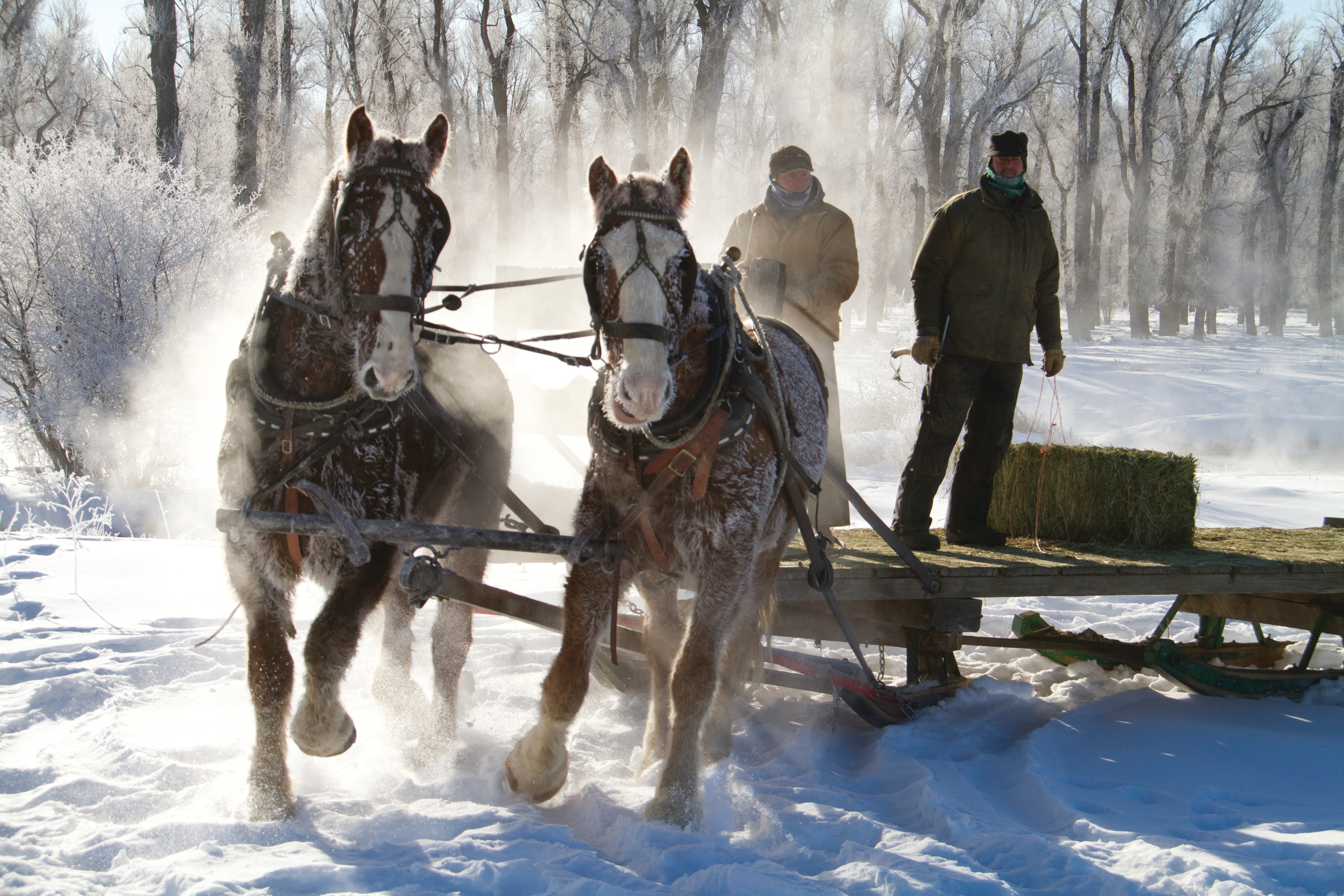
Horses have been used to assist in feeding elk on feedgrounds for more than 110 years in Wyoming. (Photo by WGFD).
Using horses in the modern era
Despite the advancement of technology, horses continue to be an invaluable resource for Game and Fish employees. From the annual horsemanship training in Meeteetse to daily fieldwork throughout the state, these animals play a crucial role in wildlife management. In every aspect of the department's work, horses assist managers in conserving and managing the state's wildlife resources for future generations while honoring the heritage of the West.
And to all Game and Fish employees who prefer the sure-footed practicality and distinctive charm of a mule, their contribution is equally valued, even if your equine partner has slightly longer ears.
— Raegin Akhtar is the information and education specialist for the Wyoming Game and Fish Department in the Jackson and Pinedale regions.