Wildlife managers in the Sheridan Region are conducting two mule deer management projects in January 2026 involving low-level aircraft flights that may be visible to the public in areas along the eastern and western foothills of the Bighorn Mountains.
Aerial captures of mule deer will take place in mid-January as part of the statewide Mule Deer Monitoring Project. The project is collecting data on five focal mule deer herds around Wyoming, including the North Bighorn deer herd that encompasses Deer Hunt Areas 24, 25, 27, 28 and 50-53. Current capture dates are Jan. 17-22, though dates may shift due to daily weather conditions.
This is the fourth year of the five-year project that seeks answers as to why mule deer have declined in recent years and identify potential solutions. Final captures will take place in early 2027.
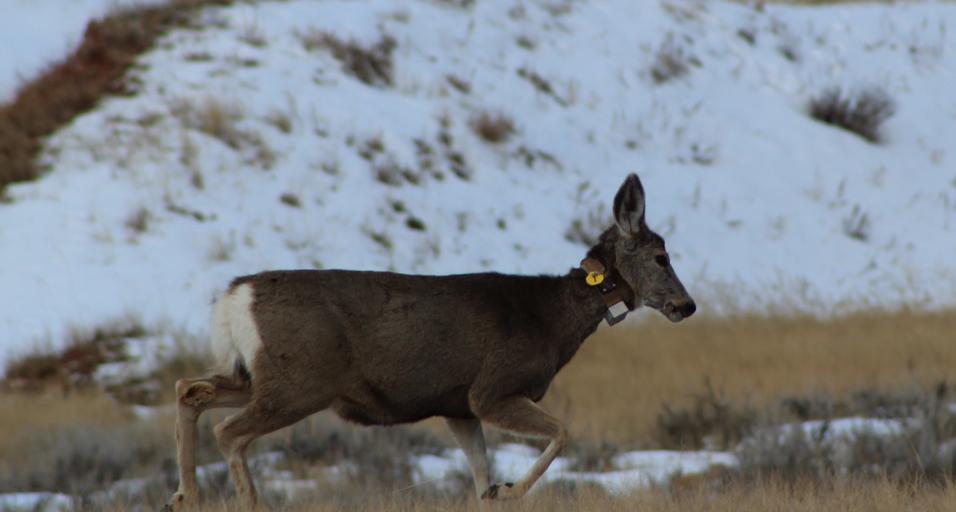
In the Sheridan Region, captures will happen over several days on public and private land from the Montana-Wyoming state line to south of Buffalo. Captures will also take place in the Cody Region, along the northwestern foothills. Animals will be netted from a helicopter by a professional wildlife capture crew, have blood drawn and be fitted with a GPS collar at the capture site and released. The collars will collect and store a location every two hours, resulting in thousands of data points per collar that will be downloaded and analyzed when the collar is retrieved.
The goal is to start each year with collars on 30 bucks, 80 does and 100 juveniles (6-month old). January’s captures will replace several collars of adult animals that have died in the past year and place collars on 100 juveniles.
Collars on adults are programmed to drop off in 2028. Collars placed on juveniles are programmed to drop off in early 2027.
Data gathered from the project will help wildlife managers better understand herd performance, causes of mortality, harvest strategies, and update seasonal range maps.
Also in January, Game and Fish wildlife managers will complete a sightability survey of mule deer in the Upper Powder River Herd Unit, which encompasses Deer Hunt Areas 30, 32, 33, 163 and 169 on the west side of Interstate 25 south of Buffalo. The survey will involve multiple flights between Jan. 12-20, though dates may shift due to daily weather conditions.
Sightability surveys are an intensive, aerial monitoring effort designed to provide a more accurate total number of animals than traditional ground surveys. When combined with classification and harvest data, these surveys can improve annual population estimates.
Survey areas are selected randomly and flown with two observers and a pilot. Observers record habitat type, percentage of snow cover, and overall behavior and number of each group of deer. Those details help wildlife managers estimate how many deer may be missed in the count and give a more accurate final population estimate.
The Upper Powder River Herd has been below management objective for several years. Primary mortality factors documented from collared deer in recent years include vehicle collisions, disease, and malnutrition likely related to deteriorated habitat and extended drought.
When the Upper Powder River herd survey is complete, all mule deer herd units in the Sheridan Region will have undergone this type of survey in the past four years. Along with harvest data, landowner and hunter comments and composition surveys, results from the sightability survey will be used to develop 2026 hunting season proposals.