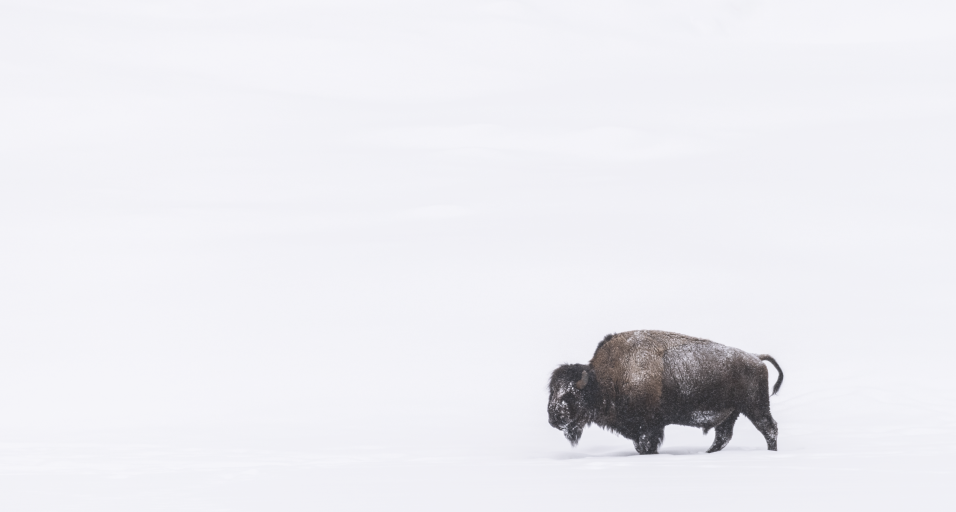
Winter in Wyoming can be a lot of things — long, cold, windy, quiet, desolate. But it also can be a combination of beautiful and brutal when it comes to the overall scene and wildlife.
Many animals put in a lot of work throughout the year to survive the winter. Food isn’t as plentiful and available as other parts of the year, so wildlife, big and small, do their best Boy Scout impressions to get prepared.
While Wyoming’s scenery and open spaces are often breathtaking when there’s no snow, they can be equally eye-catching when there is a blanket of the white stuff on the ground.
The 13 photos selected for this photo essay came from nearly 100 submitted by Wyoming Game and Fish Department employees. Narrowing them down to 13 was difficult, but enjoyable. A special thank you to all the Game and Fish employees who participated in this endeavor.
BISON IN SNOW
By Clare Ryan, contract employee, Lander
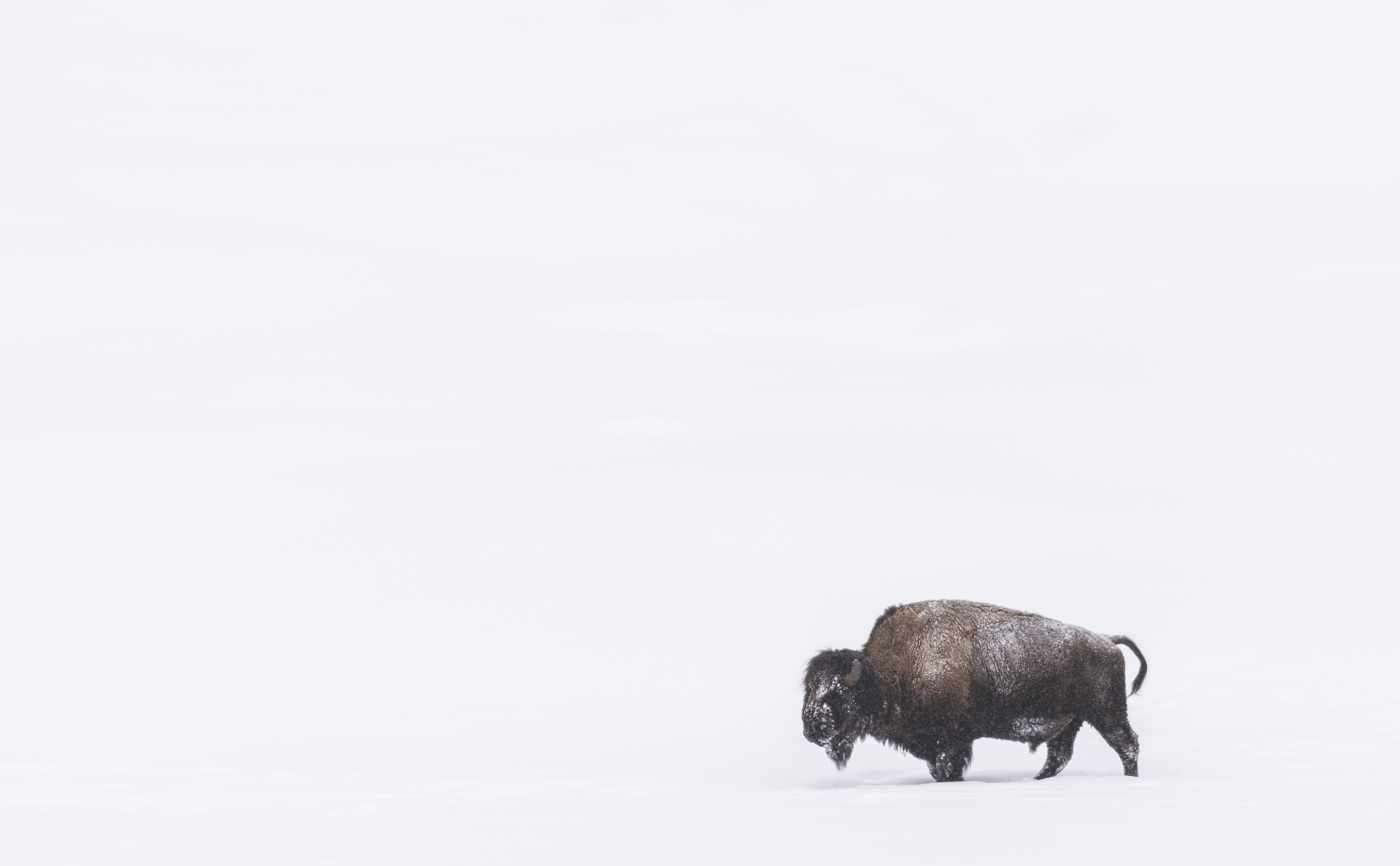
In February, I came across this lone bull bison traveling through the Lamar Valley in a snowstorm. It was 8 degrees below zero, and snow had started accumulating on his face and back, but he was unbothered. A bison’s large body and thick fur coat allow it to survive frigid winter temperatures. Snow may cover their outer guard hairs, making them look cold, but their soft, inner wool keeps cold air away from the skin. This bull was warmer than I was standing alone on the side of the road. I watched him move toward the trees in the heavy quiet that comes with falling snow. In the great expanse of the valley, the white-out conditions made me feel like the bison and I were alone in the world. My previous winter trips into Yellowstone National Park fell during unseasonably warm stretches with little snow in the valley, so I was excited to get the opportunity to photograph snowy bison this year.
BUCK WHITE-TAILED DEER
By Craig Swanson, habitat access biologist, Cody
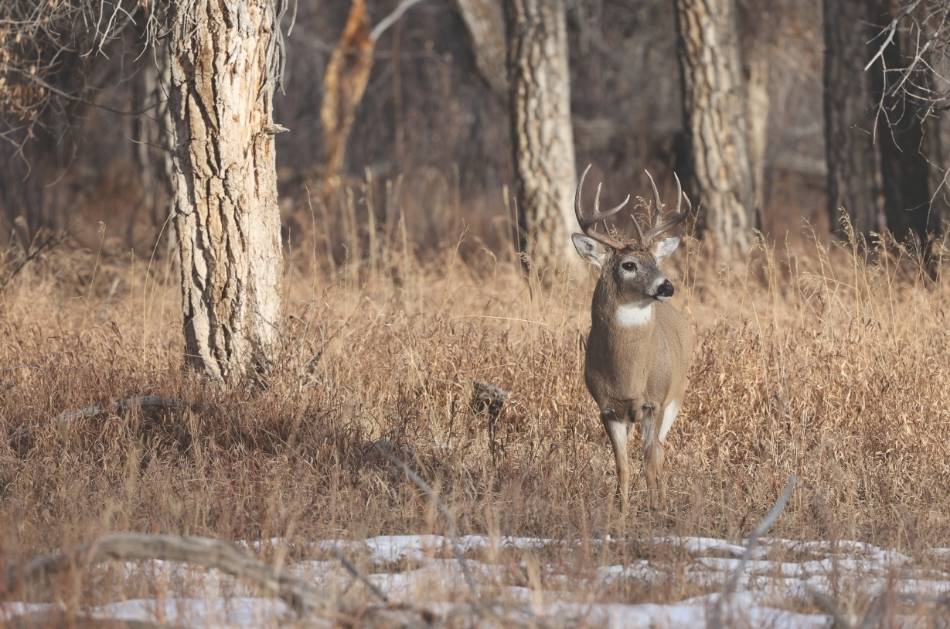
I was hunting white-tailed does, and the first spot didn’t pan out. I was going to another area when I spotted this buck. He was more concerned about another smaller buck with a busted rack 80 yards away than me taking pictures. They kept an eye on each other for several minutes before each went its own way. I took more photos than I thought I would during the trip.
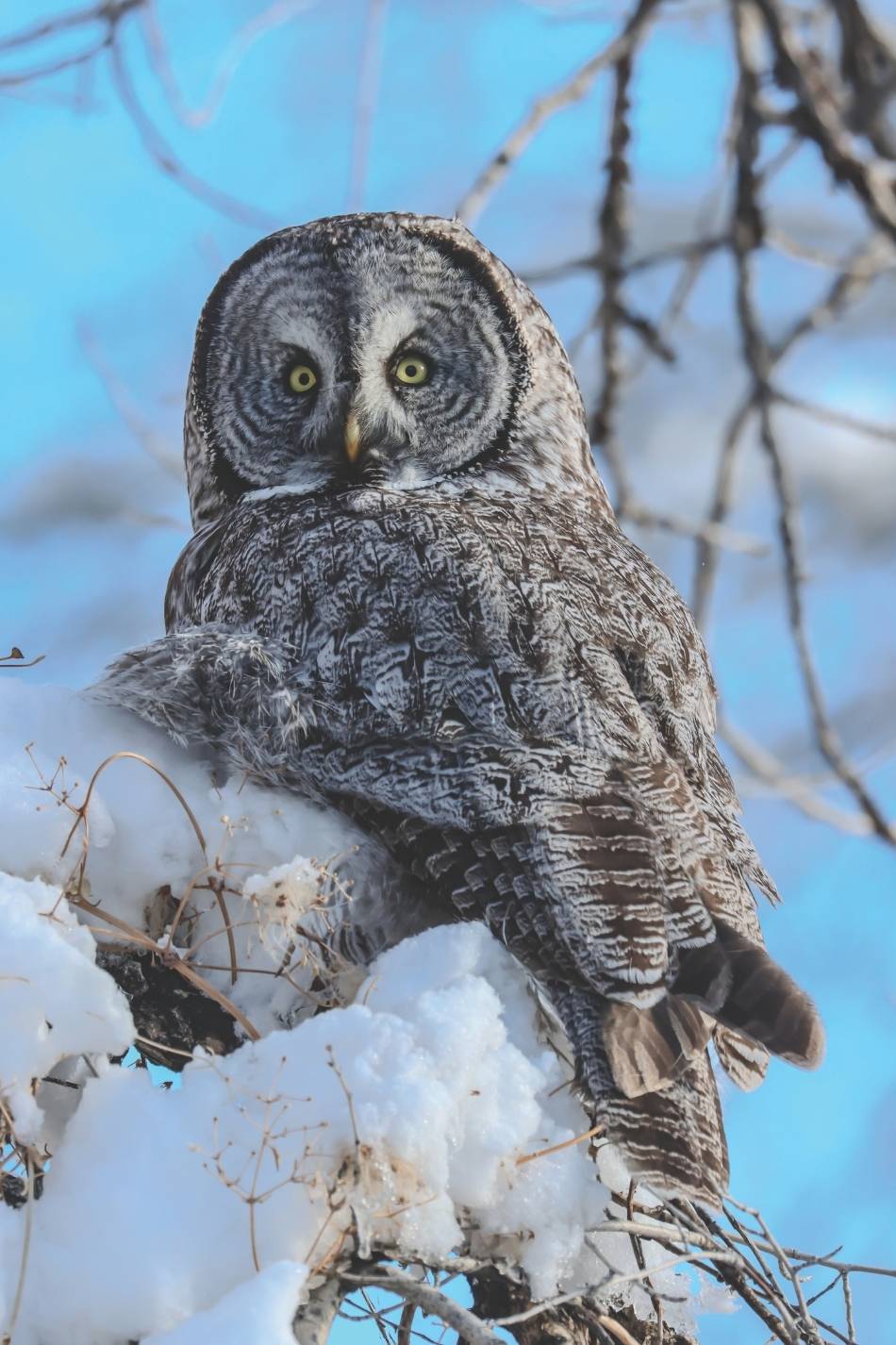
GREAT GRAY OWL
By Amy Anderson, regional habitat biologist, Lander
When a friend calls and says, “There's a great gray owl at the park,” it doesn't matter what the weather is like outside; I’m going to check it out. In this case, it was a blizzard with a foot of snow on the ground. I put on my muck boots and mittens and headed out with camera and binoculars in tow. What a thrill it was to spend a couple of hours watching this gorgeous owl. It spent time preening, sleeping and quietly observing the dog walkers and joggers that passed by, most of whom were none the wiser to the presence of greatness. Luckily, the clouds lifted long enough for blue skies to poke through so I could grab this beautiful shot of an amazing owl.
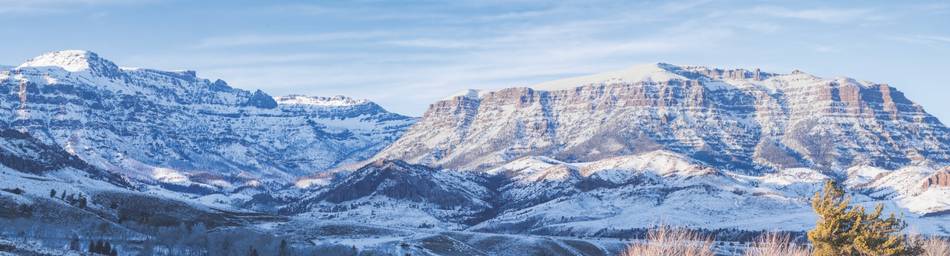
JIM MOUNTAIN
By Mark Nelson, chief of policy and planning, Cheyenne
The sun was setting fast over Jim Mountain in the Absaroka Range west of Cody. I quickly set up my tripod and managed to capture the golden light on the steep crags contrasted by long shadows over the range. The snow took on that blue hue so familiar on a winter’s evening. Always curious about the history of areas I photograph, I learned that Jim Mountain was named after fur trapper Jim Baker. He traveled throughout the West and is probably best known for the battle he engaged in against the Arapaho, Cheyenne and Sioux near Savery along the border between Colorado and Wyoming. It was said 23 trappers fought against 500 in the battle that lasted up to six days. Interestingly, not only does a mountain bear his name, he had a big role in the naming of another peak — Battle Mountain — where that clash occurred. Baker had high praise from his fellow mountain men. He was regarded as an expert shot with a gun and a bow and was skilled with the lariat.
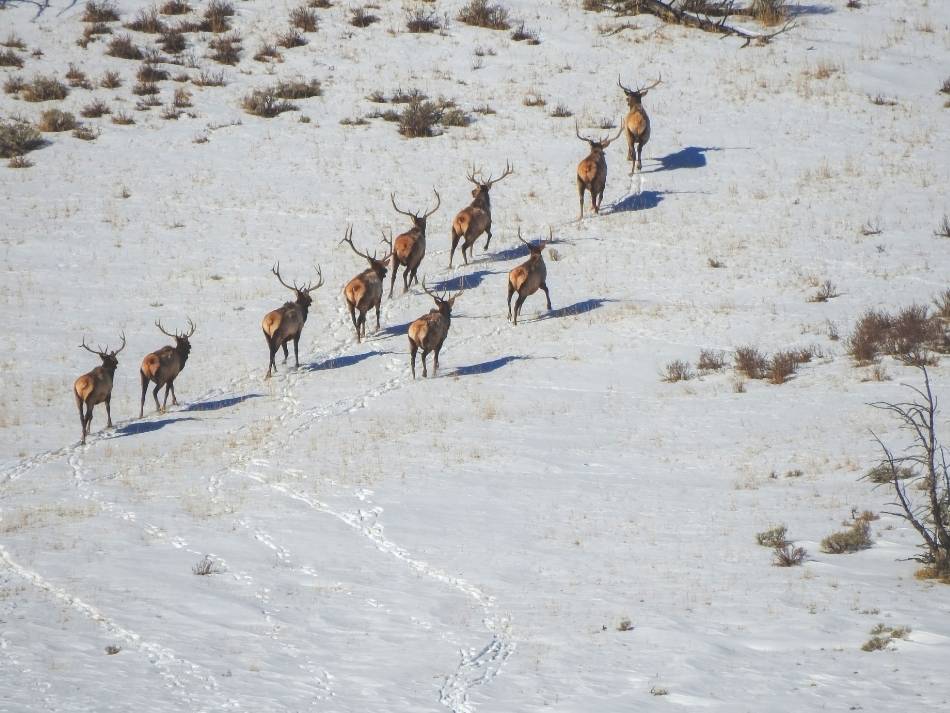
BACHELOR BULLS
By Craig Swanson, habitat access biologist, Cody
This photo was taken nine days before I had a total hip replacement. I was headed to tear out old, interior fences. There is a spot I go to glass to make sure I don’t bump any elk. These bulls were on the boundary of one of the Wyoming Game and Fish Department’s wildlife habitat management areas. It had been several years since I saw a bachelor group of bulls in this area. It used to be somewhat common, so this was a real treat. They were moving up a ridge when I spotted them. This was the only photograph I got with all the bulls in the frame. The rest of the time, they were spread out.
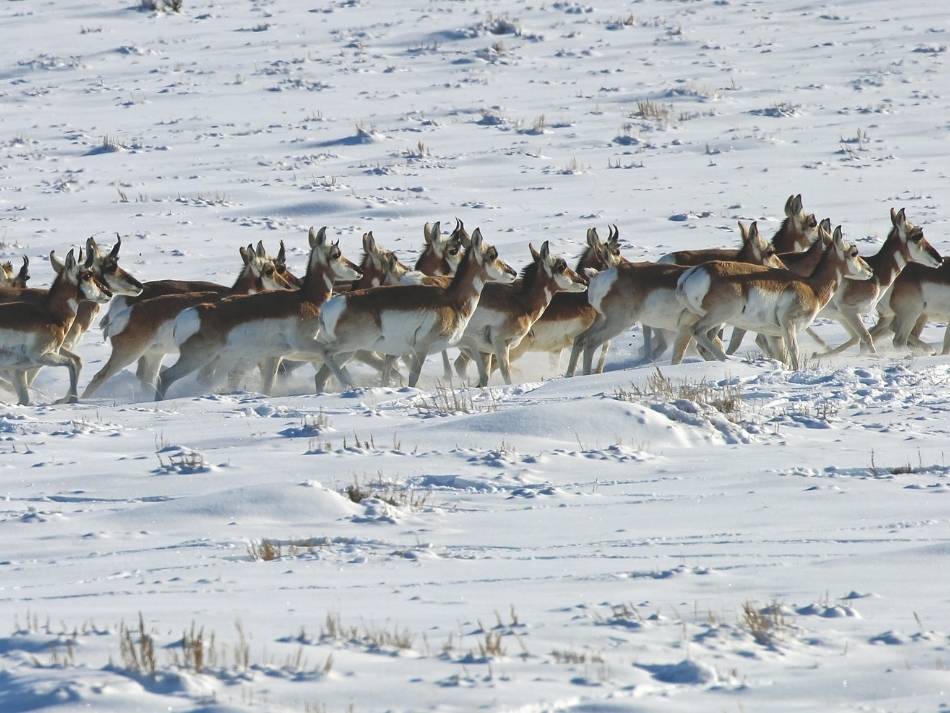
PRONGHORN
By Justin Binfet, deputy chief of wildlife, Casper
This picture was taken at Bates Hole south of Casper during the winter of 2019-20 — a hard winter in the area and other parts of Wyoming. Bates Hole has the highest density of wintering pronghorn in North America as it is protected from wind, and snow usually doesn’t get too deep. However, there was more snow than normal at this time. In fact, some multi-generational ranchers in the area said this was the most snow they’ve seen in Bates Hole. I was working in the area and came upon this big group. They ran in front of the truck, so I gave them plenty of room to cross so as not to stress them. It was evident they were struggling in the crusted snow.
SNOW GEESE
By Grant Frost, senior wildlife biologist, Cheyenne
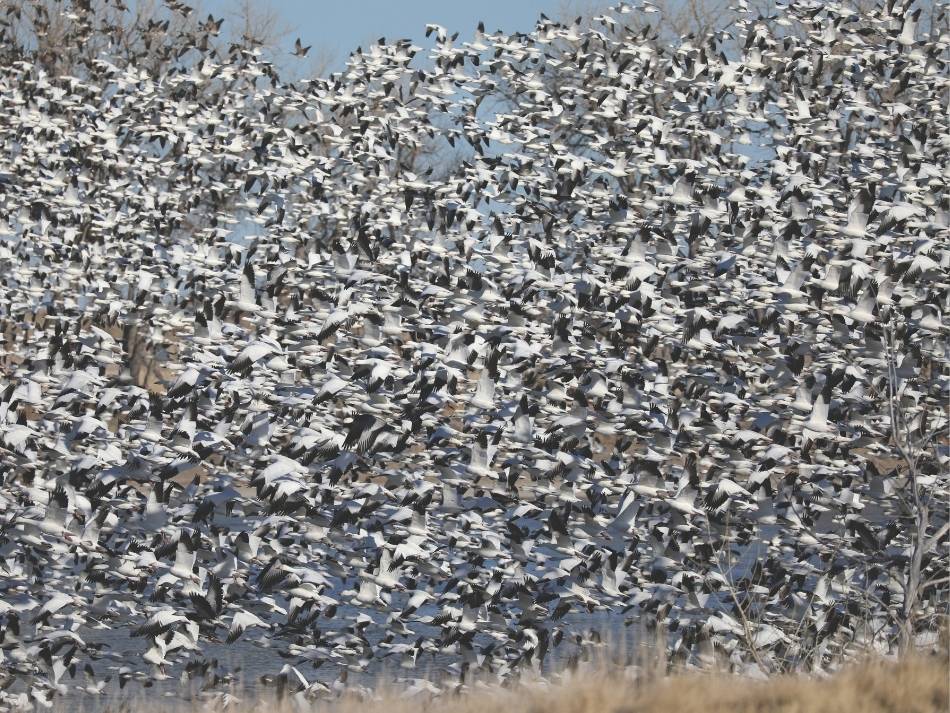
Goshen County in eastern Wyoming has become quite the location for impressive gatherings of birds. In March, thousands of Sandhill cranes roost at night at the Table Mountain Wildlife Habitat Management Area. But earlier, sometime in February, the snow geese begin to arrive at nearby Goshen Hole Reservoir at Springer WHMA. Although not as large a gathering of geese as some other places in the country, upward of 30,000 of any kind of creature in one place is an impressive sight. If they are settled on the reservoir, it’s just this large, white blob of birds, and it’s hard to judge the numbers, but it’s fairly quiet. However, any kind of disturbance, such as a bald eagle flying nearby, can unnerve them and they take flight. When they take off en masse, it’s a real sensory experience. You hear a change from a few geese honking to a near-hushed sound as thousands of wings push the birds into the air. This doesn’t last long because once in the air, they all start honking again and it becomes almost deafening. If the eagle flies on, they will slowly circle and start to settle back on the lake. This can be repeated over and over again. During this time of year, roads that get close to the reservoir are closed, but the unit is open and it’s only a short hike to get to it. Different times of day can offer different experiences, from seeing all the birds together, like in this picture, to seeing wave after wave after endless wave of geese returning after feeding in nearby fields.
EAGLE AND MAGPIE
By Spencer Carstens, regional access coordinator, Cody
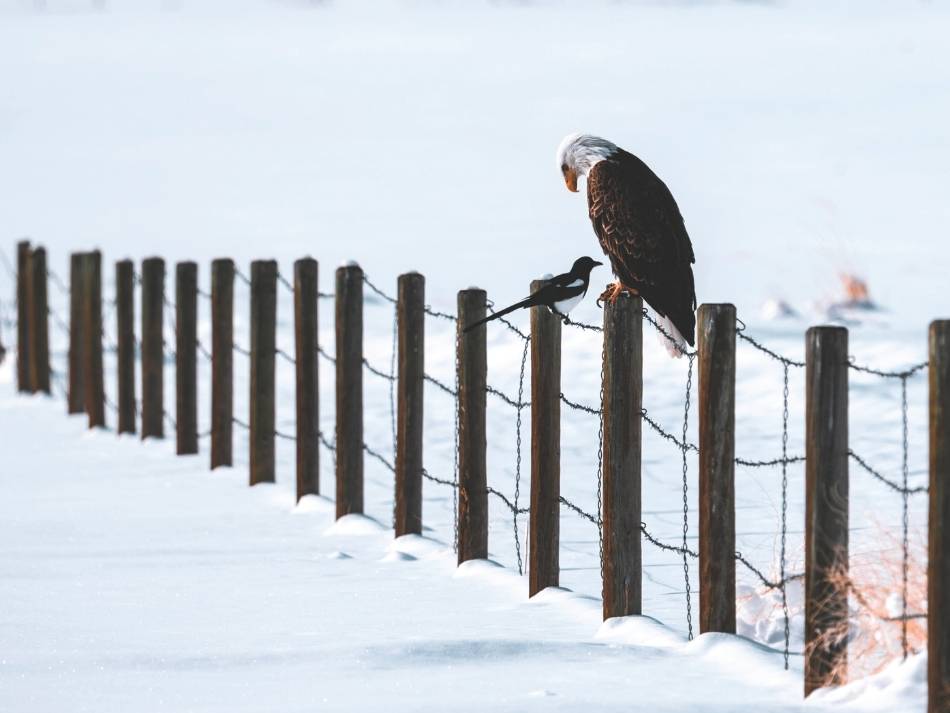
I captured this photo on the South Fork of the Shoshone River near Cody. It was a cold, January morning and this bald eagle was perched on a fence near the river, which was the only open water around. I have found open bodies of water are a great place to find eagles in the winter when other food sources are scarce and most of the other birds have left for the winter. The magpie in the photo kept flying around, pestering the eagle. All the eagle did in response was look down on it.
HUNTING AT GLENDO
By Molly Bredehoft, tooth aging coordinator, Laramie
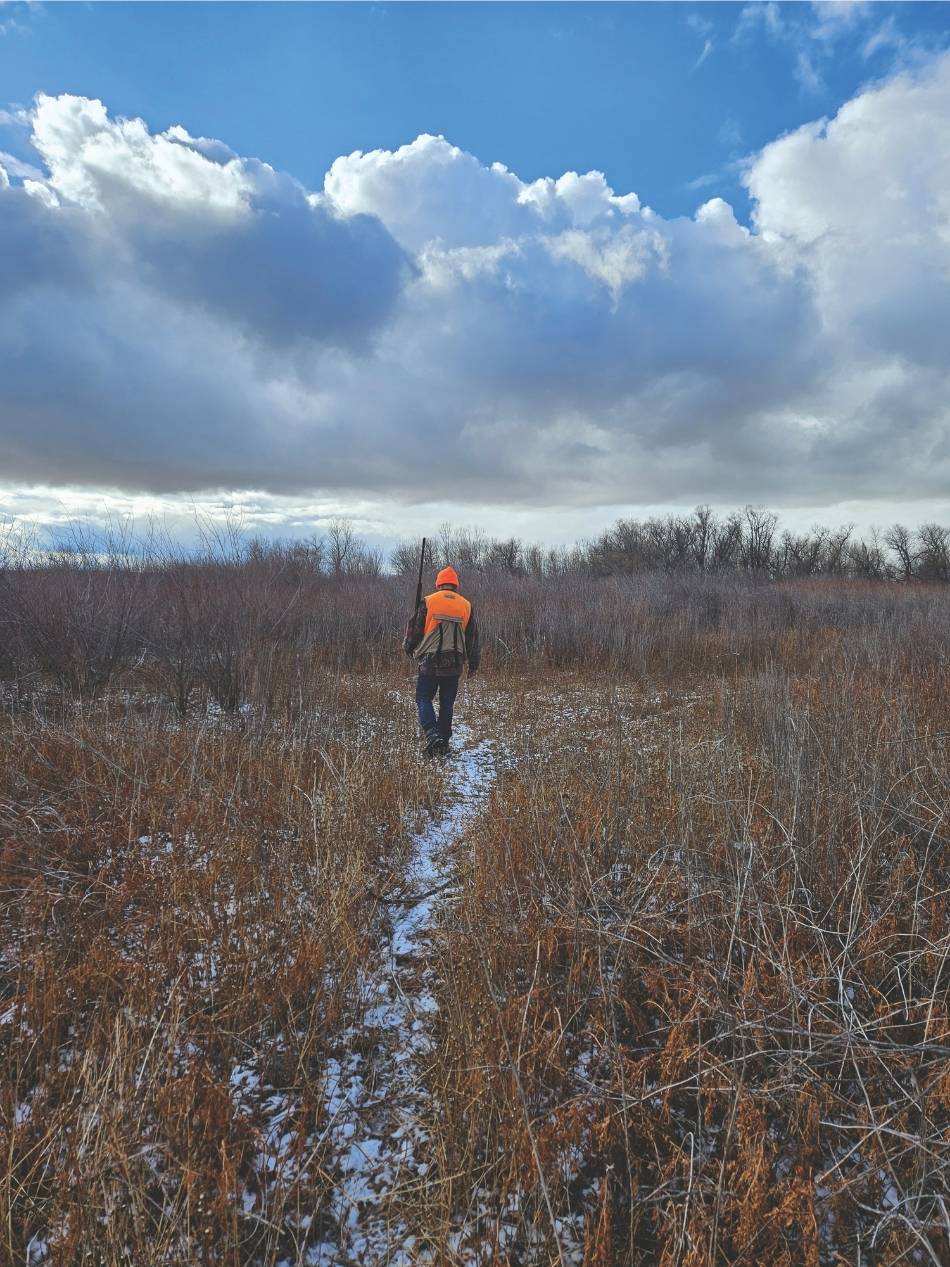
On a cold, December day my husband, Ray, and I went pheasant hunting at Glendo State Park. Finding time to get out and enjoy the activities we love is always a challenge with busy work and family schedules, not to mention finding a day for just the two of us to be together. Despite the icy wind and stormy skies, we hunted through the brush, fallen leaves and dried grass. We walked several miles through snow showers and gusts of wind, but despite the weather, we let our worries dissolve with each step. Luckily, the dusting of snow played to our advantage. We followed some tracks and had a successful day. I enjoy this photo as it shows how the quiet of winter is beginning to take over the landscape, settling everything in to await the much-anticipated spring.
HAIRY WOODPECKER
By Mark Nelson, chief of policy and planning, Cheyenne
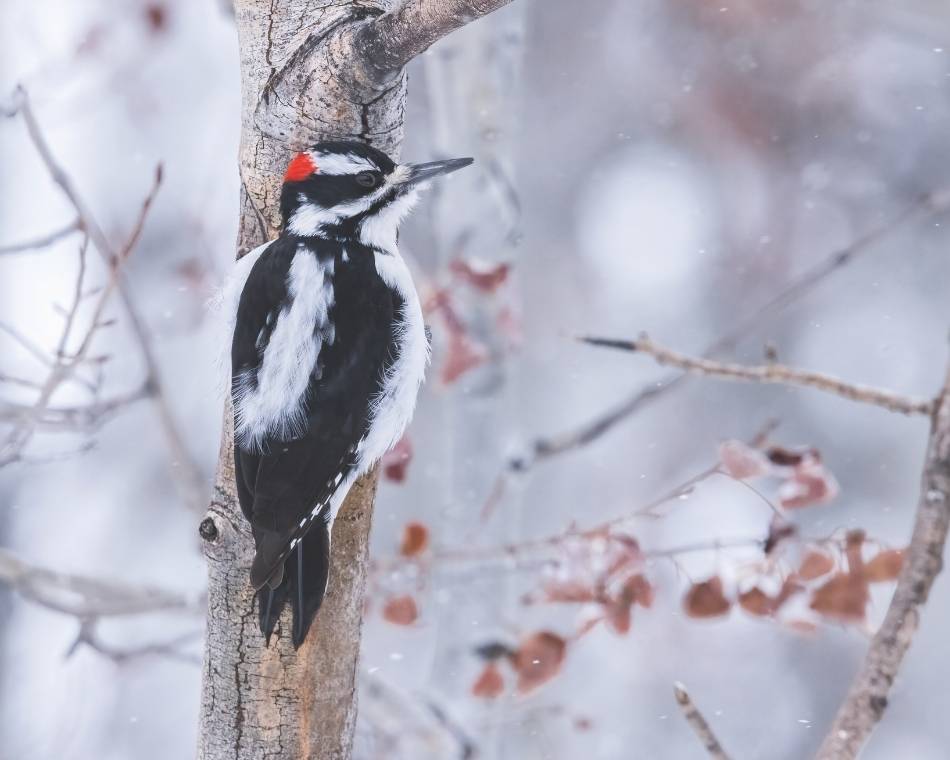
I took this image when, oddly enough, the snow was falling straight down outside Cheyenne. The snow muted the sounds of the occasional mountain chickadee and red-breasted nuthatch, but the hairy woodpecker’s drumming on an old snag came through clearly. A moment later, the male woodpecker alighted on a dead aspen nearby. I loved how the bright-red cap on the back of his head, exclusive to males, contrasted with the soft, winter background. After a couple of taps with his thick bill against the dead bark, he flew to another aspen and began a quick start-and-stop journey up the trunk. The genus name of the hairy woodpecker, Dryobates, derived from the Greek as “woodland walker,” aptly describes this bird’s foraging behavior. My bird book tells me the hairy woodpecker is the most common woodpecker in North America. The only place not colored blue depicting its year-round range in the bird guide is in far northern Canada and Alaska. A narrow swath of its range extends to the middle of Central America.
WINTER FISHING
By Ray Bredehoft, deputy chief of services, Cheyenne
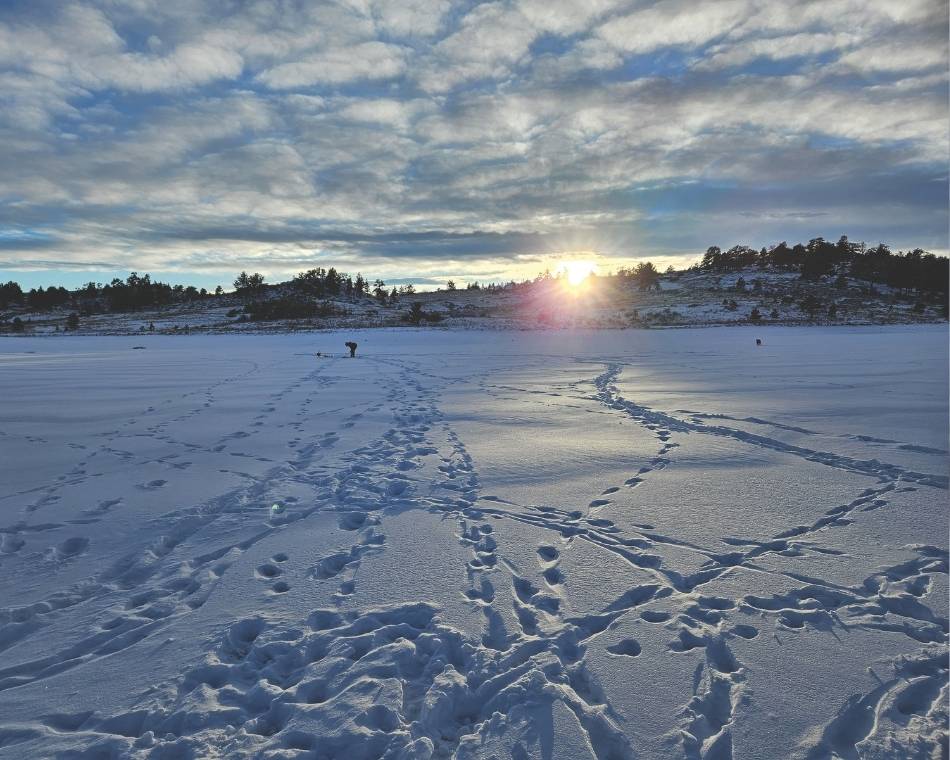
My son loves to fish during every season of the year. In this photo, we were ice fishing at North Crow Reservoir, one of his favorite places. Earlier that day, he came home from school and convinced me that there was enough time before sunset to go fish. As we made our way across the ice, I wasn’t sure who was more excited, him or our Labrador, Sadie. It turns out it was an excellent time to fish as we were the only ones on the ice. While I enjoyed the peace and quiet, my son enjoyed pulling one fish after another through the ice. As the sun began to set it was hard to convince my son and Sadie it was time to go. “We’ve got enough time for one more, dad,” my son said convincingly. And sure enough, we did.
MUSKRAT
By Amy Anderson, regional habitat biologist, Lander
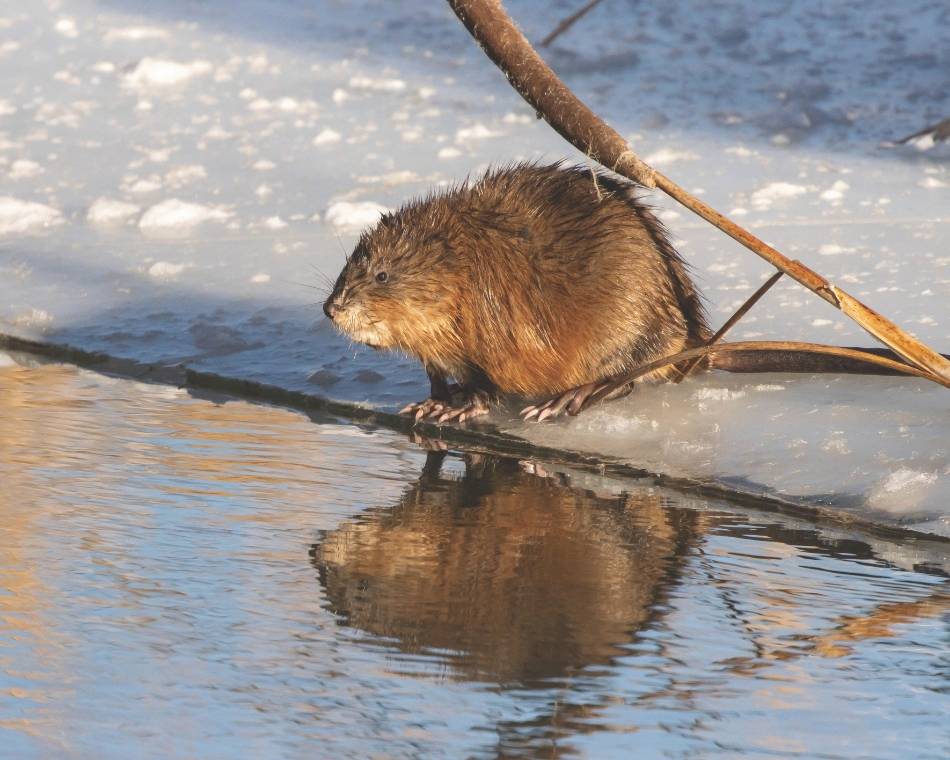
Winter is hard for me sometimes, and I don't think I'm alone. So, when those gorgeous, sunny days happen, when the wind isn't howling and the temperature actually rises enough where your nostrils don't freeze together, everyone steps out for a breath of fresh air. One of my go-to places for a winter outing is Ocean Lake Wildlife Habitat Management Area near Riverton. On this particular day, I happened upon a cute, furry muskrat when it popped up on the ice from one of the ponds. I love photos of wildlife that highlight habitat, and even better when there is a perfect reflection of the animal on the water. Muskrats are active throughout the winter, and often pop up through openings in the ice to forage. I was lucky to find a muskrat getting some fresh air in the same place I was doing the exact same thing.
MOUNTAIN LION
By Justin Binfet, deputy chief of wildlife, Casper
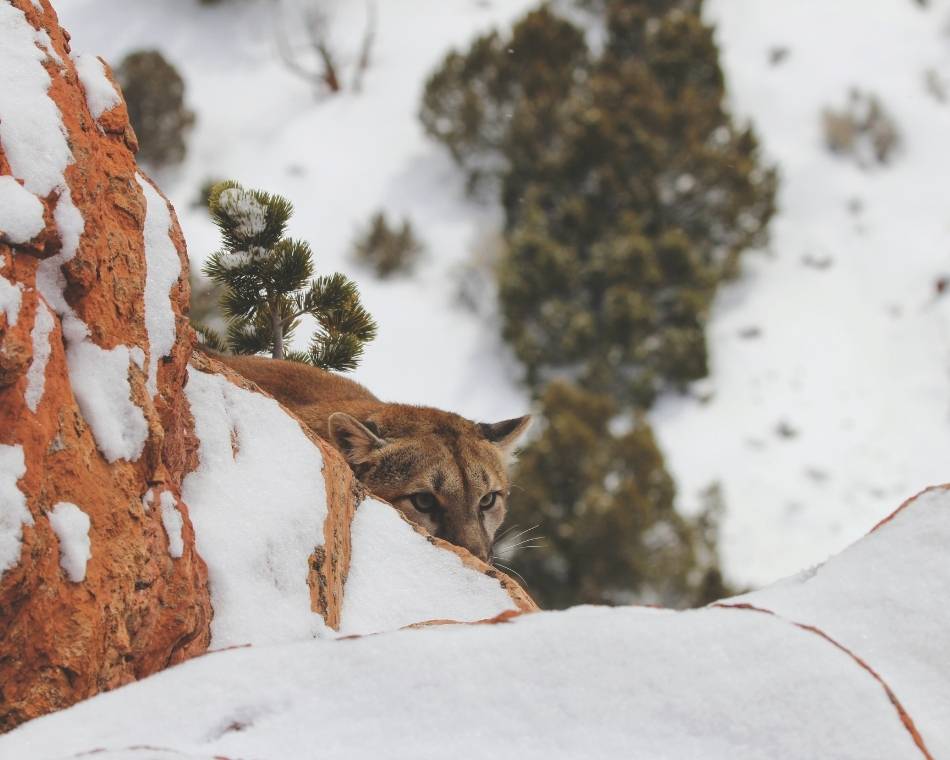
This 2-year-old female was at Bates Hole south of Casper in the winter of 2019-20, which was the first year of a four-year collaring study on mountain lions. The goal was to collar lions and track their movements. The lion was on a ledge about 100 feet tall, so we didn’t attempt to collar it from that location due to potential dangers to the animal. The lion eventually moved to a safer place in some trees, and personnel were able to get a tranquilizing dart in it and collar it. This particular lion had probably been away from her mother for 3-6 months. Data from the collar indicated it moved on to the Pole Mountain/Happy Jack area between Laramie and Cheyenne.