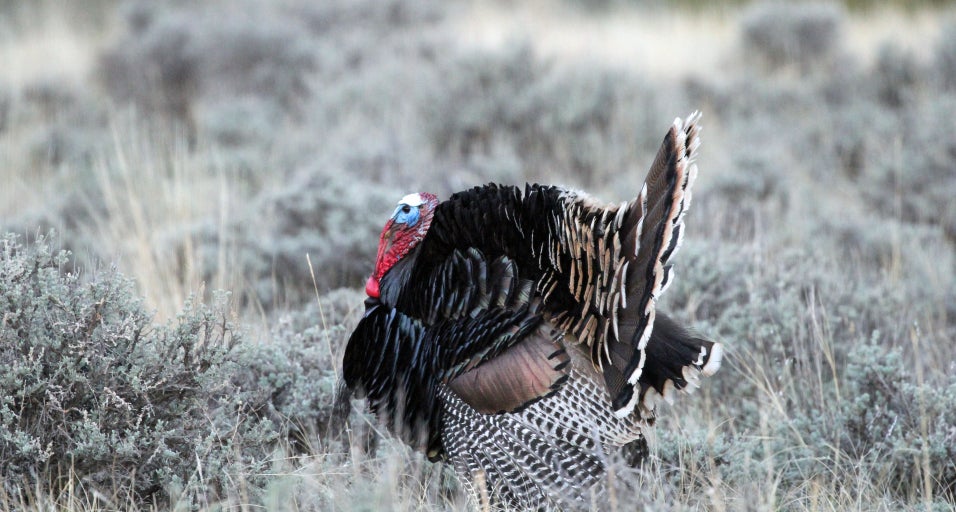
CHEYENNE — Wild turkey hunting season is open throughout the state. With fall and spring seasons to chase turkeys, hunters’ stealthy pursuits provide excellent food for their families and mementos of feathers, beards and spurs to commemorate the hunt long after.
Brandon Werner, Wyoming Game and Fish Department Casper Region wildlife management coordinator and chair of the department’s wild turkey working group, suggests hunters work on a stealthy pursuit at middle to lower elevations as the season moves from fall to early winter. “Wild turkeys often migrate in Wyoming from the mountains and foothills to lower elevations to winter along agricultural fields, creeks and river bottoms,” he said.
Werner added a useful hunting tactic is to find roost trees and feeding locations. Wild turkeys can be patterned traveling back and forth between the two. Hunters can set up between the roosting and feeding areas while wearing camo and sitting very still. A different tactic is scaring a flock of wild turkeys so they break into smaller bunches or use a dog to break up the flock. These are often family groups and can be called in using a gathering or comeback call called a keekee run, which takes some practice. Using decoys while calling can be effective as well. Doing this from a concealed location is an effective fall hunting technique that is used in many parts of the country.
In 2025, 2,488 hunters harvested 1,104 turkeys in Wyoming.
Cooking tips
Compared to domestic turkeys, wild turkeys have less fat and tend to be a little drier. Plucking a wild turkey instead of skinning it is more work but helps retain moisture and adds flavor, similar to chicken skin. A cooking bag also can help the bird retain its natural moisture. Another tip is to place bacon strips across the breast, covering with foil and removing the foil a few minutes before serving to brown the bird. Another technique is brining and smoking the bird. This helps retain moisture and compliments the wild flavor.
Thanksgiving guests will detect longer legs and a proportionally smaller, more angular breast and the fuller flavor over the commercial variety. The taste is primarily the result of a wild turkey's diet. In the spring it mostly eats grasses, forbs, seeds and insects. As summer rolls around its diet mostly consists of insects. In the fall and winter, its diet changes to more hard mast such as ponderosa pine seeds, burr oak, chokecherry, plums and currants, as well as seeds from agricultural fields and native grasses.
History
While turkeys are not native to Wyoming, Game and Fish and New Mexico Game and Fish traded sage-grouse for 15 Merriam’s turkeys in 1935. The turkeys were released on the George Waln Ranch on Cottonwood Creek in Platte County that spring and were reported to lure some of the ranch’s domestic turkeys with them into the Laramie Mountains. By 1947, Game and Fish estimated more than 1,000 turkeys. This population served as a seed source for many other wild turkey transplants around the state, and created the abundance and distribution of wild wild turkeys we have now.
Before heading out for your own turkey hunt, check out the Wyoming Game and Fish website to review the game bird and small game regulations.
-WGFD-