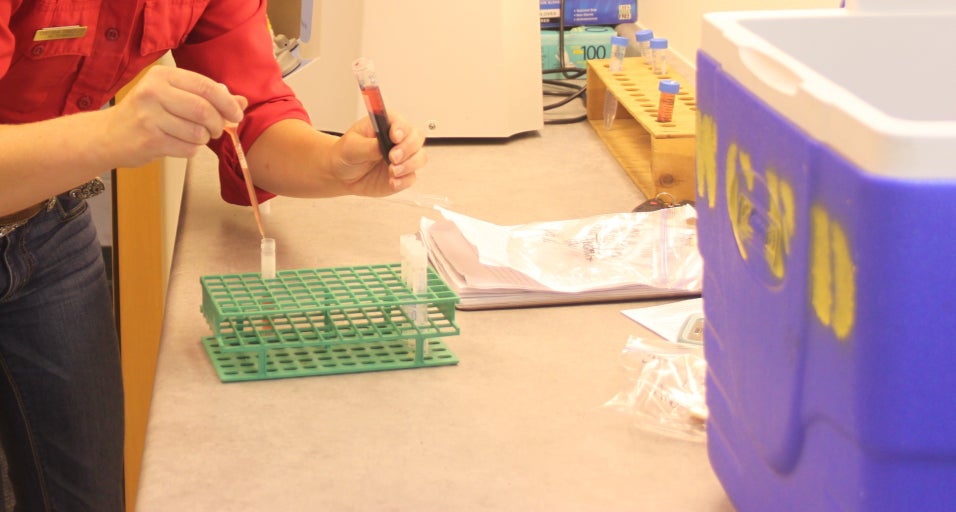
Hunters are an invaluable resource for the Wyoming Game and Fish Department’s efforts to collect biological samples for study and testing. With help from hunters, the Game and Fish Department monitors the distribution and prevalence of chronic wasting disease and brucellosis annually, to better understand how these diseases affect the health of Wyoming’s big game populations.
Chronic wasting disease monitoring
Chronic wasting disease (CWD) is a chronic, fatal disease of the central nervous system in mule deer, white-tailed deer, elk, and moose. CWD belongs to the group of rare diseases called transmissible spongiform encephalopathies (TSEs). These disorders are caused by abnormal proteins called “prions”. The disease has been detected in most deer and elk hunt areas in Wyoming.
Continued monitoring of CWD over time is important to help Game and Fish understand the potential impacts of the disease as well as evaluate management actions for deer and elk.
The surveillance regime focuses sampling efforts on specific deer and elk herds in each Department region on a five-year rotational basis. The goal is at least 200 testable samples from adult elk (both genders) and 200 testable samples from adult male deer harvested in each targeted herd. The 200-sample goal allows wildlife managers to determine a statistically-valid prevalence estimate at the 95 percent confidence level. The herd unit rotation is designed to obtain prevalence estimates for each herd unit approximately every five years to track trends over time.
Samples are collected during the fall hunting season through the cooperation of hunters who voluntarily allow Department personnel to collect lymph nodes from harvested animals at hunter check stations, meat processors, in the field or at regional Game and Fish offices. In recent years in some hunt areas of the state, a mandatory submission requirement has been implemented.
There are no mandatory submission hunt areas in the Sheridan Region in 2026, but the majority of hunt areas are focus areas for sampling, meaning Game and Fish personnel will contact hunters in the field, at game check stations and at meat processing facilities to request CWD samples from harvested animals from these hunt areas. Sampling takes just a few minutes and requires removing a set of lymph nodes from the neck of the animal. Participation is voluntary.
Sheridan Region focus deer hunt areas for 2026 are:
1, 3, 19, 21, 24, 25, 27-33, 163 and 169.
Sheridan Region focus elk hunt areas for 2026 are:
35-38.
Hunters who want their harvested animal tested, can bring the head of the animal to the Sheridan Regional Office during regular business hours. Hunters get the test results online through their account on the Game and Fish website usually within two weeks.
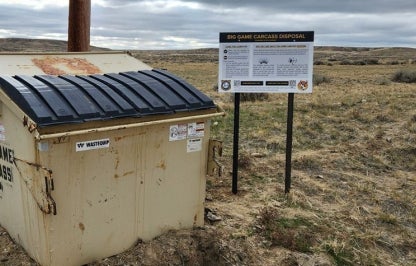
Hunters can quarter and freeze their animal until test results are available to save on meat processing costs in case the disease is detected in the harvested animal. If the disease is detected, the lab results can be used as a receipt to dispose of the carcass at an approved landfill without the disposal being considered waste of edible parts.
Animals infected with CWD can look healthy and in good condition. They usually do not show visible signs of the disease until the final few weeks of life. Therefore, a laboratory-tested sample is necessary to determine if the animal has the disease.
To date, there have been no cases of CWD in humans and no direct proof that humans can get CWD. However, animal studies suggest CWD poses a risk to some types of non-human primates, like monkeys, that eat meat from CWD-infected animals. These experimental studies raise the concern that CWD may pose a risk to humans and suggest that it is important to prevent exposures to CWD. The Centers for Disease Control and the World Health Organization recommend that CWD-infected animals not be consumed.
Brucellosis sampling
This fall elk hunters in select elk hunt areas are being asked to collect blood samples from their harvested animal to help in brucellosis surveillance efforts.
Brucellosis is a disease caused by the bacteria Brucella abortus. Elk, bison and domestic cattle are susceptible to brucellosis, which may cause animals to abort calves and further transmit the disease. Brucellosis has been shown to slightly reduce pregnancy rates, but not limit, elk populations. The primary management concern is the possible transmission of brucellosis from elk or bison to domestic cattle.
Elk hunt areas in the Bighorn Mountains are a focus for brucellosis sampling this year. In the Sheridan Region, elk hunt areas 33-38 are targeted. Additional hunt areas on the western side of the Bighorns, and other areas of the state, are also targeted for surveillance.
Hunters in targeted elk hunt areas for the 2026 season are asked to help in data collection by collecting a blood sample from their elk immediately after harvest with a Game and Fish sample kit, keeping it cool and submitting it soon-after harvest.
Sample kits will be mailed to hunters in the targeted elk hunt areas about two weeks prior to the opening date of that particular hunt area and license type. Not all hunters will receive a kit, making it particularly important for those hunters who do receive a kit and harvest an animal, to submit a sample.
Hunters are urged to wear latex/nitrile gloves while field dressing and collecting the sample. The sample should be kept cool and not allowed to freeze or spoil. Please fill out the requested information on the enclosed card and return the kit to a biologist or game warden in the field, at a check station, a Game and Fish regional office or drop the prepaid box with the sample in the mail.
Hunters who don’t harvest an elk this year should not mail back an empty kit but save the blood kit for a future hunt or return it unused to a Game and Fish office or field personnel.