CHEYENNE — The Wyoming Game and Fish Department and the Wyoming Department of Transportation are encouraging drivers to be extra vigilant in watching for wildlife on roadways as daylight saving time ends.
“District 4 maintainers have already seen a slight increase in the number of deer carcasses they have been collecting this year, notably at the higher elevations of U.S. Highway 14 and U.S. Highway 16,” said WYDOT District 4 Senior Public Relations Specialist Laura Dalles. “They have also noticed an increase during hunting seasons in the evening and night, and suspect the wildlife is becoming more nocturnal when foraging.”
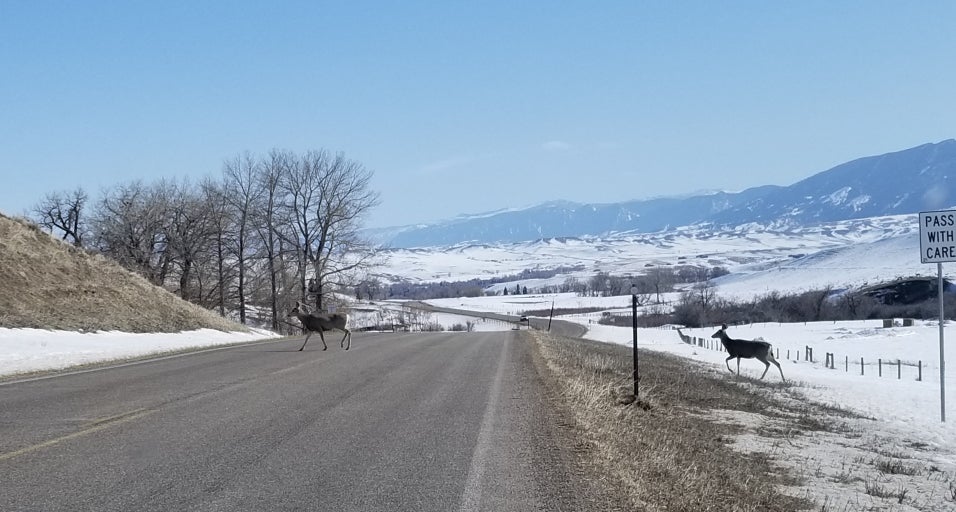
Each year, more than 7,600 wildlife collisions are documented on Wyoming roadways. Most of the collisions — 80-85% — involve mule deer. Collisions often result in significant property damage to vehicles, loss of wildlife and sometimes human injury. A recent report by the insurance company State Farm placed Wyoming in the top 15 states with the highest incidences of wildlife-vehicle collisions, with Wyoming drivers having a 1-in-94 chance of hitting an animal.
Most collisions happen during dawn and dusk hours when wildlife moves more frequently, and drivers are navigating low-light conditions that make it difficult to see deer or other wildlife at a distance.
“Deer are actively foraging to build up final fat reserves before heading into winter, as well as moving to different seasonal habitats as fall transitions to winter season,” said Game and Fish Big Game Migration Coordinator Jill Randall. “Both conditions can result in increases in collisions between motorists and deer.”
One of the most effective actions drivers can take to avoid wildlife collisions is driving at a reduced speed during morning and evening hours. Driving at lower speeds allow for increased reaction time. Drivers also are encouraged to help other travelers avoid wildlife collisions by flashing their headlights to warn oncoming traffic of wildlife in or along the road.
Drivers who collide with deer or other large wildlife on the road should call a local law enforcement agency to report the accident. Drivers also can report roadkill on the Wyoming Department of Transportation’s 511 app. Reporting collisions through the app assists WYDOT in mapping high-collision areas that could be targeted for future mitigation efforts.
Do not try to move a dead or injured animal from the roadway. If the animal is injured, it should be reported as soon as possible to a local Game and Fish regional office or personnel, local law enforcement or by calling the Stop Poaching Hotline at 877-WGFD-TIP. The hotline operates 24-hours-a-day and the report will be relayed to the nearest available Game and Fish personnel to respond. It is not legal for members of the public to euthanize injured wildlife.
“To help mitigate and potentially reduce the potential of a motorist hitting wildlife, WYDOT schedules mowing of right–of-ways twice a year,” Dalles said. “This procedure is twofold in that it reduces foraging opportunities for wildlife and eliminates tall grass, which wildlife tends to hide in, making them more visible to motorists. It also helps with minimizing drifting and snow collection during the winter months.”
Maintainers collect carcasses and record data specifying the date, species and location, which is then used to help determine areas where additional mitigation measures could be implemented, such as wildlife fencing or other structures.
Tips to help you and others be safe on the road:
- Be as aware as possible while driving and ask passengers to help watch for wildlife.
- Drive at reduced speeds in low-light conditions to give yourself more time to respond if wildlife enters the road.
- Use high beams to see more of the road.
- Scan across the road and right-of-ways frequently and look for eyeshine in the headlights.
- Pay attention to deer crossing signs. They are placed in documented high-collision areas.
- If one animal crosses the road in front of you, expect there could be one or more additional animals that will follow.
- Know that wildlife is attracted to right-of-ways for forage and sometimes onto the roadway if salt is used as de-icer.
- Do not try to herd wildlife off the road with your vehicle. If there is a group, creep up slowly until they disperse. You can honk to encourage them. If they don’t budge, contact Game and Fish.
— WGFD —