Outdoor Hall of Fame on mountain

Wyoming Outdoor Hall of Fame

The Wyoming Outdoor Hall of Fame was created in 2003 to honor individuals, both living and posthumously, who have made significant, lasting, lifetime contributions to the conservation of Wyoming’s outdoor heritage. 


Recognition is given to people who have worked consistently over many years to conserve Wyoming’s natural resources through volunteer service, environmental restoration, educational activities, audio/visual and written media, the arts and political and individual leadership. The Wyoming Outdoor Hall of Fame is designed to educate the public about and promote the significance of our state's rich outdoor heritage. 


2026 Induction Ceremony 


The Wyoming Outdoor Hall of Fame induction ceremony took place in November 2026 at the Buffalo Bill Center of the West in Cody. 


Submit a Nomination 

Hall of Fame Nomination packet 


Youth Conservationist of the Year Nomination Packet


Have questions? Please call (307) 631-6878 for more information.


Get involved, become a sponsor


The outdoor industry is crucial for the state of Wyoming and the committee wants to continue to honor the people who make it possible. 

All donations are tax deductible.

Have questions? Please call (307) 631-6878 for more information. 

Past Hall of Fame Inductees

Year Inducted: 2005
James R. Simon
James R. Simon
Year Inducted: 2005

Jim Simon was born in North Platte, Nebraska, in 1908 and moved  to  Riverton, Wyoming, with his family when he was ten. He became an amateur naturalist wh ile in his teens and decided to pursue a
degree in zoology. Studying under Dr. John Scott at the University of Wyoming, he obtained a master's degree, then stayed on to teach zoology for two years.

In 1936, Jim took an assignment as a ranger and naturalist in Yellowstone National Park where he studied distribution of fish species in the park and published his book, Yellowstone Fishes.

In 1937, Dr. Scott appointed Jim as Wyoming state fish commissioner and state fish warden. Jim undertook a complete inventory of Wyoming fishes and disposed of several obsolete hatcheries.

With the outbreak of World War II, Jim joined the Navy and served in the Pacific Theater, leaving naval service with the rank of lieutenant commander. After the war, he returned to Wyoming and the Game and  Fish Department where he published his definitive Wyoming Fishes 1946.

Jim  had  honed his skills with both still and motion-picture equipment, and upon his return to Wyoming, he began filming wildlife. One of his first film productions, Wyoming's Big Game, revealed his artistic talent and his eye for photographing wildlife.

In 1947, he became director of the Jackson Hole Wildlife Park and the New York Zoological Society's Field  Station near Moran where he perfected his filmmaking skills, and his work soon came to the attention of Walt Disney. Disney later offered Jim a contract as field director and cinematographer.

His Vanishing Prairie and The Living Desert both won academy awards, as did Bear Country, Water Birds, and White Wilderness. His jaguar documentary, Jungle Cat, won filmdom's Famous Fives Award.

Following an African expedition to produce documentary for the New York Zoological Society, Jim brought  his family back to Wyoming. He was  hired as special projects director by the Wyoming Travel Commission and immediately created a series of publications and  television spots promoting Wyoming's outdoors. In  1971, Jim received the prestigious National Press Photographers Association Television News  Film Award.

Jim Simon's life would be cut short by lung cancer in 1973. In a personal note a year before his death, Wyoming Senator Clifford Hansen wrote to Jim, Few people have done more unusual things than you, and fewer still  have contributed so much to a state and nation. -Jay Lawson

Year Inducted: 2005
Paul Petzoldt
Paul Petzoldt
Year Inducted: 2005

Born in 1908, Paul Petzoldt faced difficult times as a child. His family lost its Iowa farm and moved to Twin Falls, Idaho, when Paul was eleven.

He began his climbing career in the rock bluffs overlooking  the Snake  River near Twin  Falls. At sixteen, he climbed the Grand Teton with a  friend -  they  were only the fourth party to make  the ascent. The adventure led him to other climbs in North and South  America, Europe, and Asia. Guiding tourists in the Tetons, he developed new techniques for safe climbing,  many of which he refined during his service with the Tenth Mountain Division in World War II.

In 1961, Petzoldt launched a climbing school in Lander, Wyoming. At about the same time, he testified in favor of the Wilderness Act, which became federal law in 1964.

The creation of the wilderness system fueled a growing interest in the American backcountry. Thousands of people flocked to the wilderness with great enthusiasm and remarkably little training. Petzoldt saw both the interest and the lack of experience and decided to open a school of his own. The National Outdoor Leadership School opened for business in Lander in the summer of 1965.

The classes spent a month in the Wind River Range, backpacking, climbing, fishing, and botanizing. Petzoldt and his colleagues emphasized the need to minimize the impact of wilderness activities: The basic thing to remember is to camp and pass through an area and leave no trace of your being there, he told the  students. The school and its charismatic leader rapidly gained an international reputation. More than 75,000 people have been through NOLS courses, learning backcountry techniques and, at the same time, a reverence for the backcountry itself.

Not satisfied with this contribution to ethical outdoor recreation, Petzoldt launched an even broader program- the Wilderness Education Association. Beginning in  1977,  the association built a curriculum that stresses  low -impact  use of the backcountry.

In 1994 at the age of eighty-six, Petzoldt climbed to the moraine of Middle Teton Glacier at an altitude of 11,000 feet on the Grand Teton. Hand ic a pped by his vision-  he had lost most of his eyesight to glaucoma- he called a halt.

I've been teaching judgment for sixty years, he said. I was afraid if I tried the final pitch, I'd step on a rock that wasn't there.

He came back down to  the valleys unbowed. In 1999, he died at the age of ninety-one. -Chris Madson

Year Inducted: 2005
George Bird Grinnel
George Bird Grinnel
Year Inducted: 2005

George Bird Grinnell was born in Brooklyn in 1849. When he was about eight years old, his family moved to Audubon  Park, where the widow of John James Audubon ran a small elementary school,
which the young George attended. This childhood contact with the Audubons kindled a lifelong interest in natural history and conservation.

In 1870, he volunteered to go to Nebraska, Wyoming, and Utah on a collecting expedition with the paleontologist, Othniel Marsh. He returned to the plains in 1872, accompanied the Custer expedition to South Dakota's Black Hills in 1874, served as chief naturalist on the Ludlow expedition to Yellowstone Park in  18 75, and  made several other western  hunting trips between 1876 and 1880. In 1883, Grinnell bought a ranch in Wyoming’s Shirley Basin.

In 1880, he took over the editorship of Field and Stream, a sporting publication that, under Grinnell's leadership, became the leading voice for conservation of big game and wild land in America. In 1881, he took up the fight to preserve the remnants of the bison and, in 1882, began a campaign to protect Yellowstone's wildlife that ended with the passage of the Yellowstone Park Protection Act in 1894. At about the same time, Grinnell began a drive to end spring shooting of waterfowl, an effort that culminated in the passage of the Migratory Bird Treaty Act in 1918.

In 1884, Grinnell called for an association of men bound together by their interest in game and fish, a suggestion  that led  to  the formation of  the  Boone and  Crockett Club, a  major force in early conservation. Grinnell worked behind the scenes as he so often did, serving as a member of the executive committee. In 1886, he organized the National Audubon Society. Inspired by Grinnell's strong views on the sale of wild game and plumes, his close friend, John Lacey, introduced a bill that supported state game laws by making the interstate shipment of illegally killed game a violation of federal statute. The Lacey Act is still a crucial part of American conservation.

Grinnell was stalwart in the struggle to protect the nation's forests, advocating government system of forest conservation as early as 1883, an idea that led to the establishment of our national forests. He championed the idea of  protecting Glacier Na tio na l Pa rk. An avid  hunter and angler, he was one of the most influential advocates of sportsmanship  and ethics in the blood sports. When he died in 1938, The New York Times remembered him as the father of American conservation. --Chris Madson

Year Inducted: 2005
Drs. E. Tom Thorne and Elizabeth Beth Williams
Year Inducted: 2005

Beth Williams earned her D.V.M. at Purdue University in 1977. While working on her Ph. D. in veterinary pathology at Colorado State University, Beth earned fame for providing the first scientific description of chronic wasting disease and cont in ued to be a leading expert on CWD throughout her career.  She was involved in many wildlife organizations and was frequently recognized for her accomplishments. She served on United Nations, National Academy of Scie nce and the National Institutes of local committees concerned with animal health issues. During her career, Beth worked on diseases affecting a host of wildlife species in the West.

In 1980, Beth married Tom Thorne, and in 198 2, she joined the Department of Veterinary Sciences at the University of Wyoming, beginning one of the most productive husband-and-wife collaborations in the history of American conservation.

Tom Thorne earned a bachelor's degree in zoology and D.V.M. at Oklahoma State University. In 1968, he started work as a wildlife veterinarian with the Wyoming Game and Fish Department, where he researched  brucellosis in elk and bison, a disease that threatened the economy and ecological integrity of western Wyoming. As a  prominent expert on brucellosis, tuberculosis, chronic wasting disease and many other wildlife health issues, he worked on diseases in most of Wyoming's big game animals and edited and co-wrote Diseases of Wildlife in Wyoming, one of the indispensable texts for wildlife veterinarians in the West. Tom was respected internationally, was a sought after speaker and received numerous awards. He was also deeply involved with a variety of wildlife organizations.

In 1983, Thorne supervised the difficult effort to return black-footed ferrets to the wild and later supervised the captive breeding program that saved the rare Wyoming toad from extinction.

With his wife, Beth, Tom worked tirelessly to solve the problems of disease in game animals and other wildlife. If there was a sick animal anywhere in the Rocky Mountain West, the chances were good that Tom and Beth we're trying to make it well. -Chris Madson

Year Inducted: 2004
President Theodore Roosevelt
Year Inducted: 2004

Five national parks, 150 national forests, four national game preserves, eighteen national monuments, fifty­ one federal bird reservations and twenty-one reclamation projects. Nearly 230 million acres were preserved by Teddy Roosevelt. The twenty-sixth President of the United States was arguably the greatest conservationist the country ever has known.

With public reforms and a tougher foreign policy, the youngest man ever to hold the office brought "new ex­citement and power to the presidency," but conservation was at his core. He established four commissions to study it and used his bully pulpit to lay the foundation for the nation's conservation system. Committed to wildlife and wise land use, he established laws and institutions to protect and preserve wildlife and land for future generations and created the U.S. Forest Service. He stood his ground on the environment, even as his views and policies faced constant assault by commercial interests that saw unlimited resources available for exploitation and financial gain.

The Grand Canyon exists as it does today because of Roosevelt, as does Devil's Tower in eastern  Wyoming and a host of other natural areas and forests like the Teton and the Bighorn. He set the stage for the National Park Service, which was created alter his presidency, and championed the Antiquities Act, allowing the federal government to preserve landmarks and historic sites.

"The conservation of our natural resources and their proper use constitute the fundamental problem which underlies almost every other problem of our national life," he said in 1907.

Witnessing the near extinction of some big game, bird, and fish species in the West by market hunters and settlers, he founded the Boone and Crockett Club to preserve wildlife and hunting and foster the "fair-chase" ethic upon which stale hunting and game laws are based. The teddy bear toy got its name after  Roosevelt, in 1904, refused to kill a bear cub that his party had either trapped for an easy target or come across in its travels.

A widely traveled and dedicated hunter who owned a ranch in North Dakota's badlands, Roosevelt was a naturalist and historian who was considered one of the world's foremost experts on American big game. His White House vacations were often hunting trips in the West, and he led two scientific expeditions to Africa and South America. He also wrote thirty-five books, many on wildlife and natural resources.

Year Inducted: 2004
D.C. Nowlin
D.C. Nowlin
Year Inducted: 2004

The buffalo and antelope were nearly gone from Wyoming at the end of the nineteenth century. Elk and bighorn sheep had been extirpated from entire mountain ranges. The outlook was bleak, and a dirge was sounding for Wyoming's wildlife. Then D.C. Nowlin arrived.

The former Texas Ranger had been smitten by Wyoming when he passed through the state on a cattle drive, so he sold his land in Texas and Mexico and started a cattle ranch near Big Piney. Appalled by the decline of game, he ran for the state legislature in 1899 and was elected. Immediately, he began drafting legislation to protect game by establishing seasons, bag limits, legal tackle for fish and the job of a state game warden. Albert Nelson was the first to hold the job, but he resigned in frustration when the courts refused to convict a poacher, and Nowlin took the job.

He was the state game warden for eight years, during which he established a fund for managing wildlife by imposing fees for hunting and fishing. The system he created, which also helped control hunting, is the same one that Wyoming and the rest of the states use today.

Nowlin knew he couldn't enforce the game laws alone. He hired three full - time wardens and twenty "special assistant" wardens that didn't get paid, only reimbursed for their expenses, and others who were volunteers. For­est and park rangers were deputized to help, and with an adequate force in place, he turned the tide on illegal hunting in a few short years. Even as the chief of the newly created agency, Nowlin traveled more than 1,000 miles o n horseback to see for himself what was going on in Wyoming's big game strong holds.

The first harvest-reporting system was developed under Nowlin to replace earlier guesses about how many animals hunters killed. Every successful big-game hunter was required to send a coupon from his license to Nowlin's office so that the kill could be recorded.

Not only did the game benefit from Nowlin's system, but the people of Wyoming did, too. Game under his model truly belonged to the people instead of the wealthy. Later, Nowlin oversaw the first reintroduction of elk from Jackson Hole to areas where they had been extirpated, an effort that involved trapping the elk and transporting them by sleigh and wagon over Teton Pass to a rail station in Idaho, where they could be shipped to other parts of Wyoming and the West.

Before he left Wyoming due to poor health, he was named manager of the new National Elk Refuge, where he served several years.

Year Inducted: 2004
Olaus & Mardy Murie
Olaus & Mardy Murie
Year Inducted: 2004

The Muries were crusaders who never gave up fighting for wild things and wild places. They brought the importance of protecting wilderness to the public consciousness and battled Congress to ensure wilderness sur­vived. Passionate but gentle, the Muries helped lay the foundation for the modern conservation movement in the United States.

They lived most of their lives in Wyoming where they helped start the Wilderness Society and create Grand Teton National Park and the Teton Science School. Olaus was a biologist for the U.S. Biological Survey (now the U.S. Fish and Wildlife Service) who became known as "Mister  Elk" for his studies of North America's largest elk herd in Jackson. He was a much-respected but controversial figure, disagreeing with the survey on predator control. In his work on the herd, he concluded that killing off predators had upset the natural balance and that entire ecosystems should be preserved, setting the course for his and Mary's conservation work.

Throughout the 1940s, 1950s, and  1960s, conservationists converged on the Murie ranch, debating and discussing environmental policy and hammering out the Wilderness Act.

Articulate, intelligent, worldly, but always down to earth, Mardy, the first woman to graduate from the University of Alaska, became known as the "Grandmother of Conservation." For more than three decades, she spoke out and wrote letters about wilderness. Recruiting former Supreme Court Justice William O.Douglas to the cause, she convinced President Eisenhower to protect 8 million acres in Alaska as a refuge. Even at seventy-eight, after Olaus' death, she worked on the Alaska Lands Act, which increased national park acreage from 7 million to 50 million acres, added 54 million acres to the national wildlife refuge system and 56 million acres of wilderness. She earned the Presidential Medal of Freedom in 1998.

Both Olaus and Mardy were accomplished authors. Mardy's Two in the Far North about the couple's research mission in Alaska was crucial in getting the Arctic National Wildlife Refuge set aside, and Olaus' nature guides and Elk of North America are still recognized as some of the best by biologists today.

Year Inducted: 2004
Frank and Lois Layton
Year Inducted: 2004

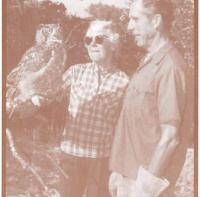
There was no instruction manual and no one to turn to for advice when Lois Layton embarked on her lifelong dream of helping wildlife. It was trial and error, but today, forty-five years later, 250 to 350 birds a year owe their lives to Lois and Frank Layton.

Lois and Frank have dedicated theirs to nursing birds back to health and releasing the m into their natural environments. A nurse by trade, Oklahoma native Lois gave up caring for people when she arrived in Casper on her way to live in Alaska, some thing  she'd always wanted to do. Her plans changed when she met and married Frank and made Wyoming her home. While Frank worked full time as an accountant, Lois started her injured and orphaned rehabilitation operation on a small scale, working mainly with birds.

By 1970, she was caring for wildlife full time. In 1986, Frank retired and pitched in. With few references to consult, they learned as they went along with only a brief set of instructions from the Seattle Audubon Society. Dr. Oliver Scott gave the Laytons some advice, along with a large, open barn where the raptors could stretch their wings and gain the crucial strength they needed to be released back into the wild.

Local veterinarians also provided some advice and initially some services for free. But as the bills for the vari­ous X- rays, laboratory tests, and treatments grew, rather than shutting their doors, the Layton's work to find alternative ways to help fund their efforts.

The Nature Conservancy, the Murie Audubon Society of Casper, and the public pitch in to help. But it's food for the birds, which  each can eat a quarter to a pound of meat a day, that's the most costly and often totals a third to half of the operation's cost. Hunters and meat processors donate big-game meat; and road kill, when available, provides a hearty meal for the birds. Livestock operators also provide hearts for food. Last year, the Murie Audubon Society raised $60,000 for a new barn and the Laytons to replace the aging one.

Birds that have been electrocuted, poisoned or have a broken wing are some of the many that find their way to the Laytons. The pair have nursed more than 1,000 eagle's back to health. Most of the recovered birds can survive in the wild after they're healthy, and those that don't are used for education. Educating the public is a crucial part of the Layton's rehabilitation effort, and they often speak to groups about birds and the needs of young wildlife to prevent an animal from becoming orphaned. The Laytons have made, and are making, a substantial contribution to Wyoming wildlife at the most basic level-one bird at a time.

Year Inducted: 2004
Calvin King
Calvin King
Year Inducted: 2004

Cal is a true Renaissance man, constantly learning and researching. Cal King was probably the most educated game warden in the country during his time patrolling the backcountry of Wyoming, and he put his knowledge to work, applying new scientific principles to wildlife management and helping change its course in the West.

A graduate of the  U.S. Naval Academy, Colorado A&M (now Colorado State), the University of Wyoming, and later, Purdue University. The former WWII fighter pilot began his wildlife career as a game warden in Thermopolis in 1919. "I couldn't have gotten a better job," he says .

Even though he was known for his courtesy, he got tough on poachers and drastically cut the number of
crimes. He even nabbed one of the FBI's Ten Most Wanted before moving on to become the first wildlife biologist in the Bighorn Basin in 1956. Right away, he began taking inventory of big-game habitat and established vegetation transects and photo points in crucial winter ranges. King was one of the first to connect the size of big-game herds and the management of hunting with the availability and quality of forage.

King authored three books based on his research, Reestablishing Elk in the Bighorn  Mountains of Wyoming, History of Wildlife in the Bighorn Basin of Wyoming, and  Reasons for the Decline of Game in the in Bighorn Basin of Wyoming, now a Wyoming wildlife biologist's staple. He was always on the lookout for the different perspec­tive, the different approach. For his book on wildlife history, he conducted extensive interviews with old game wardens, trappers, and cowboys who knew the area and the wildlife that frequented it. He once took a trip to the Arctic to hunt with the native Inuit and study their polar-bear traps.

An untiring advocate for wildlife, King fought off proposals to convert public big-game winter ranges to pri­vate land and granted a conservation easement to the Nature Conservancy on his own land above Thermopolis. King has spoken around the country on ecological issues, including a stint at the World's Fair in Seattle. A phi­lanthropist and successful investor, King still studies history and science and freely shares his knowledge with anyone who wants it. Since his retirement, he works with his prize homing pigeons, recently patented a new skunk trap, and donated his extensive plant collection, accumulated over decades of field work, to the University of Wyoming.

Year Inducted: 2004
Curt Gowdy
Curt Gowdy
Year Inducted: 2004

For more than a half-century, his warm, distinctive voice was synonymous with American sports. On NBC TV and CBS radio, Curt Gowdy covered nine Super Bowls, thirteen World Series, and eight Olympic games. He was the Yankees' and the Red Sox 's main man and called play-by-play on some or the greatest  moments in sports history. But the self-described "Cowboy at the Mike" was also known for giving a voice to conservation, bringing hunting and fishing into mainstream culture.

He fished with presidents Carter and Bush and his television show, The American Sportsman, ran for twenty two seasons on ABC beginning in the mid- 1960s. Gowdy's success and public rapport as a sports  broadcaster helped draw people to the immensely popular show, as did his celebrity line up: Bing Crosby, Ted Williams, and Peter O'Toole were so me of his guests. Viewers were treated to a different expedition each Sunday afternoon, from duck hunting on the prairies to chasing a rhino on an African safari.Gowdy's adventures deepened the legitimacy of outdoor sports by bringing them into people's living rooms, and always, the show was laced with a strong message of wildlife and fisheries conservation. He hosted, wrote, and produced the show, for which he won six of his thirteen Emmy awards. It's coming back this fall as The New American Sportsman, although the retired Gowdy won't be hosting it.

But no matter where Gowdy went in his many travels, he'd "just as soon go back and fish in Wyoming as any­ where."

Born in 1919 in Green River, he grew up fishing lakes and rivers around Wyoming with his father, Edward. A basketball player at the University of Wyoming, Gowdy enlisted to be a fighter pilot after college, but a ruptured disc kept him home. He made his broadcasting debut  in 1943 on a soap box in a vacant lot in Cheyenne, calling a six- man high school football game before a handful of fans in the biting cold for $5.

"In the end, it was the only job I ever had, " he told  Esquire magazine.

Whether it was the Jets' upset win over Baltimore in Super Bowl III or when Hank Aaron broke Babe Ruth's home run record, Gowdy took a simple approach: "I tried to pretend that I was sitting in the stands with a buddy watching the game - poking him in the ribs when something exciting happened," Gowdy said. "I never took myself too seriously." Fortunately for wildlife, the public did.