
Wildlife Disease and Health
The Wyoming Game and Fish Department monitors and researches a variety of wildlife diseases. Improving our knowledge of diseases, including their prevalence throughout the state and their mechanisms of transmission, allows us to better understand how they may impact wildlife populations. This information is used by managers to better conserve Wyoming's wildlife.
Highly Pathogenic Avian Influenza
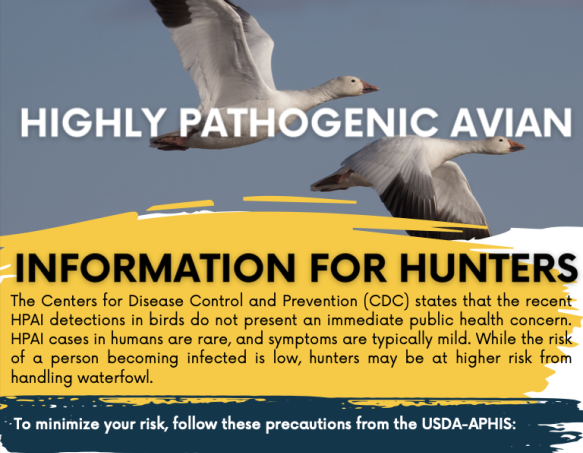
The Centers for Disease Control and Prevention (CDC) states that the recent HPAI detections in birds do not present an immediate public health concern. HPAI cases in humans are rare, and symptoms are typically mild. While the risk of a person becoming infected is low, hunters may be at higher risk from handling waterfowl. To minimize your risk, follow the precautions from the USDA-APHIS listed in this HPAI PDF.
New World Screwworm
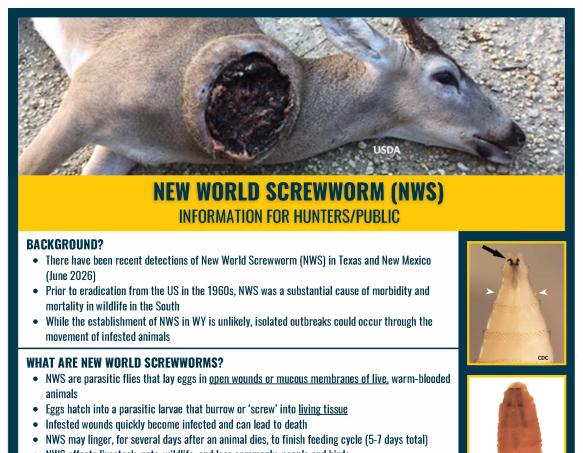
New World Screwworm (NWS) has recently been found in Texas and New Mexico (June 2026). It used to cause serious illness and death in wildlife in the southern U.S., and although it’s unlikely to become established in Wyoming, isolated cases could still occur if infested animals move here. Please use the form to report any possible sightings and the PDF to learn more about NWS and how to recognize it.
Chronic Wasting Disease
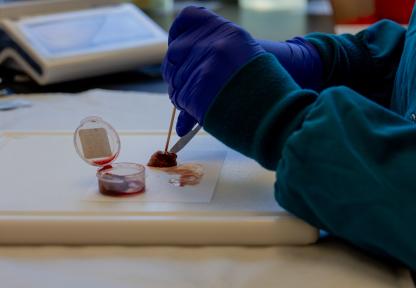
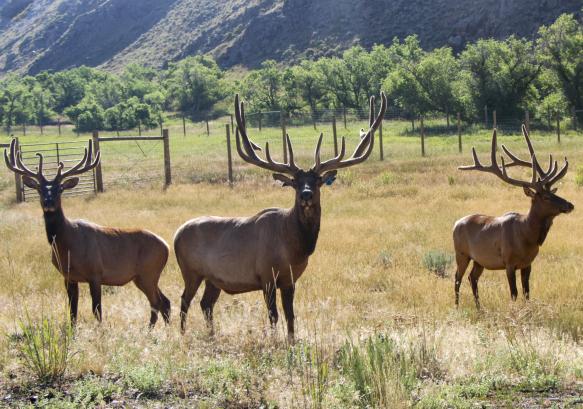
Chronic Wasting Disease (CWD) is a chronic, fatal disease of the central nervous system in mule deer, white-tailed deer, elk, and moose. CWD was first detected in Wyoming in 1985, and can now be found across the majority of the state. The Wyoming Game and Fish Department monitors select hunt areas for CWD each year to determine disease prevalence.
Brucellosis
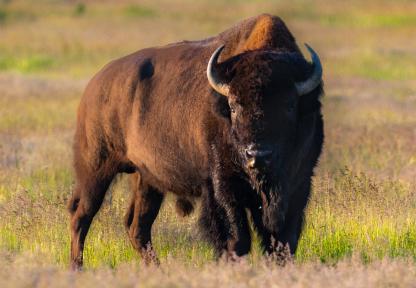
Brucellosis is a bacterial disease that primarily affects elk and bison. After infection, cows often abort their first fetus, and sometimes will also abort subsequent pregnancies. Brucellosis also infects domestic cattle. An eradication program has almost eliminated the disease in cattle, but infected elk and bison pose a continuing threat.
Bighorn Sheep Pneumonia
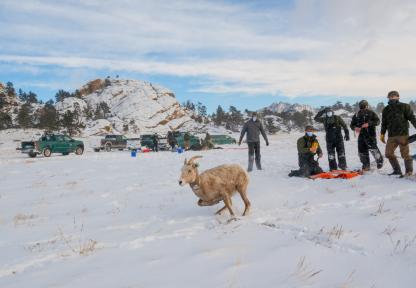
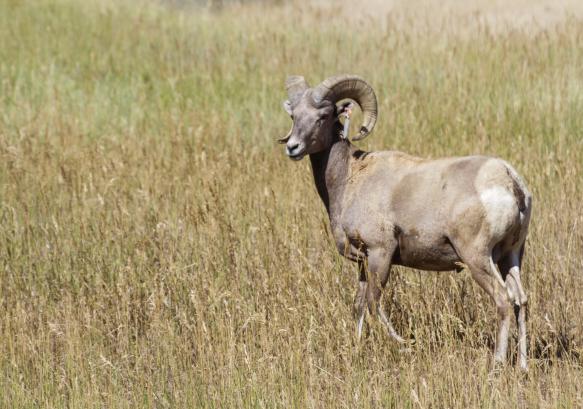
Respiratory disease is a leading cause of population declines in bighorn sheep in the western United States. Sporadic outbreaks of pneumonia cause large die-offs, often followed by multiple years of poor lamb survival. The Wyoming Game and Fish Department has been conducting statewide bighorn sheep herd health surveillance since 2011.
Other wildlife diseases
-
Adenovirus Hemorrhagic Disease (AHD)
Anthrax
Arterial Worm
Avian Botulism
Avian Cholera
Avian Influenza
Hemorrhagic Disease - Bluetongue
Chytridiomycosis (Chytrid fungus)
Echinococcus Tapeworm
Ghost Moose
Hantavirus
Keratoconjuctivitis
Mange - Scabies
Mycoplasma bovis
Rabies
Ranavirus
Sarcocystis
Tularemia
West Nile Virus
White-nose Syndrome
Rabbit Hemorrhagic Disease Virus 2 (RHDV2)
Avian Paramyxovirus-1 (APMV-1)
Backyard bird health
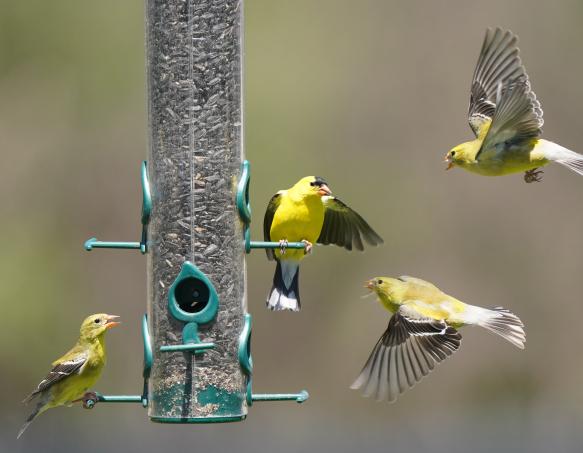
Keeping songbirds safe
Discover ways to help keep songbirds safe by cleaning your feeders and following other important safety tips to enhance the health of backyard birds.
Report a suspected wildlife disease incident.
General wildlife disease incident report
If you have observed an incident involving wildlife that you perceive as a suspected disease incident, please fill out this form. We will follow up by phone or email to determine if the incident needs further investigation.
Highly Pathogenic Avian Influenza (HPAI) incident report
If you have found sick or dead birds, please review the criteria in this form to determine if the incident should be reported. The Wildlife Health Lab relies on reports from the public to monitor HPAI and collect samples for disease testing.
Rabbit Hemorrhagic Disease Virus 2 (RHDV2) incident report
If you have found numerous dead rabbits/hares or noticed a recent lack of rabbits/hares on your property, please complete this form. RHDV2 was first detected in Wyoming in 2020 and has since been detected in many areas of the state.
New World Screwworm (NWS) incident report
If you have observed an incident involving wildlife that you suspect may have NWS, or if you observe any of the following symptoms—maggot- or larvae-infested wounds in living animals; wounds with deep pockets and vertically buried maggots; or foul-smelling, open wounds—please fill out this form.
Wildlife disease distribution maps
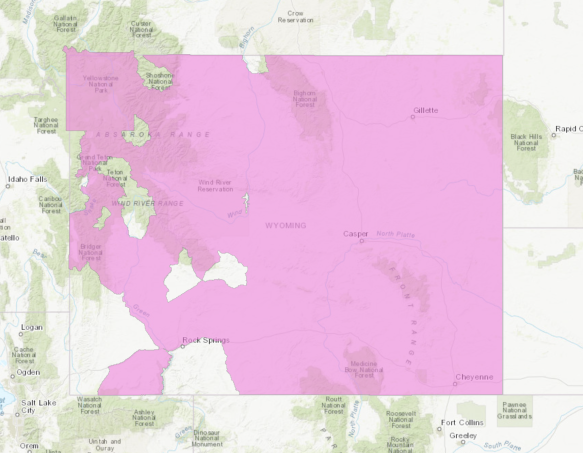
Continually updated maps are available to understand the current distribution of certain diseases. Maps most accurately depict disease distribution, rather than intensity, as continual disease testing is not performed for all populations. Click on any of the diseases below to view its map.
Hemorrhagic Disease/Bluetongue
Highly Pathogenic Avian Influenza (HPAI)
Rabbit Hemorrhagic Disease Virus 2 (RHDV2)
Veterinary Services
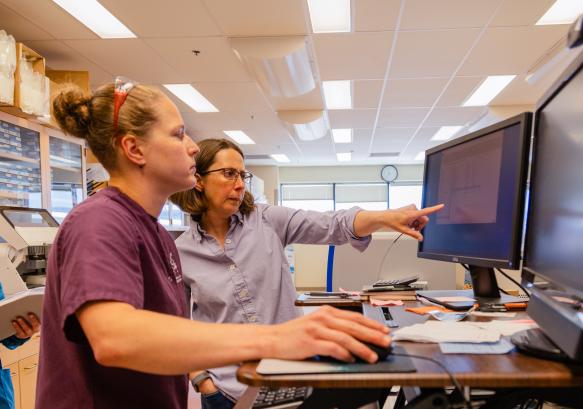
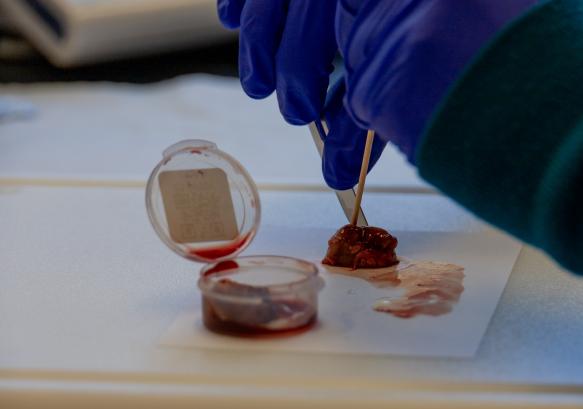
Veterinary Services is a small statewide branch of the Wyoming Game and Fish Department. The branch's primary goal is to provide diagnostics, information, education, and research on wildlife disease and wildlife anesthesia to the Department and the general public. The branch employs Wildlife Veterinarians and other staff who work statewide, including at the following facilities:
Access CWD test results
You can access your results online through your sportsperson's account if you submitted a sample for Chronic Wasting Disease testing. Results are typically available within three weeks.
Find carcass disposal locations
Game and Fish regulations outline requirements for transporting and disposing of animal carcasses to prevent diseases from being moved around the state.
Branch goals
Wildlife disease is becoming one of the most challenging issues that management agencies face today. Many diseases can be shared between wildlife, domestic animals and humans. Wildlife agencies play a critical role in disease surveillance and research which can help improve the overall health of wildlife populations as well as contribute to improved health and welfare of domestic animals and humans.
Many people are surprised that biologists and game wardens need to take a class on anesthesia. In today’s world – we are seeing human populations expand into increasingly urban environments. As a result, we see more contact and conflict between the urban environment and wildlife species. Wild critters have an incredible ability to get themselves stuck in all kinds of interesting situations. Swing sets, hammocks, christmas lights, swimming pools, and fences are all at the top of the list of wildlife obstacles. Our biologists and game wardens receive regular training from Veterinary Services on how to safely sedate and handle wildlife species to help get them out of these situations and move them to safer locations.
Veterinary services works closely with wildlife biologists to conduct both captive and field research with a focus on improving the overall health and welfare of wildlife populations in Wyoming. Much of our research is focused on disease management tools and applications, development of new disease diagnostic tools and development and validation of field anesthetic protocols for wildlife.
Publications
-
Answer
Allen SE, Kurz JP, Cufaude T, Killion H, Van Wick P, Jennings-Gaines J, Sondgeroth K. 2026. Mycobacterium avium subspecies paratuberculosis infection in a rocky mountain bighorn sheep (Ovis canadensis canadensis) with additional herd surveillance using non-invasive methods. Journal of Wildlife Disease.
Russell TI, Cross PC, Dugovich BS, Tomaszewski EM, Lawson ARJ, Lutz DW, Gregory ZW, Hnilicka PA, Tennant JM, Parrie LE, Allen SE, Merkle JA, Malmberg JL. 2026. CWD reduces mule deer survival and hunter success in the Wind River Basin of Wyoming. From the Field Elevating Indigenous Voices 1, 41-60.
Allen SE, Hashem B, Bahnson C, Knox L, Van Wick P. 2026. Evaluation of Pronghorn (Antilocapra americana) Chemical Immobilization in a Captive Research Facility in Wyoming, USA (2021-2025). J Wild Dis
Ralston BA, Jennings J, Allen SE. 2026. Comparison of the detection of the chronic wasting disease prion by real-time quaking-induced conversion (RT-QulC) and silica-nanoparticle RT-QuIC (nanoRT-QuIC) assays in retropharyngeal lymph nodes of white-tailed deer, mule deer, and Rocky Mountain elk. J Vet Diagn DOI: 10.1177/10406387251411975
Allen SE, Van Wick P, Nelson D, Carlisle JD, Jennings J, Buxbaum K, Smith AB, Holbrook J, Shamon H. 2026. Swift fox (Vulpes velox) serosurveillance and parasitic survey from southeastern Wyoming, USA. J Wild Dis 62, 126-134.DOI: 10.7589/JWD-D-25-00064
Forzán MJ, Jennings-Gaines J, Burrough E, Allen SE. B cell Lymphoma in an adult female mule deer (Odocoileus hemionus) from Wyoming, USA. 2025. J Wild Dis 61, 802-805. DOI: 10.7589/JWD-D-25-00034
Johnson MD, Malmberg JL, Kurz J, Jennings-Gaines J, Allen SE. 2025. Validation of tonsil tissue for ELISA testing in chronic wasting disease detection of mule deer (Odocoileus hemionus). J Wild Dis 61, 530-535. DOI: 10.7589/JWD-D-24-00161
Moss WE, Binfet J, Hall LE, Allen SE, Edward WH, Jennings-Gaines JE, Cross PC. 2025. The effectiveness of harvest for limiting wildlife disease: insights from 20 years of chronic wasting disease in Wyoming. Ecol Appl 35, e3089. DOI: 10.1002/eap.3089
Kulpa MR, Lefoulon E, Beckmen KB, Allen SE, Malmberg J, Crouse JA, Thompson DP, Benedict BM, Goldsmith DG, McCarthy S, Jones LC, Yablsey MJ, Kutz SJ, *Verocai GG. 2025. A footworm in the door: Revising Onchocerca phylogeny with previously unknown cryptic species in wild North American ungulates. J Parasitol 55, 59-68. DOI: 10.1016/j.ijpara.2024.10.006
Allen SE, O’Toole D, Wood M, Van Wick P, Parrie L, Malmberg J, Edwards H. 2025. “Luck be a lady”: Retrospective study of a disease-associated prions (PrPSc) distribution and lesions in captive, environmentally exposed female Rocky Mountain elk (Cervus canadensis nelsoni) with LL132 genotype. J Wild Dis 61, 199-205. DOI: 10.7589/JWD-D-24-00056
Hashem B, Van Wick P, Allen SE. 2024. Nalbuphine, medetomidine, and azaperone use in free-ranging American black bears and mountain lions in Wyoming. J Wild Manag 88, e22658. DOI: 10.1002/jwmg.22658
Malmberg JL, Allen SE, Jennings-Gaines JE, Johnson M, Luukkonen KL, Robbins KM, Cornish TE, Smiley RA, Wagler BL,
Gregory Z, Lutz D, Hnilicka P, Monteith KL, Edwards WH. 2024. Pathology of chronic Mycoplasma ovipneumoniae carriers in a declining bighorn sheep population. J Wild Dis 60, 448-460. DOI: 10.7589/JWD-D-23-00132
Wood ME, Edwards WH, Jennings-Gaines JE, Gaston M, Van Wick P, Amundson S, Allen SE, Wolfe LL. 2023. Clearance of Mycoplasma ovipneumoniae in captive bighorn sheep (Ovis canadensis) following extended oral doxycycline treatment. J Wild Dis 59, 753-758. DOI: 10.7589/JWD-D-22-00094
Malmberg JL, Jennings-Gaines J, Allen SE. 2023. Wild turkeys (Meleagris gallopavo) are susceptible to H5N1 highly pathogenic avian influenza virus (HPAIV). J Wild Dis 59, 767-773. DOI: 10.7589/JWD-D-22-00161
Allen SE, Kunkel M, Nemeth NM. 2023. Using opportunistic samples to monitor West Nile virus infection status in the greater sage-grouse (Centrocercus urophasianus) in Wyoming, USA (2020-2022). J Wild Dis 59, 774-779. DOI: 10.7589/JWD-D-22-00164
Allen SE, Van Wick P, Courtemanche AB, Cufaude T. 2023. Butorphanol, azaperone and medetomidine for the chemical immobilization in free-ranging Shiras (Alces alces shirasi) moose: ground and helicopter darting in Wyoming, USA. J Wild Dis 59, 359-362. DOI: 10.7589/JWD-D-22-00072
Johnson M, Anderson C, Peckham E, Killion H, Allen SE, Creekmore T, Edwards WH, Blaeser M, Davison M, Schwalbe E, Wray A, Sondgeroth KS, Malmberg JL. 2022. Source and seasonality of epizootic mycoplasmosis in free-ranging pronghorn (Antilocapra americana). J Wild Dis 58, 524-536. DOI: 10.7589/JWD-D-21-00117
LaCava MEF, Malmberg JL, Edwards WH, Johnson LNL, Allen SE, Ernest HB. 2021. Spatio-temporal analyses reveal infectious disease-driven selection in a free-ranging ungulate. R Soc Open Sci. 8, 210802. DOI: 10.1098/rsos.210802